Optimizing Weekday Computation: How Date Libraries Replace Division with Multiplication for Better Performance
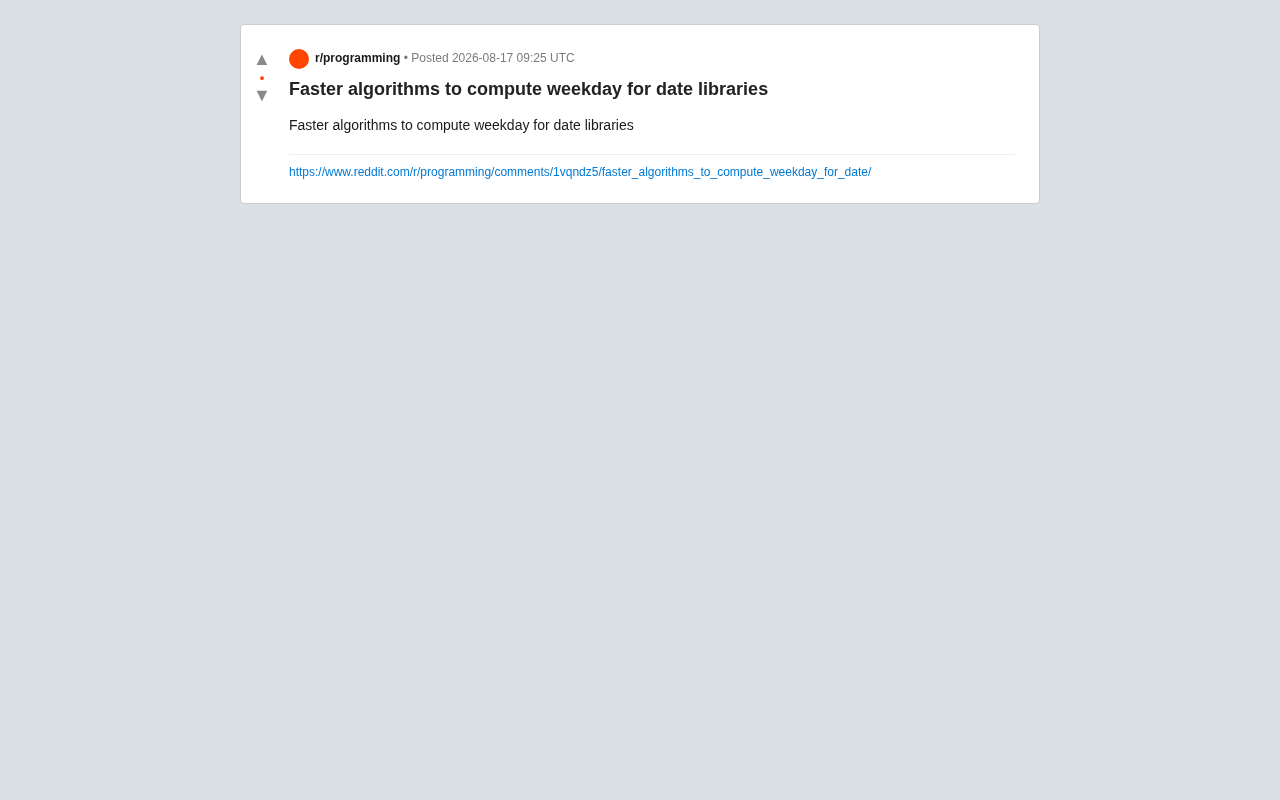
How date libraries optimize weekday calculations by replacing division with multiplication and eliminating branches.
This article explores how date libraries optimize the seemingly simple task of computing the day of the week. Starting from classic methods like Zeller's Congruence, it dives into modern techniques including replacing division with magic-number multiplication, using lookup tables, eliminating CPU pipeline-stalling branches in leap year checks, and explains why these micro-optimizations matter at scale in time-series databases and high-frequency trading systems.
A Performance Detail That's Often Overlooked
In everyday development, calculating the day of the week for a given date seems like the most mundane operation imaginable. We call a function from a date library, get back "Monday" or "Sunday," and move on to writing business logic. But rarely does anyone stop to think: how is this seemingly simple calculation actually implemented under the hood? When an application needs to process tens of thousands of dates in a very short time, the efficiency of weekday computation becomes a very real performance bottleneck.
A Reddit discussion about "faster algorithms to compute weekdays" touches on this commonly overlooked topic. It reminds us that even the most basic computational primitives have room for engineering optimization. For components that are called at high frequency—like Python's datetime, C++'s chrono, or various system-level date libraries—even tiny efficiency improvements are significantly amplified at scale.
Classic Approaches to Weekday Calculation
To appreciate the significance of optimization, we first need to understand the traditional approaches. The most common method for calculating the day of the week is to convert a date into a continuous day count (e.g., the number of days since some epoch), then take the result modulo 7. This approach is intuitive and correct, but the date-to-day conversion itself involves leap year checks, cumulative month-day additions, and several other steps.
Zeller's Congruence
Long before computers became widespread, mathematicians had already devised formulas to derive the weekday directly from year, month, and day. The most famous of these is Zeller's Congruence. Through a series of floor divisions and modular arithmetic operations, it directly produces the weekday result without needing to construct a full day count.
Zeller's Congruence was published by German mathematician Christian Zeller in 1887. Its core idea is to use modular arithmetic (congruence relations) to map the numerical values of year, month, and day through a set of fixed coefficients to a weekday number between 0 and 6. A key design choice in the formula is treating January and February as months 13 and 14 of the previous year, which places the leap day at the "end of the year" and avoids special-casing February. The typical form of the formula is h = (q + ⌊13(m+1)/5⌋ + K + ⌊K/4⌋ + ⌊J/4⌋ - 2J) mod 7, where q is the day of the month, m is the month, K is the last two digits of the year, and J is the century number. Each term has calendrical significance: ⌊13(m+1)/5⌋ approximates the cumulative day offset for the month, while the K/4 and J/4 terms handle leap year and century leap year corrections respectively. These seemingly "magic number" coefficients are actually a precise mathematical encoding of the structure of the Gregorian calendar.
The Doomsday Algorithm
Another classic approach is John Conway's "Doomsday Rule," which leverages the fact that several fixed dates each year all fall on the same weekday, enabling one to even compute the result mentally. While it's better suited for human memorization, the mathematical ideas behind it have inspired many software implementations.
Core Ideas Behind Modern Optimization
These classic formulas are correct, but they're not optimal for modern CPUs. Real performance optimization often comes down to reducing expensive operations—especially division and modulo—which are far more costly at the hardware level than addition, multiplication, and bit shifts.
Replacing Division with Multiplication
Modern compilers and high-performance libraries widely employ a technique that converts "division by a constant" into "multiplication by a magic constant followed by a right shift." Since the divisor (e.g., 7) is known at compile time, the corresponding fixed-point multiplication factor can be precomputed. This replaces one division with one multiplication plus one shift, which is much faster on pipelined CPUs.
The mathematical basis for this optimization is that on most CPU architectures, integer division instructions have far higher latency than multiplication. For example, on x86-64, a single 64-bit integer division might take 20–90 clock cycles, while multiplication takes only 3–4 cycles. For division by a constant d, you can find a large integer M and a shift amount s such that ⌊n/d⌋ = ⌊n×M / 2^s⌋ holds for all n within the target range. For example, when dividing by 7, M=0x2492492492492493 (in the 64-bit case), and the quotient can be obtained precisely through high-word multiplication and a right shift. This technique is not only used manually by authors of high-performance libraries—modern compilers (such as GCC, Clang, and MSVC) will also automatically convert constant division to this form at sufficiently high optimization levels. However, in certain scenarios—such as special combinations of modulo operations—manual optimization can still outperform the compiler's automatic conversion, which is precisely why specialized algorithms retain their value.
Lookup Tables and Branch Elimination
Another class of optimization caches intermediate results in lookup tables—for example, cumulative days per month, century offsets, and so on. By trading space for time, redundant runtime computation is avoided. At the same time, reducing conditional branches (such as leap year checks) is equally critical, because branch mispredictions cause CPU pipeline flushes and noticeable latency. Rewriting branch logic as branchless arithmetic expressions is a common technique in high-performance date libraries.
To understand the importance of branch elimination, you need to understand the pipeline mechanism of modern CPUs. Modern CPUs split instruction execution into multiple stages—fetch, decode, execute, memory access, write-back—allowing multiple instructions to overlap in execution (typically 15–20 stages deep). When a conditional branch is encountered, the CPU can't determine which instruction to execute next until the branch result is known, so it relies on a built-in Branch Predictor to guess the branch direction based on historical patterns and speculatively execute ahead. If the guess is correct, the pipeline runs efficiently; if wrong, all speculatively executed instructions must be discarded (Pipeline Flush), and execution restarts from the correct path—a single misprediction can waste 10–20 clock cycles. For date computation operations called billions of times in tight loops, even with a branch prediction accuracy as high as 95%, the cumulative cost of the remaining 5% mispredictions can cause significant performance degradation.
Branchless Leap Year Determination
The leap year rule itself involves multiple conditions (divisible by 4, but not by 100, unless also divisible by 400). These nested conditions naturally produce branches. Optimizers rewrite them in pure arithmetic form, keeping the entire computation path linear and predictable.
This set of leap year rules originates from the Gregorian calendar promulgated in 1582, designed to correct the calendar drift accumulated by the Julian calendar's overestimation of approximately 11 minutes and 14 seconds per year. The Julian calendar specified one leap year every 4 years, making the average year 365.25 days, but Earth's actual tropical year is approximately 365.2422 days, accumulating about 3 days of error over 400 years. The Gregorian correction produces 97 leap years per 400 years instead of 100, yielding an average year length of 365.2425 days. These three layers of nested rules naturally form multiple conditional branches in code. A common branchless implementation is: is_leap = (y % 4 == 0) & ((y % 100 != 0) | (y % 400 == 0)), using bitwise AND (&) and bitwise OR (|) instead of short-circuit logical operators (&&, ||), ensuring all subexpressions are evaluated without producing conditional jumps, thereby eliminating branches. Combined with the magic-number multiplication mentioned earlier to eliminate division in the modulo operations, the entire leap year check can be compressed into a pure chain of arithmetic operations.
Why This Kind of Optimization Matters
For the vast majority of applications, the time spent on a single weekday calculation is negligible. So why do developers continue investing effort to optimize it?
The answer lies in scale effects and infrastructure status. Date-time libraries are foundational dependencies for virtually all software—from databases and logging systems to financial trading and big data analytics, they're everywhere. When a batch processing task needs to parse billions of timestamped records, or a time-series database needs to perform time-dimension aggregation over massive datasets, micro-operations like weekday calculation are triggered repeatedly. Even if each call is just a few nanoseconds faster, the cumulative effect translates into tangible throughput improvements and energy savings.
Time-series databases (such as InfluxDB, TimescaleDB, QuestDB, etc.) are a prime example of this demand. In IoT, monitoring and alerting, and financial market data scenarios, millions of data points may be written per second. Common query patterns include "aggregate by week" and "group by weekday vs. weekend"—operations that directly depend on weekday computation. When a query needs to scan billions of rows and perform a weekday check on each one, even a 1-nanosecond speedup per calculation means saving 1 second of query time at the billion-row scale. In high-frequency trading systems, such savings can translate directly into competitive advantage. Similarly, big data ETL pipelines that process logs and need to archive or bucket them by weekday are directly affected by the efficiency of date computation, which impacts the total completion time of batch jobs.
Furthermore, this kind of work embodies an aesthetic of systems programming: polishing the most fundamental problems to perfection. It requires developers to simultaneously understand mathematics (calendars and congruences), algorithms (lookup tables and bit manipulation), and hardware (CPU pipelines and instruction costs)—a comprehensive exercise in thinking across multiple layers of abstraction.
Takeaways for Developers
The takeaway from this discussion for everyday developers is not that everyone should hand-write their own weekday algorithm—quite the opposite. It's precisely because excellent libraries have already encapsulated these details that we can focus on business logic. But it reminds us of two things:
First, never underestimate the cost of basic operations at scale. When a profiling tool points to a piece of code that "looks harmless," digging into the lower levels often reveals unexpected optimization opportunities.
Second, the continuous refinement by the open-source community is the invisible bedrock of the software ecosystem. These micro-optimizations to foundational libraries rarely make headlines, yet they silently support the runtime efficiency of countless applications built on top. It's this obsession with detail that enables the entire software world to run faster on fewer resources.
Conclusion
From Zeller's Congruence to branchless fixed-point multiplication, the evolution of computing the day of the week—an ancient problem—encapsulates the relentless pursuit of efficiency that defines computer science. It tells us that even the most inconspicuous corners contain engineering wisdom worth uncovering. Next time you call date.weekday(), perhaps you'll pause to consider: behind that single line of code lies generations of continuous pursuit of speed and elegance.
Related articles
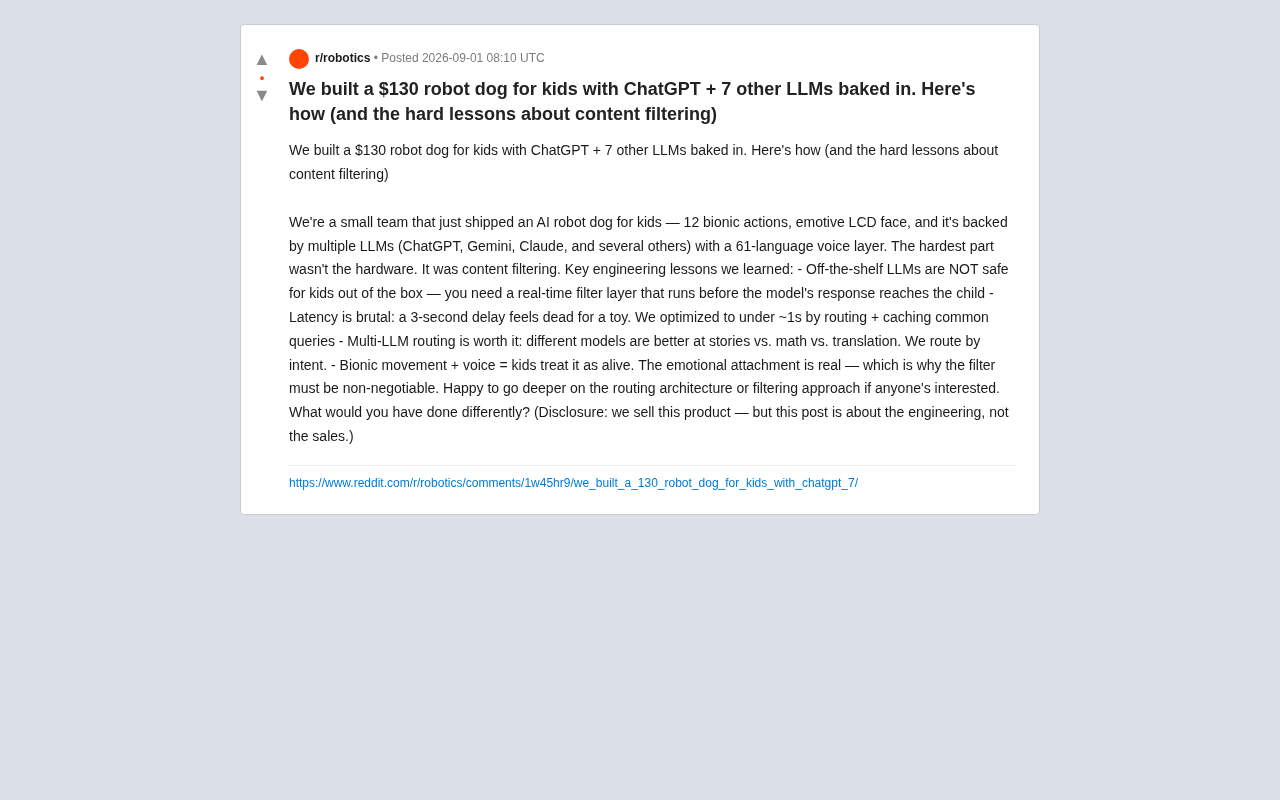
Building an AI Robot Dog for Kids: Multi-Model Routing, Content Filtering, and Latency Optimization
A $130 AI robot dog for kids integrates 8 LLMs with 61-language voice interaction. The team shares key engineering lessons on content safety filtering, multi-LLM intent routing, and sub-1-second latency optimization.

Can Omarchy Dominate the Sub-$1000 Laptop Market? An In-Depth Analysis
Omarchy, based on Arch Linux, shows unique advantages in the sub-$1000 laptop market. This analysis compares Windows and MacBook performance bottlenecks on low-spec hardware and examines why Omarchy enables cheap laptops to run smoothly, plus the ecosystem challenges and market prospects it faces.

AI Agent Beginner's Guide: Building a Creative Strategy Intelligent Assistant from Scratch
A complete guide to building a creative strategy AI Agent from scratch. No coding required — use tools like Dify and Coze to quickly build an intelligent assistant.