Opus 5.5 vs. Astra: A Better Model Doesn't Always Mean a Better App Experience

A single tweet exposes AI's new competitive reality: app experience now rivals model capability for user retention.
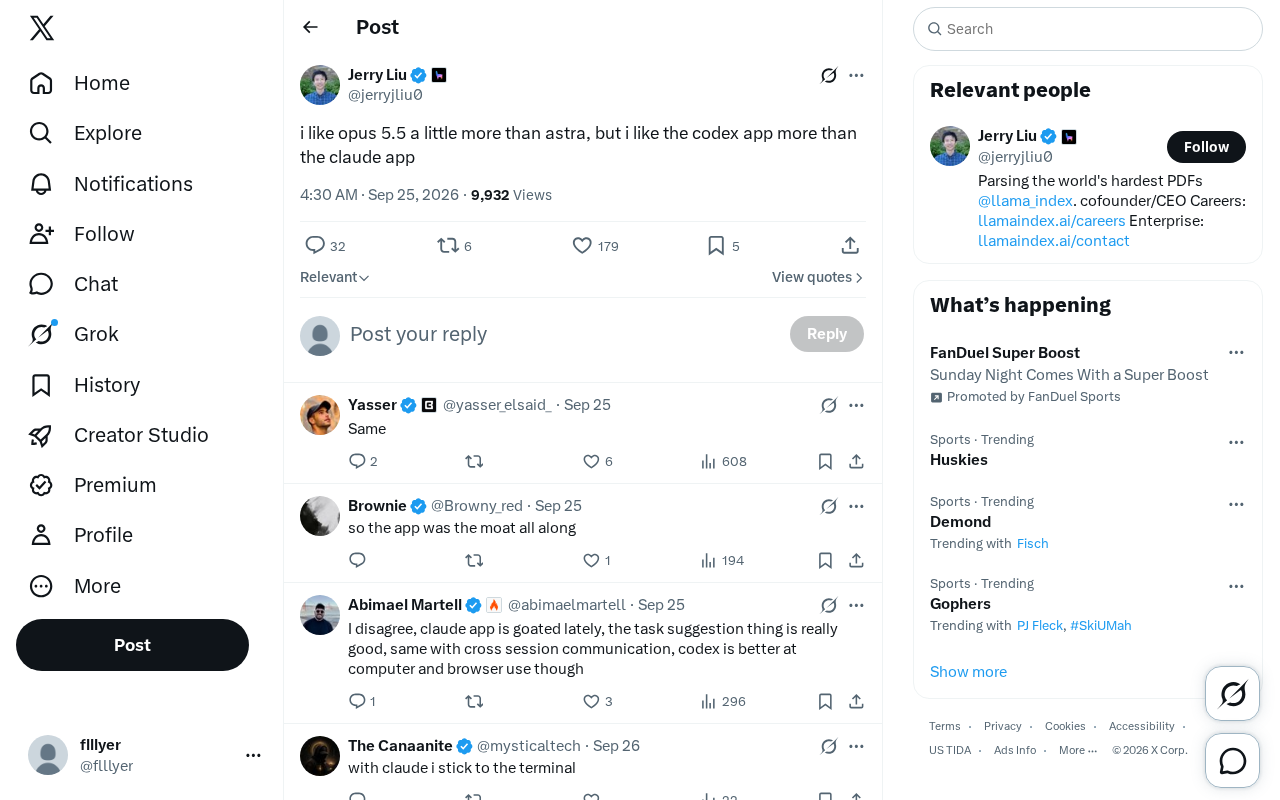
A user's offhand Twitter comment — preferring Opus 5.5 over Astra as a model, but Codex over Claude as an app — reflects a structural shift in AI product competition. As flagship models from Anthropic, Google, and OpenAI converge in capability, users can barely perceive model-level differences in daily use, yet remain acutely sensitive to app-layer factors like latency, interface design, and workflow integration. This "cross preference" trend signals that winning benchmarks is merely the entry ticket — what determines real retention is the app users open every day.
A brief comment on Twitter captured a subtle reality in today's AI tool landscape: model capability and application experience are often two entirely separate races. The observation was blunt — "I prefer Opus 5.5 over Astra, but I prefer the Codex app over the Claude app."
It sounds casual, but it reveals a product logic worth unpacking: users are increasingly evaluating AI tools by splitting their judgment between the underlying model quality and the upper-layer application experience.
When Model Preferences and App Preferences Diverge
The user expressed two distinct levels of preference. At the model level, Opus 5.5 edges out Astra. But at the application level, the Codex client experience actually surpasses Anthropic's official Claude app.
This kind of "cross preference" is becoming increasingly common in the AI product space. Users once assumed that a better model automatically meant a better product. But as foundational model capabilities have converged broadly, the gap between models is no longer decisive in most everyday scenarios. What actually drives retention and usage frequency is the application layer — interaction design, response latency, workflow integration, and the finer details of user experience.
In other words, even if your model holds a slight edge on benchmarks, users may still gravitate toward a competitor with a more polished experience. That's a wake-up call for every team building AI applications.
Why App Experience Is Starting to Outweigh Model Metrics
A few underlying product trends can be inferred from this comment.
Model Capabilities Are Converging
When the difference between Opus 5.5 and Astra is only "slight," it signals that leading models have largely caught up with one another on general-purpose tasks. Users rarely perceive a few percentage points difference on benchmarks during everyday use — but they immediately notice whether an app lags, whether the interface is clear, or whether the features actually work.
Opus 5.5 refers to the flagship model in Anthropic's Claude lineup, while Astra is Google DeepMind's multimodal AI assistant project (built on the Gemini architecture) — both positioned as high-capability general-purpose models. "Codex" here most likely refers to OpenAI's coding-focused application or plugin experience (historically, Codex was OpenAI's code-generation model, integrated into various IDE tools), as opposed to Anthropic's official client. These four names span three of the leading AI companies — Anthropic, Google, and OpenAI — which itself illustrates how intense the competition at the frontier has become. Users are simultaneously trying products from different companies and forming cross-platform comparisons in their daily use. When those comparisons shift from "which model is smarter" to "which app is easier to use," it signals a structural shift in where the industry's competitive center of gravity lies.
The Application Layer Becomes the Differentiation Battleground
The fact that the Codex app is rated higher than the Claude app points to application-layer polish becoming the decisive competitive factor. Whether it's a coding assistant or a general-purpose chat tool, whoever delivers smoother interaction flows, better context management, and more seamless tool integration is more likely to win a place in users' daily habits.
"Application-layer experience" in the context of AI products typically spans several concrete dimensions: latency and response speed (including Time to First Token, TTFT, and overall output rate); context management (how conversation history is retained, how long documents are handled); and tool invocation and workflow integration (whether the app can read and write local files, call external APIs, or embed into IDE plugins). Coding assistants are especially sensitive to these factors — a tool that offers real-time completion inside a code editor, supports multi-file context, and surfaces clear error messages will often outperform a "smarter but harder to use" competitor in daily active usage, even if its underlying model is slightly weaker. This is precisely why vertically focused applications like Cursor and GitHub Copilot have maintained significant developer market share even when their underlying models aren't always the most capable.
Users Are Evaluating with Greater Granularity
This tweet also reflects an evolution in how users articulate their preferences — rather than broadly saying "I like this product," they're scoring model and application dimensions separately. This granular evaluation creates both pressure and opportunity for vendors: you can lose on one dimension and still have a chance to win on the other.
Implications for Developers and Vendors
For teams building AI products, this short comment offers practical guidance.
Simply stacking model capability is no longer enough to build a moat. When the gap between models shrinks to something users can barely perceive, the competitive outcome increasingly depends on engineering execution and user experience at the application layer. Response speed, interface intuitiveness, and integration with existing workflows — these "unsexy" factors are precisely what drives long-term user retention.
At the same time, models and applications can be optimized independently. Vendors don't need to chase first place on every dimension. Instead, they can build an advantage in the area where they excel — some teams have stronger models, others have better app experiences — and users will ultimately make their own combination choices based on real-world needs.
The Signal Behind a Single Tweet
To be clear, this is one user's subjective experience, not a systematic benchmark conclusion. The actual gaps between Opus 5.5, Astra, Codex, and Claude still require more user feedback and objective evaluation to properly assess.
But it's exactly these genuine, off-the-cuff user observations that often reflect the real state of a product more accurately than carefully crafted marketing copy. As more and more users begin to evaluate models and applications separately, AI vendors should take note: winning benchmarks is just the price of admission. What actually keeps users coming back is the app they open every single day.
Related articles

Free Unlimited Claude Code Solution: Agnes AI + CC Switch Setup Guide
No paid subscription needed — pair the free AI platform Agnes AI with the open-source tool CC Switch to provide a backend for Claude Code, enabling unlimited free calls to text, image, and video models. This guide covers the full setup, test results, and usage boundaries.

A Complete Zero-Cost Guide to Getting Started with Claude Code for Beginners in China
A beginner's guide to Claude Code for users in China: two installation methods (command line and IDE plugin), full configuration steps for replacing the official API with the free domestic LongCat model, and a hands-on demo of building a small tool with natural language, plus tips.

When the NSA Gets Involved: The AI Supply Chain Crisis Behind Open-Source CVEs and API Key Hijacking
Multiple open-source projects disclosed severe CVEs in one day, PHP flaws alarmed the FBI, and Railway and OpenCode were breached with API keys stolen. This article breaks down the vulnerability window, AI-accelerated exploitation, and the AI supply chain crisis behind the API key black market, with a developer defense checklist.