Opus 5.5 vs Sonnet 5.5: Real-World 3D Steampunk Whale Modeling Test

Hands-on test shows Opus 5.5 beats Sonnet 5.5 in 3D modeling quality but costs ~43% more.
A developer compared Claude Opus 5.5 and Sonnet 5.5 on a steampunk mechanical whale using identical structured prompts, driving both models through Blender via blendermcp and exporting to three.js. Opus 5.5 produced higher quality output but consumed ~1.5x more tokens and cost roughly $156 vs $109. Sonnet 5.5 exceeded expectations and offers real value in cost-sensitive scenarios. The test also reinforces a key insight: Sonnet 5.5's high benchmark scores don't cover 3D modeling, confirming that top benchmark performance doesn't guarantee universal capability.
A Head-to-Head Model Comparison Through 3D Modeling
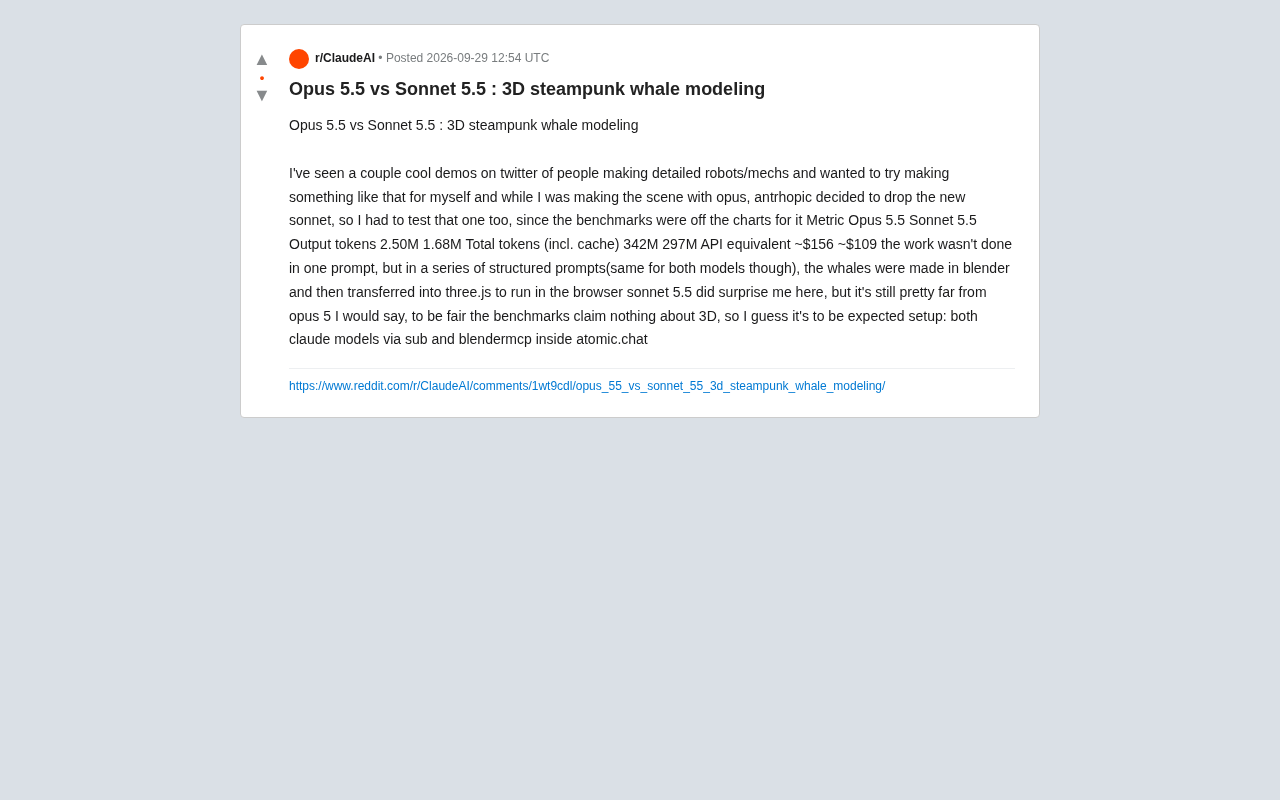
After seeing numerous AI-generated mech and robot demos on Twitter, a Reddit user decided to replicate similar results firsthand. They chose Claude Opus 5.5 to build a 3D scene — a steampunk-style mechanical whale. Midway through the project, Anthropic released Sonnet 5.5, which posted impressive benchmark scores, so the user ran both models through the same workflow for a direct comparison.
This kind of hands-on test is far more informative than cold benchmark numbers, because it reveals how models actually perform on real, complex, multi-step creative tasks.
Experimental Setup and Workflow
The final piece wasn't built with a single prompt — it was assembled through a series of structured, step-by-step instructions. Both models were given the exact same prompt sequence to keep the comparison fair.
On the technical side, the whale was modeled in Blender, exported to three.js, and rendered in the browser. The author accessed both Claude models through subscription accounts and used blendermcp (a Blender MCP interface) inside atomic.chat to drive the modeling operations.
The Blender + three.js pipeline fundamentally tests a model's understanding of spatial structure, geometric relationships, and cross-tool data conversion — areas where large language models still have notable weaknesses.
MCP (Model Context Protocol) is an open protocol introduced by Anthropic in late 2024 that connects large language models to external tools, data sources, and applications. Its core idea is to give LLMs a standardized "tool-calling interface," allowing models to interact with local software much like calling an API. blendermcp is an adapter layer built on this protocol specifically for Blender — it runs an MCP server inside Blender, receives instructions from the model (such as creating meshes, adjusting materials, or moving objects), and returns results to the model, forming a closed perception-decision-execution loop. This architecture requires the model to understand Blender's scene hierarchy (Scene → Object → Mesh → Material) and coordinate system, then translate natural language intent into precise sequences of geometric operations — placing extremely high demands on spatial reasoning.
Cost and Token Consumption
The two models showed clear differences in resource usage. Here's the data the author provided:
| Metric | Opus 5.5 | Sonnet 5.5 |
|---|---|---|
| Output tokens | 2.50M | 1.68M |
| Total tokens (incl. cache) | 342M | 297M |
| API equivalent cost | ~$156 | ~$109 |
Opus 5.5 generated roughly 49% more output tokens than Sonnet 5.5, with higher total token consumption and an API-equivalent cost nearly 50% higher. For creative tasks requiring extended, multi-round iteration, this cost gap compounds significantly in real projects and is a factor that can't be ignored when choosing a model.
The reason "total tokens (incl. cache)" is far higher than "output tokens" is that every request in a multi-turn conversation must pass the full context again, causing input tokens to accumulate linearly with each round. Anthropic's Prompt Caching mechanism applies discounted pricing to repeated prefix contexts — which is why the total token ratio (342M vs 297M) and the cost ratio ($156 vs $109) don't align perfectly: differences in cache hit rates affect actual billing. For creative tasks requiring dozens of iteration rounds, thoughtfully structuring context to maximize cache hits is the key lever for cost control.
Quality Results: Sonnet Surprises, But Opus Still Wins
The author's core conclusion: Sonnet 5.5 performed surprisingly well on this 3D modeling task, but overall quality still fell noticeably short of Opus 5.5.
He also offered a fair-minded caveat: Sonnet 5.5's impressive benchmark scores don't include any 3D modeling evaluations, so its trailing performance in this domain is actually predictable.
This points to a lesson worth internalizing — a high benchmark score doesn't mean universal capability. Benchmarks tend to focus on quantifiable domains like coding, math, and reasoning, while tasks like 3D spatial modeling — which depend heavily on geometric intuition and tool-chain collaboration — may fall entirely outside the test coverage. When your actual use case diverges from mainstream evaluation directions, leaderboard rankings lose much of their practical value.
Takeaways for Developers
This informal comparison has a limited sample size, but it offers a few practical perspectives.
For creative tasks where maximum quality is the priority and budget allows, Opus 5.5 remains the safer choice. When some quality trade-off is acceptable or cost control is critical, Sonnet 5.5 already delivers quite usable output with a clear price-performance advantage.
More broadly, this workflow — connecting an LLM to Blender via MCP and exporting to three.js — demonstrates the real-world feasibility of AI-assisted 3D content production. As the MCP ecosystem matures, models directly controlling professional creative software is moving from demo to practical use. For developers looking to explore AI-driven 3D modeling, the atomic.chat + blendermcp combination is worth trying.
One caveat: the data here comes from a single user's personal experiment on a fairly specialized task type. The conclusions shouldn't be over-generalized. For real model selection decisions, it's best to run a small-scale test against your own specific use case.
three.js is a WebGL-based JavaScript 3D rendering library that renders complex three-dimensional scenes in the browser without any plugins. Exporting Blender models as GLTF/GLB and loading them into three.js is the standard path for web-based 3D content delivery. This export step is itself an additional test of model capability: the model must ensure that geometry, UV unwrapping, and material nodes generated in Blender comply with GLTF spec constraints — otherwise the exported output may show missing materials or broken meshes in three.js. This explains why the author considers "cross-tool data conversion" an important dimension for measuring a model's overall comprehension.
Related articles

Free Unlimited Claude Code Solution: Agnes AI + CC Switch Setup Guide
No paid subscription needed — pair the free AI platform Agnes AI with the open-source tool CC Switch to provide a backend for Claude Code, enabling unlimited free calls to text, image, and video models. This guide covers the full setup, test results, and usage boundaries.

A Complete Zero-Cost Guide to Getting Started with Claude Code for Beginners in China
A beginner's guide to Claude Code for users in China: two installation methods (command line and IDE plugin), full configuration steps for replacing the official API with the free domestic LongCat model, and a hands-on demo of building a small tool with natural language, plus tips.

When the NSA Gets Involved: The AI Supply Chain Crisis Behind Open-Source CVEs and API Key Hijacking
Multiple open-source projects disclosed severe CVEs in one day, PHP flaws alarmed the FBI, and Railway and OpenCode were breached with API keys stolen. This article breaks down the vulnerability window, AI-accelerated exploitation, and the AI supply chain crisis behind the API key black market, with a developer defense checklist.