OqtaDrive at Five: From Microdrive Emulation to Sinclair Networking

OqtaDrive emulates Sinclair Microdrive with modern hardware and adds internet connectivity, iterating for five years.
OqtaDrive is a five-year open-source retro hardware project that originally aimed to emulate the Sinclair Microdrive tape storage device so that old machines like the ZX Spectrum could run software without fragile tapes. Over time it added networking, extending the hardware-dependent Sinclair Network to the internet so machines in different locations can communicate. The article analyzes its technical path: precise timing and signal protocol reproduction at the low level, and a cross-era protocol gateway at the upper level. Despite low Hacker News attention (7 upvotes, 1 comment), its incremental strategy—perfect single-point emulation first, then add networking—offers lessons for resource-limited independent projects and industrial legacy device networking.
Why a Retro Hardware Project Can Last Five Years
In the open-source hardware and retro computing community, projects that keep iterating for five years are rare. OqtaDrive is one such outlier—its original goal was simply to emulate Sinclair's Microdrive tape storage device, but it has since evolved into a complete solution capable of connecting Sinclair networks over the internet. According to discussion on Hacker News, the project has now passed the five-year mark. Although it hasn't drawn much attention (only 7 upvotes and 1 comment), its technical depth and persistence are worth examining in detail.
OqtaDrive's value lies not in commercial scale, but in the fact that it demonstrates a typical path for "modernizing retro computing": using modern microcontrollers and software stacks to revive hardware protocols from the 1980s, and then layering contemporary networking capabilities on top.
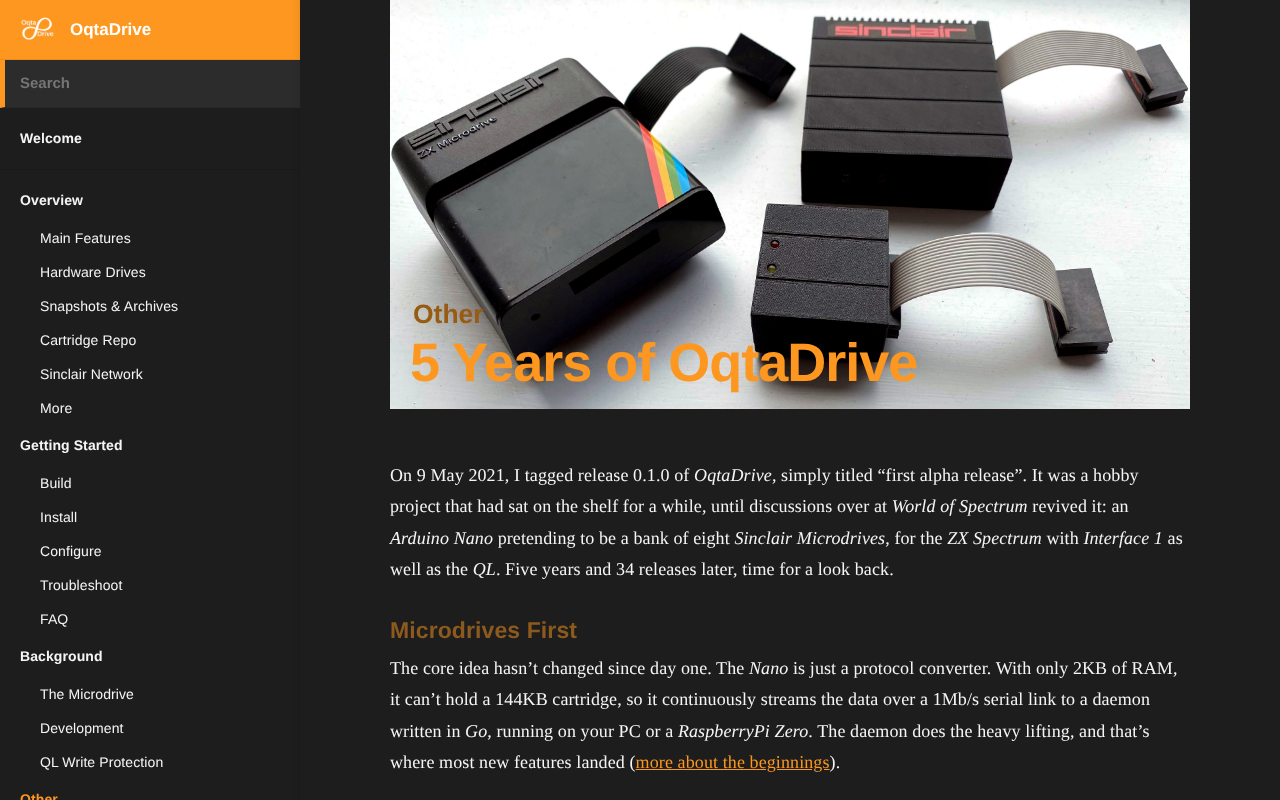
Microdrive Emulation: From Physical Media to Digital Stand-In
Sinclair's Microdrive is a miniature tape storage solution used on machines such as the ZX Spectrum. Its physical construction is unusual, and the tapes are prone to aging and failure. OqtaDrive's core idea is to use modern hardware to emulate the read/write behavior of the Microdrive, so that old machines can run software without relying on fragile original tapes.
This layer of emulation requires accurately reproducing the Microdrive's timing and signal protocols; otherwise, the old machines cannot recognize it. Over the past five years, the project team has continuously refined this low-level compatibility so that it works reliably on real hardware. For retro computing enthusiasts, this means they can continue using original equipment without worrying about data loss caused by tape damage.
Sinclair Microdrive was a miniature tape storage device launched alongside the ZX Spectrum in 1983. It used an endless loop of tape (about 5 meters long) and achieved a capacity of roughly 85KB with extremely small track spacing. Its physical construction included a motor-driven rotating drum and a precision head positioning mechanism. The tape itself was extremely thin and prone to failure due to stretching, dust, or head wear. The ZX Spectrum communicated with the Microdrive through an expansion interface called Interface 1. The communication protocol was serial and very strict about timing—each bit of commands and data had a specific duration window, and the host and drive synchronized through handshake signals. This timing sensitivity means that an emulator must not only be functionally correct but also reproduce signal behavior at the microsecond level; otherwise, the old machine will refuse to recognize it due to timeouts or checksum failures. This is exactly where OqtaDrive's difficulty lies: it needs to use a modern microcontroller to generate responses that conform to these timings in real time, while also emulating the loop positioning logic of the tape loop.
From Local Storage to Sinclair Networking
What truly makes OqtaDrive more than an ordinary storage emulator is its networking capability. Sinclair Network was the local area network solution used in those days to connect multiple Sinclair machines, originally relying on dedicated hardware and cabling. OqtaDrive extends this concept to the internet layer, allowing machines in different locations to communicate over the network.
According to the project title, this capability was gradually implemented over five years of evolution. From single-purpose Microdrive emulation to internet connectivity supporting Sinclair networks, OqtaDrive has effectively built a "network gateway" for the retro computing world. This design approach is similar to edge gateways in today's IoT devices, except that the devices being served are home computers from forty years ago.
Sinclair Network was a local area network solution designed by Sinclair in the 1980s for the ZX Spectrum series. It was originally implemented through the network port on Interface 1, using a shared twisted pair to chain up to 64 machines together, with a data transfer rate of about 100 kbit/s. It used a token-passing-like mechanism to coordinate access to the shared bus among multiple devices and avoid collisions. Back then, this kind of network was mainly used in school computer labs to share programs and data, and to exchange state in multiplayer game scenarios. OqtaDrive maps this protocol stack onto the modern internet, which is essentially protocol conversion: on one end it communicates with old machines using real Sinclair network timing, and on the other end it encapsulates data into modern network packets for long-distance transmission. This requires handling latency differences, packet loss, timing jitter, and other network problems that did not originally exist. Therefore, it is not just "extending the cable" but building a protocol gateway across eras.
The Community Logic Behind Five Years of Iteration
The data on Hacker News—only 1 comment and 7 upvotes—shows that OqtaDrive is not a mainstream topic. But it is precisely the long-term existence of such niche projects that forms the underlying diversity of the open-source hardware ecosystem. Five years means the project has gone through hardware platform changes, software dependency upgrades, and repeated debugging of protocol details—work that rarely yields short-term returns.
From an industry perspective, the vitality of retro computing projects often depends on whether maintainers are willing to keep investing and whether the community forms a stable cycle of use and feedback. OqtaDrive's five-year journey provides an observation sample: when a project expands from a single function to networking capability, its audience boundary also expands, from users who "just want to read old tapes" to players who "want to get old machines online."
Lessons for Modern Developers
OqtaDrive's technical path still has reference value for today's work. Accurately emulating old hardware protocols requires patience and reverse engineering skills, while connecting the emulation layer to a modern network stack tests layered architectural design. This model of "backward compatibility with history and upward integration with modernity" is also common in scenarios such as industrial control system migration and legacy device networking.
Another noteworthy point is the project's incremental evolution: first do single-point emulation well, then add networking capability, rather than aiming for something big and comprehensive from the start. For independent projects with limited resources, this pace may be a more sustainable choice.
Reverse engineering old hardware protocols usually requires combining logic analyzers to capture bus signals, studying original technical manuals and timing diagrams compiled by the community, and validating hypotheses through repeated trial and error. The key difference between this kind of work and conventional software development is that the target system's behavior is fixed and cannot be modified; developers can only adapt their implementation to historical specifications. At the architectural level, when connecting the emulation layer to a modern network stack, a common approach is clear layering—the bottom layer handles timing-accurate hardware signal simulation, the middle layer handles protocol semantics, and the upper layer handles network transmission and state management. This layering keeps the timing-critical parts simple and testable while isolating complex network logic in independent modules. Industrial control system migration and legacy device networking projects face similar constraints: on-site device protocols are fixed and timing-sensitive, while the upper layers need to connect to modern IT infrastructure. Therefore, OqtaDrive's layered approach has direct reference value in these scenarios.
Conclusion
OqtaDrive's five-year story has no dramatic funding or explosive growth, but it proves one thing: in the corner of retro computing, sustained technical refinement can keep hardware protocols from forty years ago running today, and even give them new ways to connect. For developers interested in open-source hardware and computing history, this is a project sample worth following.
One-line Summary
OqtaDrive uses modern hardware to emulate Sinclair Microdrive and connect it to the internet, with five years of continuous iteration.
Paragraph Summary
OqtaDrive is an open-source retro hardware project that has been running for five years. Its original goal was to emulate the Sinclair Microdrive tape storage device so that old machines such as the ZX Spectrum could run software without relying on fragile tapes. During its evolution, the project gradually added networking capability, extending the Sinclair Network—which originally depended on dedicated hardware—to the internet layer so that machines in different locations could communicate. The article analyzes its technical path: the low level requires accurately reproducing the Microdrive's timing and signal protocols, while the upper level builds a protocol gateway across eras. Although it has received very little attention on Hacker News (7 upvotes, 1 comment), its incremental evolution strategy—first doing single-point emulation well and then adding networking—has reference value for resource-limited independent projects and industrial legacy device networking scenarios.
Related articles

9 AI Subscription Plans Compared: The Real Cost Per 100M Tokens Revealed
Bilibili creator tests 9 AI subscription plans from Volcano, Alibaba, Tencent, Baidu, Zhipu, Xiaomi, MiniMax and more, converting them all to real cost per 100M tokens, breaking down fixed-quota vs. three-tier coefficient billing and how caching, time-of-day discounts, and window limits affect actual quota.

Vibe Coding for Beginners: Expressing Intent Instead of Handwriting Code
What is Vibe Coding? A 137-episode Bilibili course defines it: the core is expressing intent, not writing code. This article analyzes Vibe Coding's productivity logic, target audience, and entry expectations to help beginners decide if it's worth learning.

LangChain Beginner's Guide: An Agent Development Roadmap from LangGraph to Deep Agents
Clarify the encapsulation relationship among LangChain, LangGraph, and Deep Agents, and master the learning path and selection logic for agent development frameworks—suitable for beginners in large model development.