Oregon and Virginia Sue SpaceX: Grok Deepfake Porn Content Sparks Legal Storm
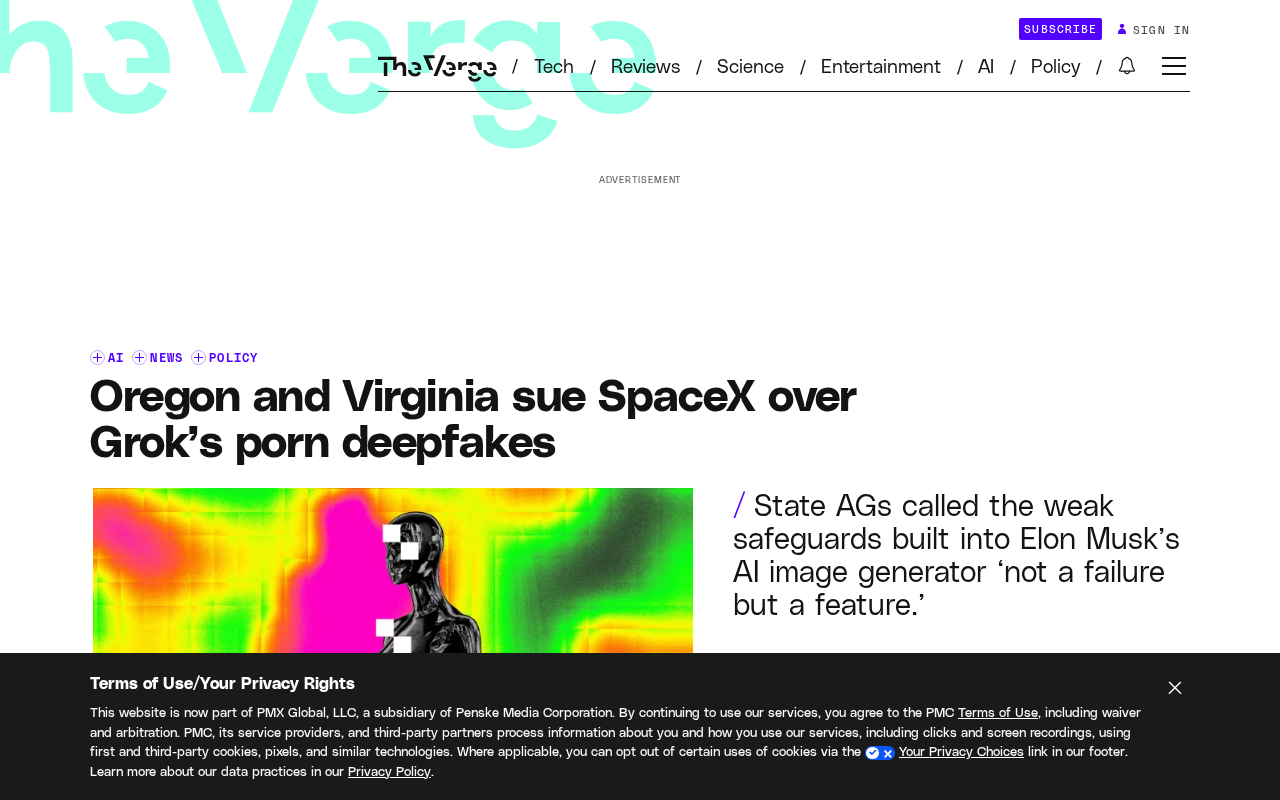
Oregon and Virginia sue SpaceX, alleging Grok generates deepfake porn and makes false safety claims.
The attorneys general of Oregon and Virginia have separately sued SpaceX, alleging violations of state consumer protection laws for failing to prevent Grok AI from generating non-consensual deepfake porn and falsely advertising platform safety. Virginia's complaint further accuses Musk of "intentionally" ignoring risks. The case hinges on the legal relatedness of SpaceX, xAI, and X platform, and the application of consumer protection law in AI governance. If the allegations hold, penalties could increase significantly, prompting more states to follow suit and creating a fragmented regulatory landscape with higher compliance costs for AI companies. The case marks an escalation in state-level regulation of AI-generated content and raises broader questions about platform responsibility and the implementation of safety commitments.
Two States Join Forces in Lawsuit, SpaceX Faces Consumer Protection Allegations
According to RSS sources, Oregon Attorney General Dan Rayfield and Virginia Attorney General Jay Jones filed similar lawsuits on Monday, alleging that SpaceX violated state consumer protection laws by ignoring industry-standard safeguards and falsely advertising the safety of its X social media platform and Grok AI features. Virginia's complaint goes further, directly accusing Musk of acting "intentionally."
The core of the lawsuit centers on "porn deepfakes" generated by Grok. The two states argue that SpaceX failed to effectively prevent its AI tool from being used to create non-consensual pornographic images and made misleading statements about its safety commitments. Although the lawsuit details have not been fully disclosed, this action marks an escalation in state-level regulatory governance of AI-generated content.
Grok's Safety Controversy and Platform Responsibility
Grok, as the AI assistant built into the X platform, has previously faced criticism for lax content moderation. This lawsuit targets SpaceX—although Grok is developed by xAI, the two states appear to treat SpaceX, the X platform, and Grok features as related entities. This legal determination of relatedness could become an important precedent for future AI liability allocation.
Industry Standards and "Intentional" Allegations
The word "intentional" in Virginia's complaint is noteworthy. It suggests that prosecutors believe SpaceX was not inadvertently negligent but knowingly chose to allow the risk. This is closely related to the determination of "deceptive practices" under consumer protection law. If the court accepts this, it could significantly increase penalties.
Regulatory Gaps in Deepfake Porn
Currently, there is no comprehensive federal legislation in the United States specifically targeting AI deepfake porn, and states are filling the gap through consumer protection laws, privacy laws, or existing criminal law provisions. The actions by Oregon and Virginia demonstrate that state attorneys general are becoming active enforcers in AI governance.
Application of Consumer Protection Law in AI Litigation
U.S. state consumer protection laws typically prohibit "Unfair or Deceptive Acts or Practices" (UDAP). In AI-related cases, prosecutors often argue that if a company's publicly stated safety safeguards do not match actual product behavior, it constitutes "deceptive" advertising; and knowingly failing to take reasonable measures when a product may be misused may be deemed an "unfair" practice. The advantage of such litigation is that there is no need to prove actual user harm—only that the company's conduct was misleading or abusive to initiate enforcement. Oregon and Virginia are using this legal framework to make the gap between Grok's safety commitments and its actual outputs (such as deepfake porn) the core allegation.
Technical Principles and Harms of Deepfake Porn
"Deepfake" refers to the use of deep learning models (such as generative adversarial networks (GANs) or diffusion models) to synthesize highly realistic fake images, videos, or audio. When such technology is used to generate pornographic content without the subject's consent, it constitutes "deepfake porn." Its harms include not only reputational and psychological damage to victims but also the fact that such content spreads rapidly, is difficult to trace, and existing laws differ in how they characterize the "production" and "distribution" stages. Currently, the U.S. lacks unified federal legislation specifically addressing AI-generated pornographic content, and states rely mainly on privacy laws, harassment laws, or child pornography-related provisions for fragmented regulation, resulting in inconsistent enforcement standards and leaving room for ambiguous liability for AI companies.
Impact on the AI Industry
This case could have a chain reaction. On one hand, it sends a signal to other AI companies: safety commitments cannot remain mere marketing rhetoric—they must be implemented through technical and managerial measures. On the other hand, it may encourage more states to follow suit, creating a fragmented regulatory landscape and increasing compliance costs for companies.
For X platform and xAI, the PR impact of the lawsuit cannot be underestimated. Musk has repeatedly emphasized Grok's "humor" and "anti-woke" traits, but the proliferation of deepfake porn could damage the platform's reputation and trigger further advertiser flight.
Conclusion
The lawsuits by Oregon and Virginia bring the issue of legal liability for AI-generated content to the forefront. Regardless of the outcome, it reminds technology companies: while pursuing innovation, they must remain vigilant about the risk of their products being misused. For readers concerned about AI governance, the progress of this case is worth continued tracking.
Related articles
David Fincher's New Film Accused of Being AI-Generated? The Truth Behind the Controversy
David Fincher's new film *The Further Misadventures of Cliff Booth* is accused of using AI, with a carriage shot in the trailer sparking controversy. Netflix's acquisition of Ben Affleck's AI company and Fincher's own openness to AI keep suspicions alive. This article sorts out the controversy and the views of all sides.

FCC Clears SpaceX's Space-Based AI Data Centers: A Debate Over Regulatory Boundaries
The FCC approved SpaceX's plan to deploy AI data centers in space but dismissed opponents' key concerns about scientific research impacts as beyond its regulatory authority. This article analyzes the regulatory boundary issues behind the decision, the deeper tensions of space-based AI infrastructure, and its implications for the industry.

Why Are Latinos Nearly Half of the U.S. Border Patrol?
Latinos hold nearly half of the U.S. Border Patrol and about 30% of ICE. Vox's Khalil Green explores their motivations, identity tensions, and why enforcement work ≠ MAGA.