Othor AI: An Open-Source BI Tool That Brings Intelligence-Agency Methods to Business Analytics
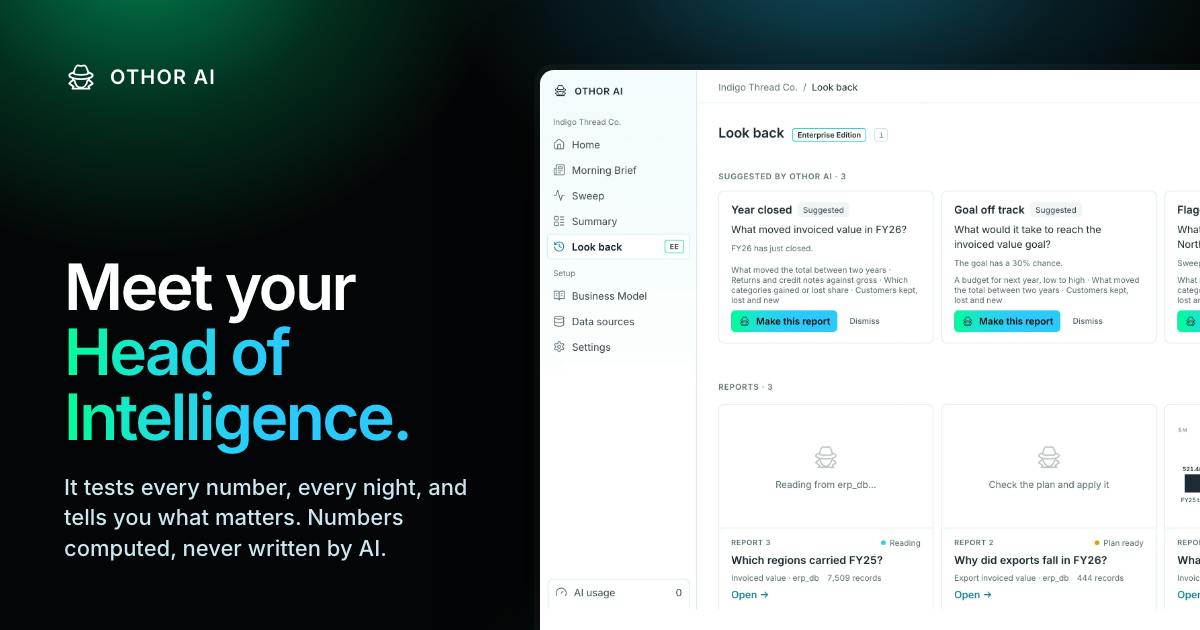
Othor AI brings intelligence analysis methodology to BI with an architecture where AI writes the words and code does the math to fight hallucination.
Othor AI is a Product Hunt business intelligence product positioned as "Your Head of Intelligence," distinguished by bringing intelligence-agency tradecraft and signal analysis into data analysis. Architecturally it splits responsibilities: AI only generates narratives while all numerical computation is handled by deterministic code, avoiding unreliable LLM arithmetic and enabling byte-for-byte replay for auditing and compliance. It emphasizes minimal AI costs and manual effort, is open-sourced under Apache-2.0 with hosted and self-deployed modes, and targets business leaders. At launch it received 76 upvotes, 5 comments, and 19th place for the day—still early, but its architecture is worth watching.
When Business Intelligence Meets Intelligence Analysis
A product with a rather distinctive approach has appeared on Product Hunt—Othor AI, positioned as "Your Head of Intelligence," with the core proposition of helping you uncover the hidden truths behind your data.
What makes this product most compelling is its methodological foundation: rather than simply wrapping a large language model around data Q&A, it claims to be built on the "tradecraft" of intelligence agencies and a century-long tradition of signal analysis. In other words, it brings the rigorous processes of intelligence analysis into the business data analytics space.
Tradecraft is a term of art in the intelligence community, referring to the standardized set of operational methods that intelligence agencies have accumulated in human intelligence (HUMINT) and signals intelligence (SIGINT) work, covering target selection, source verification, cross-referencing, hypothesis testing, and counter-deception. Its core principle is: no single source of information can be taken at face value; it must undergo multi-source comparison and structured reasoning before it can be converted into actionable intelligence. Transplanting this methodology into business data analytics means not having the model directly "read the data and give conclusions," but rather first decomposing the problem according to intelligence workflows, identifying signals, validating hypotheses, and then producing judgments.
The signal analysis tradition leans more toward the technical side, originating from wartime codebreaking and communications intelligence (such as Britain's Bletchley Park), emphasizing the extraction of weak signals from noise, pattern recognition, and reconstruction of underlying structures. This tradition later evolved into modern signal processing and statistical inference methods, whose essence lies in "signal-noise separation"—which is precisely the methodological source of Othor AI's claim to help users "discover the hidden truths behind the data."
Core Architecture: AI Writes the Words, Code Does the Math
Othor AI makes a critical architectural split: AI is responsible for organizing language, while code is responsible for computing every single number.
This design directly addresses the biggest pain point of current AI data analysis tools—large models are unreliable at arithmetic. Many BI tools let LLMs directly participate in numerical computation and aggregation, and the result is that seemingly professional reports contain erroneous numbers. Othor's approach is to hand numerical computation entirely to deterministic code, with AI only responsible for converting results into human-readable narratives. This boundary-drawing is essentially using engineering to combat hallucination.
What's even more hardcore is its emphasis on reproducibility: "any night can be replayed byte for byte"—any night's analysis can be replayed byte for byte. For business scenarios requiring auditing, compliance, or review of decision chains, this feature is highly valuable.
The unreliability of LLM numerical computation is an engineering fact that has been repeatedly verified. Large language models are essentially sequence models that generate tokens based on probability; they have no built-in arithmetic engine. When they "calculate" aggregates or ratios, they are actually predicting the most likely digit string, which is highly error-prone in multi-step operations, large-number aggregation, or decimal-precision scenarios—and errors often appear in plausible forms that are hard to spot by eye. Common industry mitigations include: having the model generate code that is then executed by an interpreter, calling external computation tools, or removing numerical computation from the model entirely. Othor AI adopts the most thorough third approach.
Reproducibility in the context of data analysis and auditing refers to the ability of the same input to produce completely consistent results under the same process, with every step's computational basis traceable. "Byte for byte replay" means the intermediate states and outputs of the entire analysis pipeline are deterministically recorded and can be fully re-enacted, which aligns closely with the requirements of financial compliance, model risk management, and decision review—and is a property that purely generative approaches struggle to provide.
Cost and Labor: Minimizing the AI Bill
Othor AI explicitly markets "the smallest AI bill" and "the least manual effort" as selling points.
Behind this is a pragmatic product judgment: in enterprise analytics scenarios, AI invocation costs accumulate rapidly with data volume and analysis frequency. If every analysis requires feeding large amounts of raw data to the model, costs will spiral out of control. Othor's approach is to have AI process only refined signals, leaving the heavy lifting to code. For teams that are budget-sensitive but want to leverage automated analytics capabilities, this trade-off has real significance.
Open Source and Deployment Flexibility
Othor AI is open-sourced under the Apache-2.0 license and offers both a hosted service and self-deployment options.
Choosing open source is not common in the BI space, especially when the product involves core enterprise data. Apache-2.0 permits commercial use and modification; for enterprises whose data cannot leave the internal network or that need deep customization, the self-deployment option is a must-have. This also lowers the barrier to procurement decisions—you can run it yourself first to see how it performs.
The Apache-2.0 license is a permissive open-source license that allows users to freely use, modify, and distribute the software, including for commercial closed-source products, without requiring derivative works to be open-sourced under the same license (unlike GPL's viral copyleft). It also includes explicit patent grant provisions, reducing legal risks for enterprise adoption. For BI products involving core enterprise data, Apache-2.0 means enterprises can self-deploy on internal networks and modify source code as needed without having to disclose changes—precisely the key requirement of data-sensitive customers.
The self-hosted model refers to software running on the enterprise's own infrastructure, with data never leaving the internal network, as opposed to vendor-hosted SaaS. Against the backdrop of increasingly strict data compliance (such as GDPR and industry-specific data export restrictions), self-deployment is often a prerequisite for enterprise procurement.
Who Should Use Othor AI
Judging from its positioning, Othor AI targets "business leaders" rather than data analysts. Its value proposition is enabling non-technical managers to quickly read signals from numbers, reducing dependence on data teams.
It should be noted that this product received 76 upvotes and 5 comments on Product Hunt, ranking 19th for the day. These numbers are not explosive, indicating it is still in an early stage.
For teams looking to try automated business intelligence, Othor AI offers an approach different from mainstream LLM-BI solutions: strictly separating deterministic computation from generative narration, and organizing the analysis workflow using intelligence analysis methodology. This architectural choice alone is worth studying for practitioners following the evolution of AI data analysis tools.
Product Hunt upvotes and ranking can serve as a rough reference for a product's early traction but should not be over-interpreted. The platform sees a large number of product launches daily, and top rankings for the day typically require hundreds of upvotes; 76 upvotes and 19th place indicate the product has gained some attention but has not yet built viral momentum, and the low comment count means the sample of real user feedback is limited. For evaluators, what's more worth examining is whether the product's methodological claims and architectural choices hold up against real-world data scenarios, rather than the upvote count on launch day itself.
One-line Summary
Othor AI brings intelligence analysis methodology to BI, using an architecture where AI writes the words and code does the math to combat hallucination.
Paragraph Summary
Othor AI is a business intelligence product on Product Hunt positioned as "Your Head of Intelligence," distinguished by bringing intelligence-agency tradecraft and signal analysis traditions into the data analysis workflow. Architecturally it makes a critical split: AI only organizes language and generates narratives, while all numerical computation is handled by deterministic code, thereby avoiding the pain point of unreliable LLM arithmetic and supporting byte-for-byte replay of any analysis to meet auditing and compliance needs. The product emphasizes minimizing AI invocation costs and manual effort, is open-sourced under Apache-2.0, offers both hosted and self-deployed modes, and targets business leaders rather than data analysts. At launch it received 76 upvotes, 5 comments, and 19th place for the day—still in an early stage, but its architectural approach is worth watching.
Related articles
GLM-5.4 Coding Test 4.6x Slower? Unpacking the Loop Transformer Architecture
GLM-5.4 coding test took 431 minutes vs. competitor's 109, 4.6x more steps. We analyze its Loop Transformer architecture, KingBench4 score of 55.3, Max tier's 1.04M token cost, and tier selection advice.

Zhipu GLM-5.4 Quietly Released: A Debut for Loop Transformer Architecture
Zhipu GLM-5.4 quietly lands in coding plans: first Loop Transformer flagship with 750B params, 1M token context, AIM math up from 19.2 to 30.4, and native vision for coding from screenshots.
GLM-5.4 Releases 750B Model: Recurrent Transformer Architecture and the 30B Benchmark Controversy
GLM-5.4 releases a 750B model with a recurrent Transformer architecture that runs the same layers twice, claimed to match 2T–3T scale. But the benchmark table tests a 30B small model, not the main model. We break down the architecture changes, benchmark data, four demos, and open-source timeline.