Out of Tokens? Hands-On Test of the DeepSeek Harness Free Quota Plugin

A plugin pools the free quotas of 36 vendors and 635 models, letting agents experiment more.
The article examines the steep bills of agent tools like DeepSeek Harness, noting that agent costs come mainly from multi-round trial and error rather than chatting—a task goes back and forth a dozen-plus rounds, each burning money. The author introduces a plugin that pools the free quotas of 36 vendors and 635 models into one pool, auto-switching when rate-limited and covering four types of quota: text, image understanding, image generation, and video generation—ready to use without code changes. The core point: more important than saving money, the pool restores users' willingness to iterate and revise more versions, because what's truly expensive isn't the AI but the standards people lower when quota runs out. It ends with installation and who it's for, noting such solutions depend on vendor policies and commercial projects should keep a paid channel.
DeepSeek Harness and other agent tools are a joy to use, but the bills can be painful. Bilibili creator PaulusA梦 shared an idea: install a plugin that pools the free quotas of 36 vendors and 635 models into one pool and switches between them automatically as needed. This article focuses on that plugin, why agents burn through so many tokens, and what the free quota pool actually solves.
Why Agents Cost Far More Than a Chat Box
DeepSeekAd Harness isn't a chat box—it's an agent. Give it a task, and it breaks it into steps, reads files, edits code, runs commands, checks results, and goes back to revise. A decent task going back and forth a dozen-plus rounds is normal. The creator gave a very typical example: ask it to fix one bug, it fixes three along the way, and then it undoes the first fix—every one of those four rounds costs money.
So an agent's bill isn't run up by chatting—it's run up by trial and error. The more you want the job done well, the more you try, and the bigger the bill. It's not that you don't know how to use it; it's precisely that you want to do the job well.
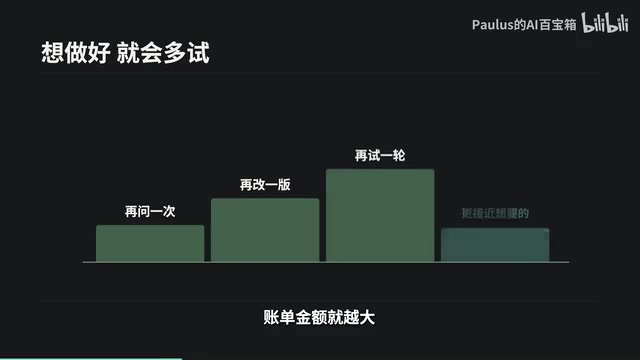
The cost gap between agents and ordinary chat boxes comes down to a different token consumption pattern. A chat box maps one Q&A to one model call, with largely controllable input and output volume. An agent, by contrast, runs a "plan—act—observe—replan" loop, and each round re-injects the system prompt, tool definitions, conversation history, file contents, and command output back into the context. Context accumulates with every round, so each subsequent round's input tokens include all prior rounds' records, and costs grow roughly quadratically. On top of that, the results returned by tool calls (reading files, running commands) also count as tokens, and long files or logs can quickly bloat the context. An agent's bill is therefore fundamentally the product of "context bloat + multi-round loops," which is why the same model costs far more in an agent scenario than in a chat scenario.
What the Plugin Does: A Free Quota Pool
The plugin isn't yet another AI—it adds a capability to DeepSeek Harness: it registers the free quotas of 36 vendors and 635 models into a pool. Once installed, API information shows up in the interface, with no code changes required.
The pool's logic is simple: when one vendor rate-limits you, it automatically switches to the next. How many requests per minute and how many tokens per day—the plugin keeps its own books; it knows how much quota you've spent better than you do; and it can automatically handle the daily check-in at whichever vendor offers quota for it. The creator used a vivid metaphor—it's like the WiFi of thirty-something households in a residential compound: you have all the passwords, and when the signal weakens it automatically switches to another. The only difference is that connecting to WiFi requires sneaking around, while using quota doesn't.
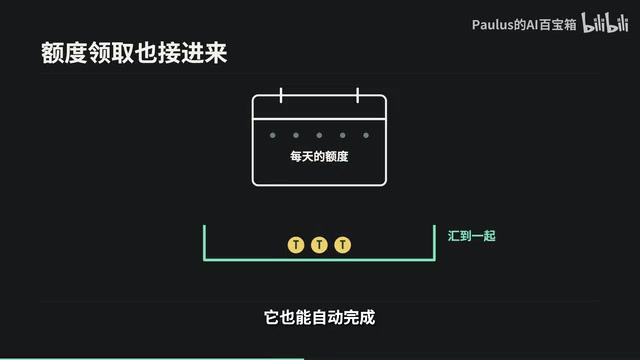
To understand this pool, you first need to know the two common ways vendors limit free quotas: RPM (requests per minute) and TPM/daily quota (tokens per minute or per day). The former limits call frequency, the latter limits total volume. The plugin's "bookkeeping" means maintaining a local counter that tracks in real time how many requests and tokens each vendor has used, and when one hits its limit or returns a 429 (rate-limited) status code, it automatically routes the request to the next vendor that still has balance. In engineering, this mechanism is usually called multi-provider failover and load balancing. Daily check-in is automation of some vendors' "daily login grants quota" rules, done via scheduled tasks. Note that the availability of such pools depends entirely on each vendor's public policies and API stability; it's not an officially supported capability but a community-side aggregation solution.
Four Accounts: Text, Image Understanding, Image Generation, Video Generation
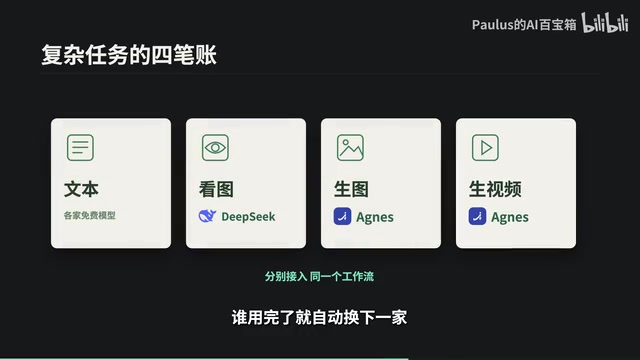
Many people hear "free quota" and assume it's just chat quota. In reality, a complex task consumes four kinds of quota: text quota for writing, quota for understanding images, and quota for generating images and videos. The plugin covers all four—text relies on each vendor's free models, image understanding on DeepSeek's built-in multimodal models, and image and video generation on Agnes, automatically switching to the next vendor when one runs out.
There's a noteworthy detail here: the three pipelines of text, visual understanding, and generative content are configured separately, meaning different capabilities can be backed by different vendors' free quotas. For users doing multimodal tasks, this coverage is far more practical than a pure text quota pool.
The "four kinds of quota" in multimodal tasks correspond to different model capabilities: text generation is handled by large language models, responsible for reasoning, coding, and planning; visual understanding (VLM) lets models "see" screenshots, charts, and UI interfaces, which is essential when an agent operates a graphical interface or analyzes images; image generation and video generation belong to generative models, which output pixel content rather than text. These four capabilities are usually provided by models with different architectures, and their billing methods differ too—generative content is often billed per image or per second, costing significantly more than text. The point of configuring the three pipelines separately is that when one type of quota runs out, only the corresponding capability is affected rather than the whole task being interrupted, and users can specify a backup vendor for each type of capability, achieving fine-grained cost control.
What You Really Save Isn't Money—It's the Courage to Experiment
The creator didn't quote specific prices because the differences between vendors are too large. But he made a more important point: what's more expensive than money is something else—when quota is running low, people instinctively conserve. One fewer question, one fewer revision, "it's about good enough." When you're on the seventh version and you tell yourself, forget it, it works, that's the real cost of using an agent: it doesn't just take your money, it pushes you to lower your standards.
Now that someone else is paying all four accounts for you, you dare to let it revise an eighth and ninth version. The creator's judgment: most of the money spent on DeepSeek Harness isn't because AI is expensive, but because you don't dare to try more.

Installation and Who It's For
Setup takes about 20 minutes. Installation is simple: search directly in the plugin marketplace—the link is in the video description; if you give DeepSeek Harness enough permissions, you can also just let it install itself.
Who it's for: developers who use agents heavily and often cut down on iterations due to quota anxiety. One caveat: such free quota pools depend on each vendor's rate-limiting and check-in rules, so stability and long-term availability will change with vendor policies. For sensitive or commercial projects, it's still advisable to keep a paid API as the primary channel.
One-line Summary
A plugin pools the free quotas of 36 vendors and 635 models, giving agents the freedom to experiment more.
Paragraph Summary
The article examines the steep bills of agent tools like DeepSeek Harness, pointing out that agent costs come mainly from multi-round trial and error rather than chatting—a task goes back and forth a dozen-plus rounds, and each round burns money. The author introduces a plugin that pools the free quotas of 36 vendors and 635 models into one pool, automatically switching to the next vendor when rate-limited, covering four types of quota: text, image understanding, image generation, and video generation—ready to use after installation with no code changes. The core point is that more important than saving money, the free quota pool restores users' willingness to iterate frequently and dare to revise several more versions, because what's really expensive isn't the AI itself but the standards people are forced to lower when quota runs out. Finally, it covers installation and who it's for, and notes that such solutions depend on vendor policies, so commercial projects should still keep a paid channel.
Related articles

Zed Editor Releases v1.29.2: Observations on a Routine Version Iteration
Zed editor releases patch v1.29.2, version bump by @JosephTLyons, commit verified via GitHub signature. This article covers the release's basic info, what a patch version means, and practical upgrade advice for users.

Anthropic IPO Questioned: Hacker News Debates Timing of Going Public
A Hacker News post titled "Just say no to Anthropic's IPO" sparks debate on the timing of Anthropic's public listing and AI capitalization, touching on valuation bubbles and mission independence.

Hands-On with the Genie 4 World Model: Directing Worlds in Real Time Like a Puppeteer
Google DeepMind's Genie 4 world model in depth: Special Guest X's hands-on demo of real-time scene direction via prompts, custom interactive apps in Project Genie, and prompts-as-seeds reproducibility.