Overseas Blogger's Hands-On GrokBot Review: Why She Abandoned Claude and Went All-In on a Multi-Agent Platform
Founder runs 30 GrokBot AI teammates and ditches all self-hosted agents — UX wins.
After extensive real-world testing, a multi-business founder migrated nearly all her workflows from self-hosted open-source agents to GrokBot, citing UX simplicity as the decisive factor. Built on three primitives — Bots, Plugins, and cloud Computers — GrokBot's standout feature is multi-account support per plugin. She now runs ~30 bots covering chief of staff duties, family scheduling, PR management, SOC 2 compliance, customer support, personal finance, and outfit planning. Its key limitation: single-player only, with no group chat support.
What Is GrokBot: Assigning Real Work to an AI Team
After spending several weeks deeply testing GrokBot, one overseas AI blogger reached a bold conclusion — she had "killed" all her running open claws (self-hosted autonomous agents) and migrated almost entirely to GrokBot. This wasn't a snap decision, but a judgment call grounded in extensive real-world testing.
GrokBot is positioned as a multi-agent platform from the SpaceX AI team, built around the core idea of "AI teammates that can actually deliver real work." Its interface sits somewhere between iMessage and a terminal — comfortable for writing code while also supporting computer use. For users who like naming agents and assigning them specific roles, the "bot as coworker" mental model maps intuitively to how work actually gets done.
One notable detail: when you create a new bot with a specific name, the system infers its purpose from that name. Create a bot called "Proddy McProd," and it understands it's probably doing product-related work. This design lowers the configuration barrier and reinforces the mental model of "hiring a bot like you'd hire an employee."
Three Core Primitives: Bots, Plugins, and Computers
Understanding GrokBot comes down to grasping three key primitives. The first is Bots (agents) — independent threads defined in the left sidebar, each with a clear scope of responsibility and its own context.
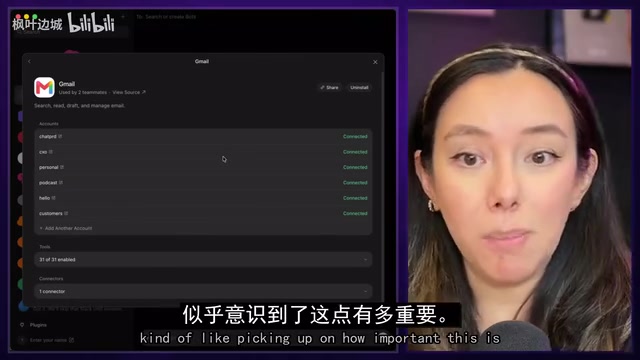
The second is Plugins — combinations of skills and connectors that integrate with different parts of your tech stack. The blogger connected Gmail, Calendar, Google Drive, Granola, GitHub, Sentry, ChatPRD, and a long list of other integrations. She credits the connector experience as what made her fall in love with GrokBot — you barely need to visit a settings page to configure plugins. Instead, bots proactively prompt you to connect when they need access, then walk you through a simple OAuth flow.
The real killer feature is a single plugin supporting multiple accounts. As a founder running multiple businesses, she has six or even ten email addresses, multiple Slack workspaces, and multiple Linear instances — GrokBot can switch between all of them freely. She also noted that OpenAI recently launched multi-Gmail/Calendar/Drive connectors for Codex and Work, signaling that other vendors are waking up to how important this capability is.
The third primitive is Computers and Routines. Each GrokBot has access to a cloud-hosted virtual machine that can log into websites, install software, generate code, and run repositories locally. Because it runs in the cloud, tasks stay continuous even when you switch to your phone. Routines are the scheduling mechanism that lets bots execute tasks on your behalf at set intervals.
OAuth (Open Authorization) is an industry-standard protocol that lets users authorize third-party applications to access their account data without handing over a username and password directly. The typical flow: a user clicks "Connect," gets redirected to the target service's (e.g., Gmail's) authorization page, confirms the permission scope, and the system issues an access token that GrokBot uses to read and write data on their behalf. This keeps credentials secure — the platform never stores your password, and you can revoke access from the source service at any time. GrokBot triggers the OAuth flow automatically when a task requires it, rather than asking users to configure integrations upfront in a settings page, which dramatically reduces friction.
From Chief to Trad: Dual-Track Agents for Work and Home
The first general-purpose bot the blogger demonstrated was "Chief" (Chief of Staff). It scans her inbox, calendar, and Slack every hour — across six email addresses, six Slack workspaces, and multiple calendars — and only surfaces alerts when they truly require her attention, silently archiving everything else. She runs it from 6 a.m. to 9 p.m., seven days a week, deliberately not overnight so she doesn't train others to expect late-night replies.
She also trained Chief to "talk like her": short, warm, and fun — never using dashes, preferring to open with "Hey" and sign off with a lowercase "C." She was pleasantly surprised by the tone prompts GrokBot generated, though she still doesn't fully trust it to draft important emails on her behalf.
She also called out a clear model weakness: the Grok model "smells like Claude" and writes poorly, but in the opposite direction — it's been noticeably tuned toward brevity and token efficiency, sometimes compressing what should be a complete sentence into three or four words, making it harder to understand.
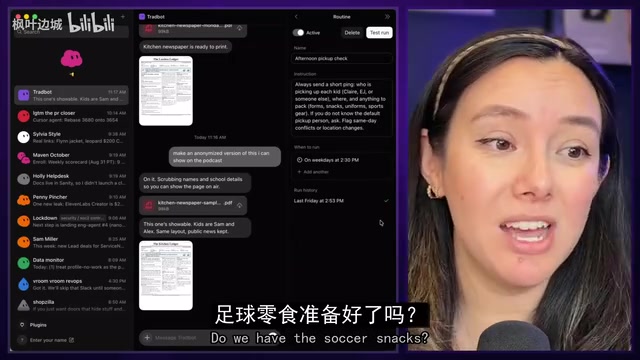
A second home agent, "TradBot," manages the complex schedules of her three kids. It generates a daily family briefing and prints a "kitchen table newspaper" via an HP printer, complete with schedules, weather, homework reminders for each child, parent tasks, and kid-friendly fun news (Pokémon World Championships, NASA telescope launches). Her core philosophy is clear: the ideal home agent gets you away from the computer and present with your family — spending too much time interacting with the agent itself is a form of failure.
Engineering and Compliance: PR Management and SOC 2 Monitoring
On the engineering side, the blogger showcased two practical bots. The first, "Look Good To Me" (PR closer), triages her pull requests daily — determining which need to be merged, closed, rebased, or replied to. It can even trigger Cursor cloud coding tasks to handle rebases and address feedback. She mentioned clearing roughly 50 backlogged PRs one Friday through it, leaving the code queue in much healthier shape.
The second is "Lockdown" (SOC 2 control bot). It logs into her SOC 2 control panel, checks whether any monitored items require human intervention, triages newly discovered vulnerabilities, submits PRs for review, and covers operational controls like account audits. She put it well: "We can have AI work for us, or we can have AI organize our work in a more effective way." This bot acts like an intern who taps you on the shoulder and says, "Hey, account review day is tomorrow."
What impressed her most was migrating the customer support agent "Holly Helpdesk" to GrokBot — quality noticeably improved. In the past week alone, multiple users proactively asked to leave positive reviews praising the support experience, something she had never seen before. Holly scans Intercom and email every hour, handles refunds and technical fixes according to the support playbook, and can even call a Cursor cloud agent to fix bugs.
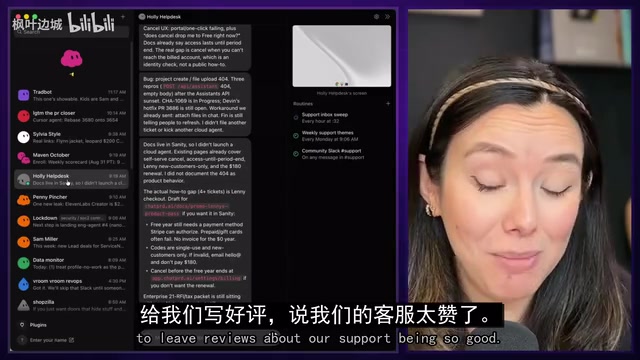
Particularly noteworthy is the tool-call approval flow: whenever a refund is needed, it sends a Stripe request (called an agent action) that requires her explicit approval before executing. This "request-then-approve" mechanism provides the human oversight necessary for sensitive operations.
SOC 2 (Service Organization Control 2) is an information security audit standard developed by the American Institute of Certified Public Accountants (AICPA), primarily targeting SaaS companies that handle customer data. It revolves around five Trust Service Criteria — security, availability, processing integrity, confidentiality, and privacy — and requires companies to continuously maintain a set of "controls" including access review, vulnerability management, and log monitoring, subject to annual third-party audits. For startups, SOC 2 compliance is often the gating requirement for enterprise procurement lists, but the day-to-day operational tasks involved (periodic account audits, evidence collection) consume enormous engineering time. Delegating this work to automated agents is a common approach to lowering compliance costs.
Rebase is a Git version control operation that "replays" commits from one branch on top of the latest node of another, keeping commit history linear and clean. Compared to merging, rebasing avoids extra merge commits, but done incorrectly it can trigger conflicts that must be resolved one by one — making it especially time-consuming when there's a large backlog of PRs. Having a bot automatically trigger Cursor cloud coding tasks to handle rebases is a classic example of offloading repetitive engineering operations to AI.
Personal Life Use Cases: From Saving Money to Shopping to Outfit Planning
The blogger also shared several more lifestyle-oriented use cases. "Penny Pincher" digs through her emails to surface subscriptions worth canceling — like an Apple game she bought when her kids were little. More interestingly, it also identifies upcoming renewals and negotiates proactively: for instance, with home insurance renewing in a few months, it'll look up market rates and negotiate with the original agent for a better price. It also discovered she hadn't used her Audible credits in months and paused her subscription for 90 days.
She even sent Penny Pincher to search the secondhand market for a Rolex from her birth year. It accurately found non-standard-size, release-year-matching options and negotiated on the ones with room to bargain — though the blogger admitted she was "too unbothered" to follow through with a purchase.
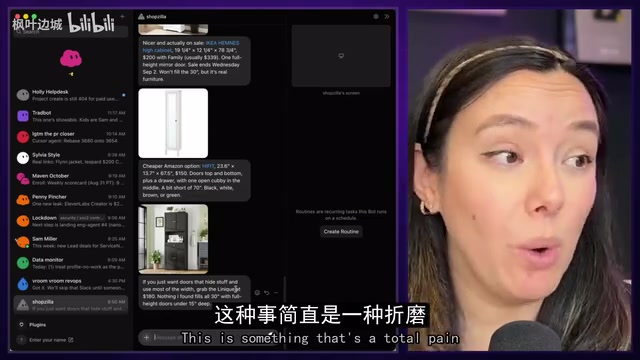
She also created a dedicated shopping bot, "ShopZilla," tasked with finding a corner bookshelf that was 30 inches wide and 15 inches deep. It browsed the web, found multiple size-matching options, and completed a task that would have been genuinely tedious to do manually.
The most entertaining was the outfit-planning bot "Sylvie Style." The blogger made her Pinterest style board public for it to analyze, had it research professional stylist methodologies on Reddit, and then generate a personal style board and prioritized shopping list. The crown jewel is "Monday wardrobe shopping": every Monday at 8 a.m. it automatically scans which retailers are running sales, identifies items that match her aesthetic, and pushes her a shopping list with direct links.
Migration and Reflections: UX Is the Deciding Factor
The blogger also walked through how she migrated from open claw. She has a dedicated "Lifeguard" bot that manages her other bots — she had it package an entire agent configuration (cron jobs, identity, rules, etc.) into a zip file, then uploaded the subfolder to GrokBot to complete a "brain transplant," migrating personality, tasks, and connectors wholesale. Once the migration was done, a single message — "kill Sam" — put the old agent to sleep.
After going through the full migration, her conclusion was clear: UX matters. It's that simple. She believes open claw defined the standard for what autonomous teammates and personal agents can do — the multi-person collaboration is a genuinely brilliant design, and the use cases are compelling. But as a technically capable user — someone who runs Tailscale, SSHes into a Mac mini, and configures Lifeguard bots — she still found maintaining open claw "too hard."
What the SpaceX AI team actually built is a simple, out-of-the-box, "90% feels like a coworker" agent experience that solved a lot of her pain points. She's now running roughly 30 bots in parallel.
She also honestly flagged GrokBot's core current limitation: it's still single-player. You can't drop a GrokBot into a group chat. By comparison, EVE agent and open claw still have an edge when it comes to multi-person collaboration. While the platform has launched bot template sharing, that's still not the same as "two people sharing the same bot conversation." It's the capability she most wants the team to build next.
Tailscale is a zero-configuration VPN tool built on the WireGuard protocol that creates a private mesh network across devices, enabling secure peer-to-peer connections without opening public ports. The blogger's mention of "running Tailscale and SSHing into a Mac mini" is her way of establishing her technical credibility — she can maintain a private network and manage a local server remotely. She didn't abandon open claw because it was too technical; she made a deliberate judgment that the maintenance cost was too high. That context makes her conclusion more compelling: even power users who are happy to tinker with infrastructure will choose a smoother alternative when UX friction gets in the way.
Related articles

Big Tech AI Engineering Interview: Full-Chain Observability from Frontend Monitoring to Agents
From PerformanceObserver metrics collection and onerror/unhandledrejection exception capture, to RAG pipeline reranking and context compression for token cost control, to designing a full-site AI full-chain observability system benchmarked against LangSmith and Sentry—breaking down the three progressive layers of big tech AI engineering interviews.

WorkBuddy Step-by-Step Guide: Build Your Own AI Agent Work Assistant
WorkBuddy step-by-step guide: starting from the limits of chat models like Doubao, learn to build your own AI Agent work assistant for batch local file processing and automation—no programming required.

Building a Local Knowledge Base with LangChain-Chatchat + DeepSeek on Windows
This article, based on a Bilibili tutorial, details the full workflow of building a local knowledge base on Windows using LangChain-Chatchat and DeepSeek, including Anaconda environment setup, Ollama model management, mirror acceleration, and common error solutions, helping you quickly implement RAG Q&A.