Palmer Luckey Backs Jensen Huang: Removing Him Would Only Make America Weaker
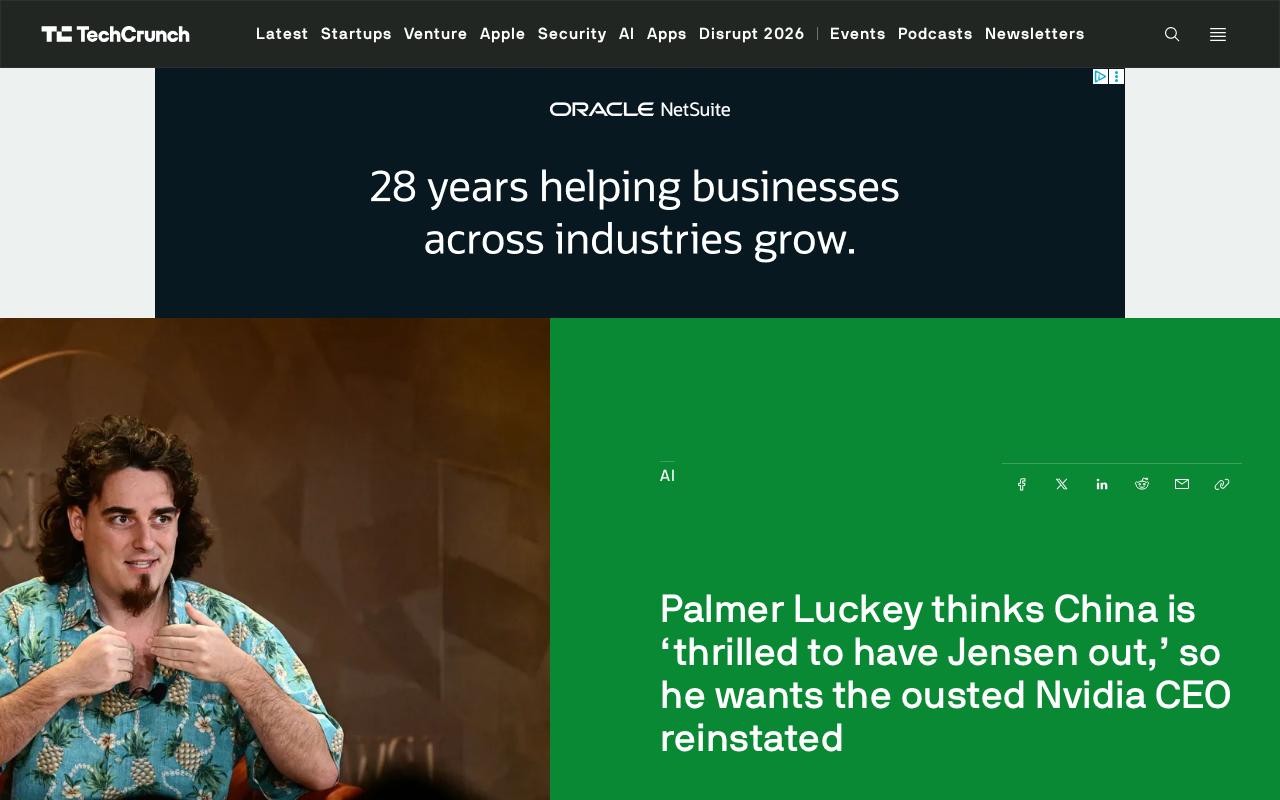
Luckey says removing Jensen Huang would weaken U.S. AI advantages and benefit China, sparking heated debate in tech circles.
Anduril CEO Palmer Luckey publicly opposed removing Nvidia CEO Jensen Huang, saying it would "make America weaker" and asserting that China would "love to see Jensen out." His logic: the barriers Nvidia has built through its GPU and CUDA ecosystem are key to U.S. leadership in AI compute, and Huang's strategic vision is an important support for that advantage; leadership turmoil could weaken Nvidia's competitiveness and give Chinese chip companies room to catch up. The article notes that this debate reflects anxiety in U.S. tech and policy circles over AI leadership, and that the Nvidia CEO's fate has been given national strategic significance. Although the statement currently comes from a single source and is a personal view that has not yet formed consensus, the tech community's attention to the stability of Nvidia's leadership is real; the disagreement lies in whether the CEO's personal ability or corporate governance resilience matters more.
A Debate Over the Future of Nvidia's CEO
According to an RSS source, Anduril CEO Palmer Luckey publicly stated that removing Nvidia CEO Jensen Huang would "make America weaker" and claimed that China would "love to see Jensen out." His remarks quickly sparked discussion in the tech community. Luckey's core logic: at a time when competition over AI chips is white-hot, Nvidia's leader is a strategic asset for the United States, and replacing him is not a wise move.
Luckey's Position: Why He Opposes Removing Huang
The Concern About "Weakening America"
Luckey said outright that removing Jensen Huang would "make America weaker." In his view, Huang is not only the soul of Nvidia but also key to America's continued lead in AI compute. Nvidia's GPU ecosystem and CUDA platform have built extremely high industry barriers, and Huang's strategic vision and execution are a crucial support for that advantage.
The Geopolitical Lens
Luckey further argued that China would "love to see Jensen out." This judgment is based on the U.S.-China contest over AI chips: Nvidia's leading position is an important bargaining chip in U.S. export controls and technology blockades, and instability in its leadership could weaken Nvidia's competitiveness, giving Chinese chip companies room to catch up. Luckey's remarks carry a clear national-security flavor, consistent with his role as CEO of defense tech company Anduril.
CUDA (Compute Unified Device Architecture) is a parallel computing platform and programming model introduced by Nvidia in 2006, allowing developers to use the thousands of cores in a GPU for general-purpose computing rather than just graphics rendering. After nearly two decades of accumulation, CUDA has formed a vast library ecosystem (such as cuDNN and TensorRT) and developer community, and the vast majority of deep learning frameworks (PyTorch, TensorFlow) natively prioritize CUDA support. This "hardware + software stack" lock-in creates extremely high migration costs: even if a competitor's chip offers comparable compute, it requires rewriting large amounts of code or relying on compatibility layers. Therefore, Nvidia's moat is not just the GPU hardware itself but the software ecosystem lock-in that CUDA represents—an essential technical backdrop when analyzing the impact of leadership changes.
Export controls refer to a country's use of legal and administrative means to restrict the flow of specific goods, technologies, or software to specific countries or entities. In the U.S.-China AI chip contest, the U.S. Department of Commerce's Bureau of Industry and Security (BIS), under the Export Administration Regulations (EAR), imposes licensing requirements on advanced-node GPUs (such as A100, H100, and their specially tailored versions) and has repeatedly tightened performance thresholds and the Entity List. Such controls use technical parameters like compute and interconnect bandwidth as demarcation criteria, directly affecting Nvidia's product design and China sales strategy. For this reason, Nvidia's competitiveness is seen as a key pillar of the effectiveness of U.S. technology blockades, and the stability of its leadership is therefore given strategic meaning beyond the commercial level.
The Deeper Logic Behind the Controversy
This debate reflects anxiety in U.S. tech and policy circles over AI leadership. Nvidia's market value and influence mean that its CEO's fate is no longer just an internal company matter but has been endowed with national strategic significance. Although Luckey's call to "reinstate" does not clearly point to a specific event, it reflects the intense attention some people pay to Nvidia's stability.
From an industry perspective, Jensen Huang's personal brand is deeply tied to Nvidia. His role as an evangelist for AI computing helped Nvidia transform from a gaming graphics card maker into an AI infrastructure giant. If the leadership were to change, investor and customer confidence could suffer, in turn affecting the overall pace of the U.S. AI industry.
Consensus and Divergence Across Multiple Perspectives
At present, this event is mainly reported by a single source, and Luckey's view is a personal statement that has not yet formed a broad consensus. But it is observable that the tech community's attention to the stability of Nvidia's leadership is real. The disagreement lies here: one side believes the CEO's personal ability is crucial, while the other emphasizes corporate governance and institutional resilience. Luckey clearly belongs to the former and has elevated the issue to the level of national competition.
Impact on the AI Industry
Whether or not Jensen Huang faces a change in position, this discussion reminds us that competition in the AI chip field has gone beyond the commercial realm and is tightly intertwined with geopolitics. Every move by Nvidia will be amplified and interpreted, and personnel changes among industry leaders may trigger chain reactions. For practitioners focused on AI infrastructure, Nvidia's stability remains a key variable affecting technology roadmaps and supply chains.
Luckey's remarks may contain exaggeration, but they reveal a reality: in the AI era, the leaders of tech giants are being given unprecedented strategic weight.
Related articles

Pure-Code Video Generation Tested: Which AI Model Actually Follows Instructions?
A Bilibili creator tested three AI models' pure-code video generation with unified prompts and three revisions each: Xiaonaomao has a high ceiling but lacks stability, GPT 6.2 Extra models well but only follows half the instructions, and OPAS 5.5 remains the benchmark.

GPT-6 Six-Tier Hands-On Test: Astra Ultra Dominates but Bills Double
GPT-6 six-tier test: Astra Ultra sweeps 3:0 in 3D tasks thanks to sub-agents and runs 14% faster, but hidden backend bills make its real cost 2.6x single-threaded.

GPT-6.2 Astra vs Fable 5.2: Huge Cost-Efficiency Gap Across 12 Real-World Tests
Bilibili creator tests GPT-6.2 Astra vs Fable 5.2 across 12 real tasks: Fable wins 7-5 but costs 7.2x more and takes nearly 5x longer. Token efficiency emerges as the key selection metric.