Paper Critters: A Children's Paper Toy Product Designed Online and Made Offline

Paper Critters lets kids design paper toys online and build them offline with a privacy-first approach.
Paper Critters is a COPPA-compliant children's product that combines digital creativity with hands-on making. Kids customize paper toy characters using web-based sticker tools, then print and assemble them in the real world. Built as a PWA to bypass app store barriers, it collects zero personal data and requires no accounts. Its "design online, make offline" philosophy offers a refreshing counter to screen-obsessed EdTech trends.
When Digital Creativity Meets Hands-On Play
In an era where children's educational technology (EdTech) products universally chase screen time metrics, a product called Paper Critters has chosen the opposite direction — it encourages kids to leave the screen after completing their digital designs and return to a hands-on experience with scissors, paper, and glue.
This product earned 103 upvotes on Product Hunt, landing at #6 on the daily leaderboard under the "Kids, Toys, Family" categories. Built by Ruperto Fabito, Jr., its core concept is crystal clear: design online, make offline. Children use sticker tools on a webpage to customize paper toy characters, then print out finished templates complete with cut lines and fold lines, assembling them by hand into real 3D paper figures.
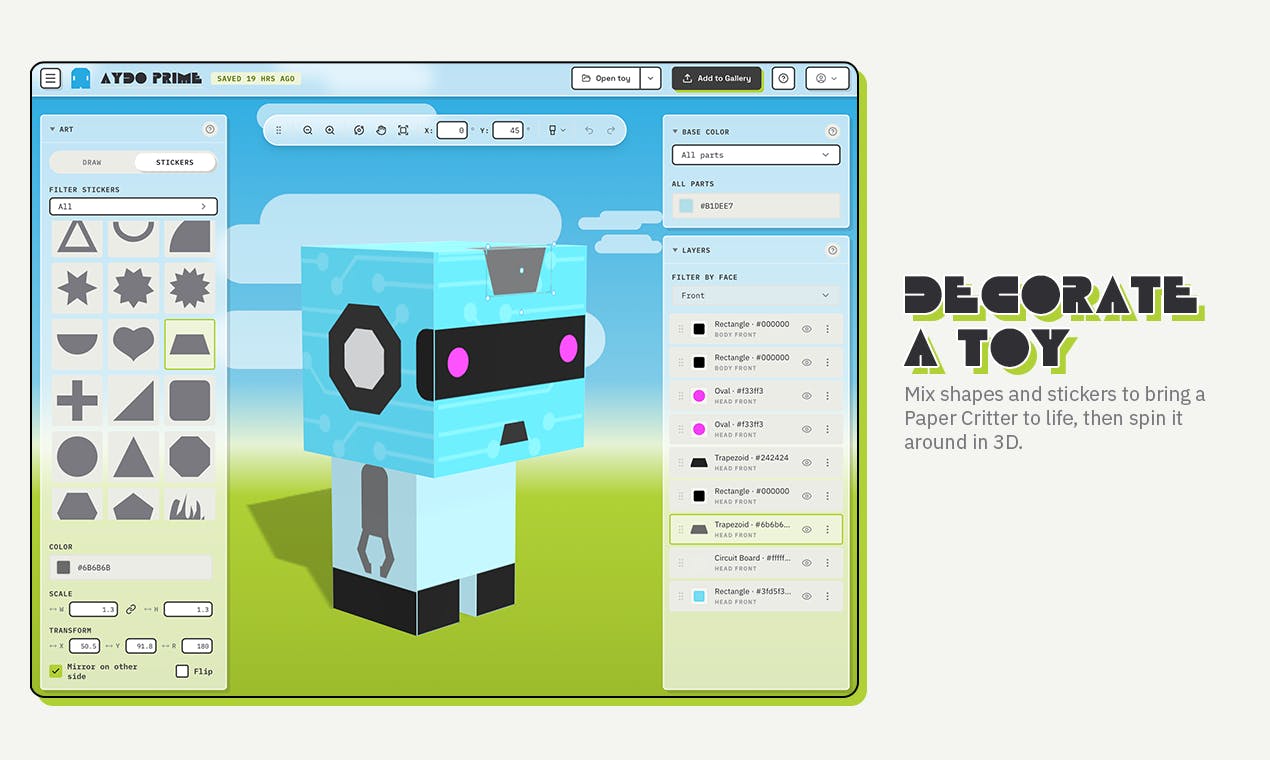
This "digital + physical" hybrid model isn't new, but it strikes a perfect balance for children's products: it preserves the creative freedom that digital tools provide while rebuilding children's focus and fine motor skill training through physical making. In fact, developmental psychology research has repeatedly confirmed that fine motor skills training — cutting, folding, gluing — is closely linked to children's cognitive development. Improvements in finger dexterity not only help develop writing abilities but also positively correlate with executive function development in the prefrontal cortex. Papercraft as an art form has a long history, from Japanese origami to European paper models, and has always been a classic vehicle for hands-on children's education. Paper Critters essentially uses digital tools to lower the design barrier for papercraft while preserving the core educational value of hands-on making.
Notably, the global EdTech market exceeded $400 billion in 2024, yet the vast majority of products in this space compete for children's screen attention. The American Academy of Pediatrics (AAP) recommends in its screen time guidelines that children aged 2-5 should have no more than 1 hour of screen time per day, while parents of children 6 and older should set reasonable limits based on individual circumstances. A growing body of research suggests that excessive screen exposure may affect children's sleep quality, attention span, and social skill development. Against this backdrop, Paper Critters' "voluntary exit" strategy is not just a differentiation play — it also aligns with parents' growing demand for "screen reduction."
COPPA Compliance: The Core Threshold for Children's Online Products
The most noteworthy aspect of Paper Critters is that it places COPPA compliance (Children's Online Privacy Protection Act) at the forefront of its product positioning.
COPPA was enacted by the U.S. Federal Trade Commission (FTC) in 1998 and took effect in 2000. It remains one of the most influential children's online privacy regulations worldwide. The law's core requirement is that any online service targeting children under 13 must obtain "verifiable parental consent" before collecting, using, or disclosing children's personal information. The scope of what constitutes personal information is remarkably broad — it includes not only traditional identifiers like names, addresses, and email, but also photos, videos, audio files, and even persistent identifiers that can identify devices, such as cookies and IP addresses.
This regulation is far from toothless. The FTC's enforcement record is formidable: in 2019, YouTube was fined $170 million for COPPA violations; in 2023, Epic Games (developer of Fortnite) was fined a record-breaking $520 million for COPPA violations and dark pattern usage; and Microsoft's Xbox was fined $20 million in 2023 for illegally collecting children's data. These cases demonstrate that regardless of company size, the cost of COPPA violations is severe. Additionally, the FTC officially released a proposed revision to COPPA rules in 2024, further restricting the commercial use of children's data and imposing stricter responsibilities on businesses regarding data retention periods, third-party sharing, and targeted advertising.
Many startups have faced massive fines for overlooking this. Paper Critters' approach is thorough:
- No account required: Kids can start using it immediately without registration
- No email needed: No personally identifiable information is collected
- Local private saving: Creations can be saved privately rather than being forced to upload
- Moderated gallery: Publicly displayed content goes through manual review
This "privacy by design" approach is not just a compliance requirement — it's the key to earning parental trust. The concept of privacy by design was first proposed by Canadian Privacy Commissioner Ann Cavoukian in the 1990s. Its core principle is embedding privacy protection at the deepest layer of product architecture, rather than treating it as an afterthought. This philosophy was later formally adopted as a legal requirement under Article 25 of the EU's GDPR (General Data Protection Regulation). Paper Critters' strategy of "simply not collecting data" is privacy by design taken to its logical extreme — when you don't hold user data at all, the risks of data breaches and misuse are eliminated at the source.
In the children's product space, parents are the real decision-makers, and "safety" and "no advertising traps" often matter more to them than features themselves. Multiple consumer surveys show that over 70% of parents rank "privacy and safety" among their top three considerations when choosing digital products for their children — even higher than "educational effectiveness" and "fun factor." This means COPPA compliance isn't just about legal risk mitigation; it's also an effective market positioning strategy.
PWA Architecture: A Lightweight Solution That Bypasses App Stores
From a technical architecture perspective, Paper Critters uses a PWA (Progressive Web App) approach — a technical choice worth analyzing independently.
PWA is a web application paradigm that Google began promoting around 2015. Its technical foundation consists of three core components: Service Worker (a script running in the browser background that handles resource caching and network request interception, enabling offline access and fast loading), Web App Manifest (a JSON configuration file defining the app's name, icon, launch behavior, and other metadata, allowing browsers to "install" web pages to a device's home screen in a native app-like fashion), and mandatory HTTPS connections (ensuring secure data transmission). When these three work together, users get an experience approaching native apps — launching from a home screen icon, running in full screen, receiving push notifications, and even using cached content during unstable network conditions.
Why PWA Instead of a Native App
PWA allows users to "install" a webpage directly to their home screen, delivering a near-native app experience without going through the App Store or Google Play download and review process. For a children's product, this brings several clear advantages:
- Lower barrier to entry: Parents don't need to search and download from an app store — they just click a link to start using it
- Bypassing app store children's category reviews: Apple and Google impose extra-strict reviews for children's apps
- Cross-platform consistency: Fully responsive across phones, tablets, and desktops with a single codebase covering all devices
The second point deserves elaboration. In 2019, Apple updated its App Store Review Guidelines, specifically Guideline 1.3 (Kids Category), requiring all apps categorized under "Kids" to exclude third-party advertising and analytics SDKs, prohibit any data transmission to third parties, and implement parental gates to prevent children from accidentally making purchases or leaving the app's controlled environment. Google Play's "Families" policy similarly requires developers to fill out detailed data safety forms and pass additional manual reviews. While these policies are well-intentioned in protecting children, the compliance costs and review timelines can become significant entry barriers for small teams and indie developers. The PWA approach bypasses this layer of review while achieving equivalent or even higher levels of privacy protection through its own COPPA-compliant design.
PWA Trade-offs
PWA does have limitations. It cannot fully leverage certain native hardware capabilities (such as Bluetooth, NFC, or advanced camera features), and its offline experience and performance still fall short of native apps. Based on real-world testing, PWA frame rates for animation rendering and complex graphics processing are typically 15%-30% lower than native apps. iOS support has also lagged — Apple didn't support Service Workers in Safari until 2018, and still doesn't fully support PWA push notifications (though iOS 16.4 introduced conditional support for Web Push). Additionally, PWA local storage capacity is limited by browser restrictions, typically between 50MB-200MB, with data beyond that range potentially subject to automatic browser cleanup.
However, for a lightweight tool like Paper Critters whose core workflow is "design + print," these PWA trade-offs are reasonable. Its focus isn't on complex in-screen interactions but on exporting design results to the real world. Operations like sticker dragging and character customization have limited computational complexity, requiring neither GPU acceleration nor complex local database support. And the critical "print" action happens to be a natively supported browser function (window.print() API), requiring no additional hardware interface calls. This means PWA's limitations are virtually non-issues in this specific scenario.
Business Model and Product Design Considerations
Paper Critters adopts a "free to start" model, consistent with the prevailing strategy for children's products: attract family users through zero barriers first, then explore premium services or subscription monetization.
It's worth noting that "free to start" differs subtly from the more common "freemium" model. Freemium typically means core features are free and premium features are paid, with users getting a relatively complete experience at the free tier. "Free to start" is more like a trial invitation — it implies the product's full value requires a paid unlock, but the initial experience costs nothing. For children's products, this wording choice also has COPPA compliance implications: directly marketing paid content to children faces legal restrictions, while a "free to start" positioning naturally pushes the payment decision to the parent side.
From a product design perspective, it captures several valuable entry points:
- Creation becomes a tangible product: A child's digital design can immediately become a touchable physical object — this kind of instant feedback is extremely appealing to children. Developmental psychologist Jean Piaget's theory of cognitive development notes that children (especially those in the 2-7 year preoperational stage) primarily understand the world through concrete perception and manipulation. Transforming abstract digital creations into touchable objects essentially shifts the cognitive process from "symbolic operation" back to "embodied cognition," which is more effective for deepening understanding and building a sense of achievement.
- Repeat consumption scenario: Paper toys are disposable and endlessly reprintable, naturally lending themselves to repeated use
- Family co-activity: The online design, offline making model creates space for parent-child collaboration
That said, this type of product faces practical challenges: it depends on families owning a printer, and printing supply costs fall on the user. According to market data, home printer penetration in the U.S. is approximately 60%-65%, with significant variation across Europe and the Asia-Pacific region. Even for those who own printers, color printing costs per page (including ink and paper) typically range from $0.15 to $0.50, and using thicker cardstock for better paper toy quality pushes costs even higher. This means Paper Critters' target audience faces implicit geographic and economic barriers. Additionally, some families are transitioning to a "printer-free" purely digital lifestyle, a trend that could constrain the product's growth potential over the long term.
Meanwhile, whether the novelty of paper toys can be sustained long-term depends on the update frequency of the character library and sticker system. Drawing from similar content-driven product experiences, 30-day retention rates after initial use tend to correlate strongly with new content update cadence — if the character library stagnates for too long, user churn is virtually inevitable. This is why many successful creative children's products (like the Toca Boca series) have adopted strategies of continuously releasing themed expansion packs.
"Reverse Innovation" in the Screen Age
The value of Paper Critters lies not in cutting-edge AI or algorithms, but in its clear-eyed understanding of children's product design philosophy: In an era where everyone wants to extend children's screen time, actively guiding kids away from screens is itself a form of differentiation.
This "reverse innovation" approach isn't unique in the children's product space. Osmo (founded in 2013, later acquired by ByteDance) is another successful case of merging digital and physical — it uses an iPad camera to recognize physical blocks and letter cards placed on a tabletop, translating physical manipulation into on-screen interactive feedback. KiwiCo goes even further, centering entirely on physical craft subscription boxes with digital content serving only as supplementary instructions. The success of these products validates a trend: in an over-digitized environment, products that reintroduce physical experiences are becoming differentiated options that parents are willing to pay for.
Paper Critters uses PWA to lower the technical barrier, COPPA compliance to build parental trust, and a "digital design + physical making" hybrid model to balance screen time with hands-on experience. These design choices may seem modest, but together they form a well-considered, clearly targeted children's product.
For practitioners following the EdTech and family tech space, Paper Critters offers a product thinking sample worth studying: sometimes, the best children's tech products are the ones that know when to step aside.
Related articles

GitHub Daily · October 23: Agent Runtimes and Skill Libraries Surge on the Same Day
NVIDIA open-sources OpenShell, a Rust security runtime for autonomous agents; Claude-Red turns security methodology into SKILL.md skills; VoxCPM2 drops the tokenizer.

Build an AI Super Employee System at Zero Cost: A Full Breakdown of Automated Agent Workflows
A deep breakdown of the AI super employee system demoed on Bilibili: agent orchestration, digital human voiceovers, map and enterprise lead generation, 24/7 customer service, and legal modules. We analyze the business logic and compliance risks behind zero-cost signup to help entrepreneurs judge the real ROI of this AI digital employee system.

The Essential Difference Between Chatbots and AI Agents: Crossing from Conversation to Execution
What's the difference between a chatbot and an AI agent? Based on the MCP series on the Learn Tech channel, this article uses examples like booking flights and summarizing notes to explain: a chatbot only gives answers, while an agent actually completes tasks through a think-act-observe loop. It breaks down the four core components—model, tools, memory, and goal—as well as MCP's role as a bridge, and discusses agents' applicable boundaries and permission risks.