PaperCritic: Training AI Reviewers with Reinforcement Learning to Focus on Assessing Paper Soundness
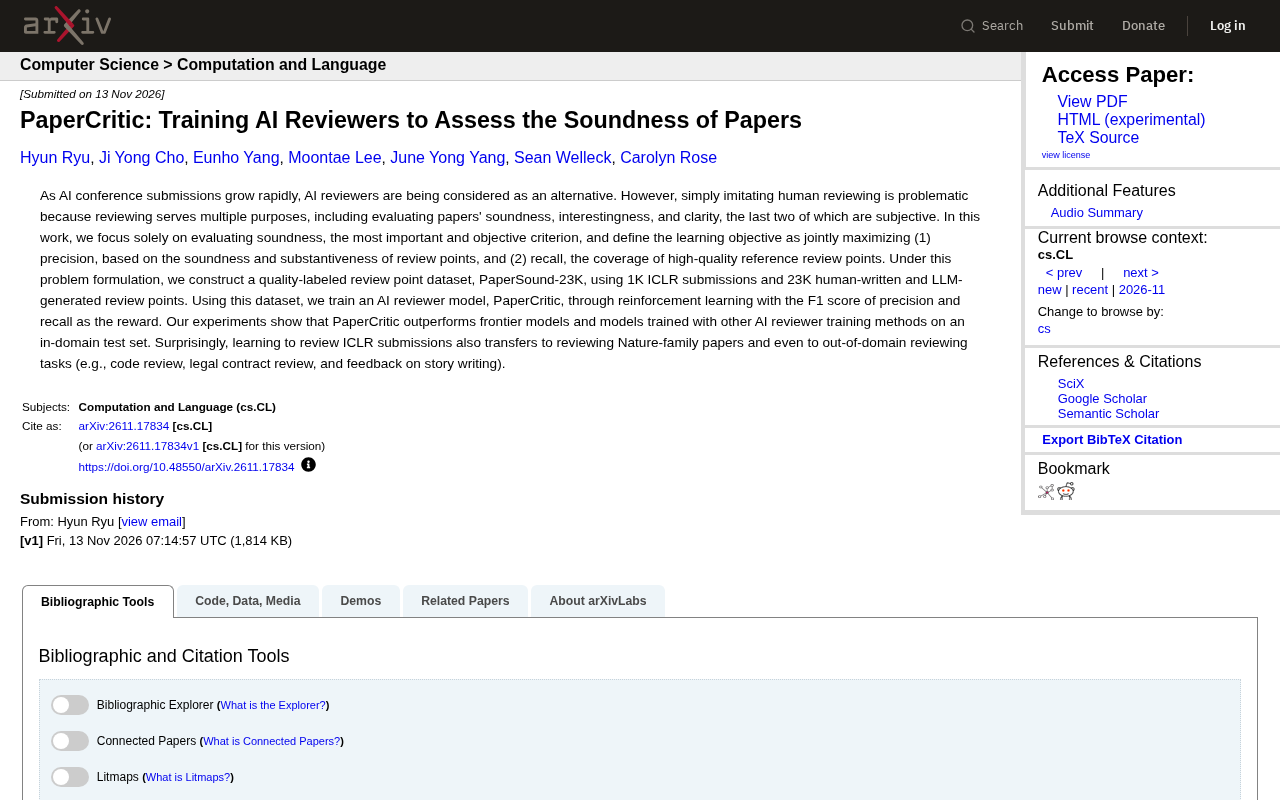
A new paper focuses only on the most objective review dimension—soundness—and trains PaperCritic with reinforcement learning optimizing F1, achieving cross-domain transfer.
This article introduces a new study on AI reviewers. The authors argue that simply imitating human reviewers introduces subjective noise, so they limit the learning objective to the most objective dimension of reviewing—soundness—and decompose review quality into precision (whether comments are valid and substantive) and recall (coverage of high-quality reference points), using their F1 score as the reinforcement learning reward. The authors construct the PaperSound-23K dataset, annotating 23K review points from 1K ICLR submissions. The trained PaperCritic outperforms frontier models on in-domain test sets and transfers to Nature-family papers and out-of-domain tasks such as code review, legal contract review, and story-writing feedback. The article also analyzes the boundaries of this trade-off: the model does not assess interestingness or clarity, and reference-based reward design requires caution in high-risk scenarios.
AI reviewer research is shifting from "imitating humans" to "decomposing objectives." A recent paper proposes that rather than having models broadly learn human review comments, it is better to focus solely on the most objective and central dimension of reviewing—paper soundness—and use reinforcement learning to directly optimize the F1 score of precision and recall. The resulting PaperCritic model not only surpasses frontier models on in-domain test sets but also transfers its reviewing ability to Nature-family papers and even cross-domain tasks such as code review, legal contract review, and story-writing feedback.
Why "Imitating Human Reviewers" Is Problematic
As AI conference submissions grow rapidly, AI reviewers are seen as an alternative to relieve reviewing pressure. But the authors point out a structural flaw in simply imitating human reviewers: reviewing itself serves multiple purposes, including assessing a paper's reliability, interestingness, and clarity, with the latter two being inherently subjective. Having a model fit review comments laden with subjective preferences amounts to mixing irreducible subjectivity into the training objective; what the model learns may merely be "talking like a certain reviewer" rather than genuinely judging whether a paper holds up.
Therefore, this work makes a clear trade-off: evaluate only soundness. The rationale is that it is both the most important criterion in reviewing and the most objective and verifiable one. This trade-off transforms an open-ended text generation problem into a learning problem with measurable objectives and computable rewards.
Decomposing Reviewing into Precision and Recall
In formalizing the problem, the authors define the learning objective as simultaneously maximizing two metrics:
- Precision: based on the soundness and substantiveness of the review points themselves—i.e., whether each comment the model raises is valid and has substantive content;
- Recall: the degree of coverage of high-quality reference review points—i.e., whether the model misses the genuinely important comments in human reviews.
These two metrics correspond to two common failure modes of review quality: nonsense (low precision) and missing key issues (low recall). Using the F1 score of the two as the reinforcement learning reward signal directly pushes the model toward "saying the right things and saying them all" rather than "sounding like a human."
Precision and recall are two foundational metrics in information retrieval and classification tasks. Precision measures "how many of the results the model produces are correct," while recall measures "how many of all the results that should be found are actually found by the model." The two typically trade off: improving precision often comes at the cost of recall, and vice versa. The F1 score is their harmonic mean, used to comprehensively measure model performance. In this paper's context, precision corresponds to the proportion of the model's review comments that are genuinely valid and substantive, and recall corresponds to the proportion of important comments in human reference reviews that the model covers. Using F1 as the reinforcement learning reward signal means the model must balance "not saying wrong things" and "not missing key issues" rather than pursuing only one end.
PaperSound-23K: Quality Labels for Review Points
Supporting this training objective is the dataset PaperSound-23K constructed by the authors. Based on 1K ICLR submissions, it contains 23K review points sourced from both human-written reviews and LLM-generated review points, with quality annotations applied to these points.
The construction philosophy of this dataset is noteworthy: the unit of annotation is the "review point" rather than the entire review. A full review often mixes reliable judgments, subjective preferences, and formatting comments, making it very noisy as a direct training signal; only after decomposition into point level is it possible to make relatively clean judgments about the soundness and substantiveness of each comment, and thereby compute precision and recall. This also explains why the model learns transferable reviewing ability—it learns "how to judge whether a comment holds" rather than "how to imitate a reviewing style."
In NLP, decomposing long texts into finer-grained "points" (claims or aspects) before annotation is a common strategy for reducing noise and improving annotation consistency. A full review often mixes factual judgments, subjective preferences, formatting suggestions, and other components; if the entire review is used directly as the training target, the model easily learns surface features unrelated to paper quality. Point-level annotation requires annotators to judge whether each independent comment holds and has substantive content, making the training signal cleaner and facilitating precision and recall computation. Similar ideas have been applied in fact-checking and argument mining tasks; this paper transfers them to the scenario of review quality assessment.
Experimental Results and Cross-Domain Transfer
Using the above dataset with the F1 score of precision and recall as the reward, the authors train the AI reviewer model PaperCritic via reinforcement learning. Experiments show that on in-domain test sets, PaperCritic outperforms frontier models as well as models obtained by other AI reviewer training methods.
More noteworthy is the transfer performance. The authors claim that the ability learned from reviewing ICLR submissions surprisingly transfers to reviewing Nature-family papers and even to out-of-domain reviewing-type tasks such as code review, legal contract review, and story-writing feedback. This result suggests that what the paper trains may not be some conference-specific reviewing routine but a more general ability to "verify the reliability of arguments"—judging whether a line of reasoning has support and whether key issues are omitted, which applies equally to code, contracts, and narrative texts.
Reinforcement Learning (RL) is a method that optimizes model behavior through reward signals. Unlike supervised learning, which directly fits annotated answers, RL lets the model generate outputs, evaluates output quality according to some computable reward function, and updates model parameters accordingly. This paper uses the F1 score as the reward, a typical "reference-based reward design": after the model generates review points, they are compared with high-quality reference points, precision and recall are computed, and F1 is synthesized as the reward. The advantage of this design is that the reward can be computed automatically without manual per-item scoring; the limitation is that reward quality depends heavily on the coverage and accuracy of the reference points. The success of cross-domain transfer indicates that what the model learns may not merely be specific patterns of ICLR reviewing but a more general ability to "judge whether an argument is reliable."
A Brief Analysis: The Boundaries Imposed by the Trade-off
The methodological value of this work lies in stripping away subjective dimensions in exchange for an optimizable objective function. But this also means PaperCritic does not aim to answer questions like "is this paper interesting or clear." For the conference review process, soundness judgment can play the role of initial screening and quality gatekeeping, but assessment of interestingness and clarity of expression still requires human reviewers. Positioning AI reviewers as "reliability checkers" rather than "all-purpose reviewers" may be a more realistic path to deployment at the current stage.
Another direction worth observing is the robustness of the reward design. With F1 as the reward and annotated points as references, the model's behavior will closely track the distribution of reference points; when the reference reviews themselves have omissions or biases, the baseline for recall computation shifts accordingly. The success of cross-domain transfer shows that the model has learned some general judgment ability, but in high-risk scenarios (such as legal contract review), this reference-based evaluation approach still requires caution.
Domain transfer refers to applying a model's ability to a different domain after training in one domain. In this paper, PaperCritic is trained on ICLR paper review data yet shows transfer effects on Nature-family papers, code review, legal contract review, and story-writing feedback. Such transfer is possible because the core ability the model learns—judging whether a line of reasoning has support and whether key issues are omitted—is shared across different text types. However, transfer effects do not equate to professional-grade reliability. In high-risk scenarios such as legal contract review, the cost of incorrect judgments is far higher than in academic reviewing, and obtaining reference points is itself more difficult. Therefore, the success of cross-domain transfer indicates more that the method has general potential rather than that the model is mature enough for direct deployment in high-risk scenarios.
One-line Summary
A new paper proposes focusing solely on the most objective dimension of reviewing—soundness—and uses reinforcement learning to optimize F1 to train PaperCritic, achieving cross-domain transfer.
Paragraph Summary
This article introduces a new study on AI reviewers. The authors point out that simply imitating human reviewers introduces subjective noise, so they limit the learning objective to the most objective dimension of reviewing—soundness—and decompose review quality into precision (whether comments are valid and substantive) and recall (coverage of high-quality reference points), using their F1 score as the reinforcement learning reward. The authors construct the PaperSound-23K dataset, annotating the quality of 23K review points based on 1K ICLR submissions. The trained PaperCritic outperforms frontier models on in-domain test sets and transfers its reviewing ability to Nature-family papers and out-of-domain tasks such as code review, legal contract review, and story-writing feedback. The article also analyzes the boundaries imposed by this trade-off: the model does not assess interestingness or clarity, and the reference-based reward design requires caution in high-risk scenarios.
Related articles

Codex in Practice: From Installation and Configuration to Multi-Agent Collaboration
Based on a Bilibili Codex course overview, this guide maps the full path of AI coding assistants from installation and agents.md context design to CLI commands, MCP integration, and multi-agent collaboration.

Claude Code Installation and Model Switching Guide for Users in China
How can developers in China install Claude Code reliably? This article compiles a Bilibili creator's hands-on solution: install via NPM, skip official login, use CC Switch to configure API Keys and freely switch between DeepSeek, Kimi, and other models to avoid account bans.

AI Supply Chain Security: What Canary Tokens Reveal
Starting from a Hacker News discussion, this article analyzes the role of canary tokens in AI supply chain security: how they detect abnormal access to model weights, training data, and credentials, as well as coverage blind spots and cost constraints during implementation.