PaperPilot: A Pure Rust, Zero-Cloud PDF Engine with WASM + MCP
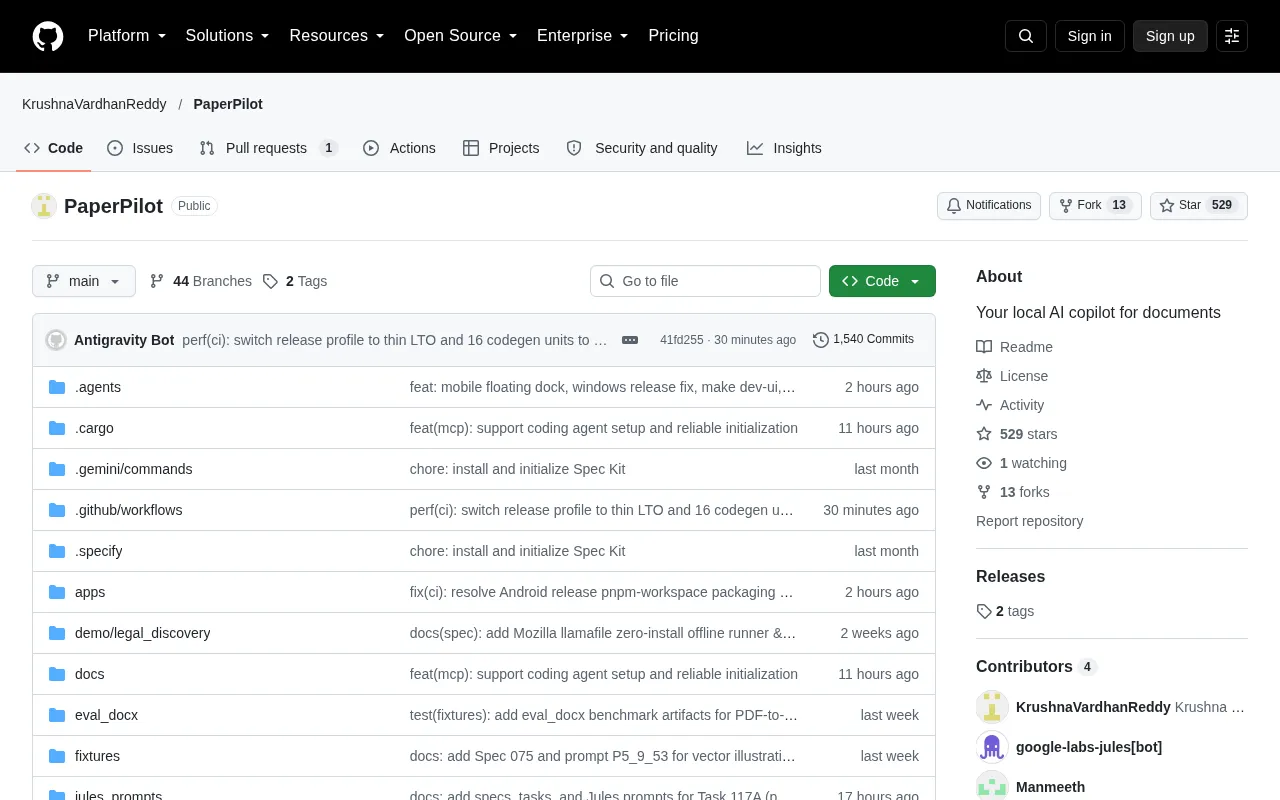
PaperPilot builds a local WASM PDF engine in pure Rust and exposes capabilities to AI via MCP.
PaperPilot is a pure Rust PDF engine that runs entirely locally in the browser via WebAssembly, keeping files on the device and directly addressing privacy and compliance needs. It builds its own parsing and rendering core for control over text extraction, page structure, and security, at the cost of PDF spec coverage and ecosystem maturity. It also exposes PDF capabilities to AI tools via MCP so local documents can connect to AI apps without cloud uploads. The article analyzes trade-offs in performance, compatibility, and ecosystem, noting the architecture's value for local-first document products.
Handling PDFs in the browser has always been awkward: either you upload the file to someone else's server, or you put up with janky JavaScript libraries. The PaperPilot project tries to offer a third answer — a pure Rust PDF engine that runs entirely locally, executed in the browser via WASM and exposing its capabilities to AI tools through the MCP protocol. The attention it's received on Hacker News suggests this direction strikes a chord with a lot of people.
Why "zero-cloud" is a real need
PDFs are a category of document with extremely high privacy density: contracts, invoices, medical records, identity documents — nearly all of them circulate in this format. Traditional online PDF tools work by uploading the file, parsing it on a server, and sending the result back. For individual users this is a matter of trust; for enterprise users it's often a compliance red line — many industries have internal rules that explicitly prohibit sending customer documents to third-party services.
PaperPilot's approach is to move the entire pipeline back to the local device: writing the parsing and rendering core in Rust, compiling it to WebAssembly so it executes inside the browser sandbox, and keeping files on the device. The appeal of this combination is that Rust's memory safety and performance happen to be exactly the two qualities that parsing binary formats like PDF needs most — historically, a large share of PDF-related vulnerabilities have come from parsers hitting out-of-bounds memory access when handling malformed files.
Judging purely by the architectural choice, this is a "do the right thing, and do it right" solution, not yet another product that wraps a Python script in a web shell.
What a pure Rust PDF engine means
Most web-based PDF approaches take one of two paths: render directly with PDF.js, or use the browser's built-in preview capability. The former is feature-complete but has a huge codebase that's hard to customize; the latter makes structured extraction nearly impossible. PaperPilot chose to build its own Rust engine, and the control this buys shows up on several levels.
First, parsing can be more granular. For text extraction, page structure, metadata, and bookmarks, a self-built engine can expose interfaces on demand rather than accommodating a third-party library's abstractions. Second, the rendering path can be optimized for the WASM environment, avoiding unnecessary baggage carried for desktop compatibility. Third, security can be designed along Rust's ownership model, treating "handling untrusted input" as a first-class concern.
The cost, of course, also exists: a self-built engine means chewing through the historical legacy traps in the PDF spec yourself — from font embedding to encryption dictionaries, each one can become a source of long-tail bugs.
WASM makes local execution the default
WebAssembly isn't a gimmick in this scheme; it's a necessary component. Compiling Rust to WASM gets you three things at once: near-native execution speed, sandbox isolation provided by the browser, and a "zero-install" distribution experience. Users can just open a web page and use it, but the computation happens entirely on their own machine.
This deployment shape is particularly well suited to privacy-sensitive scenarios. Users don't need to judge whether "this website is trustworthy," because the data never leaves the browser at all. For developers, the same Rust core can also be compiled into a native library for command-line or other host use — WASM is just one target. This "one core, many runtimes" structure is far healthier than maintaining two separate implementations.
WebAssembly (WASM) is a portable binary instruction format standardized by the W3C, designed to let code compiled from system-level languages such as C/C++/Rust run securely in the browser at near-native speed. It runs inside the browser's sandbox environment and cannot directly access the file system or network unless the host explicitly grants permission. Compared with JavaScript, WASM loading and execution are more predictable, making it suitable for compute-intensive tasks. Compiling Rust to WASM requires tools like wasm-bindgen to generate JS glue code and handle memory and type conversion; meanwhile, WASM's linear memory model means data passing between it and JS requires explicit copying, which is a factor to consider during performance tuning.
MCP integration: handing PDF capabilities to AI tools
The MCP in the project name is another point worth expanding on. Model Context Protocol is a protocol layer that lets AI applications call external tool capabilities. PaperPilot exposes PDF parsing capabilities through it, meaning an AI assistant can read and understand documents locally without first uploading files to the model provider's storage.
The significance of this combination is that it fills the missing link between "local documents + cloud intelligence." In the past, to get AI to process a PDF, the usual approach was to upload the file, extract text on the server side, and then feed the text to the model. But if parsing happens locally and only the necessary text fragments are passed to the model through the protocol, the privacy boundary becomes much clearer.
It should be noted that the specific implementation details of this capability are not fully elaborated in the original project information, and readers will need to verify actual usability in the repository themselves.
Model Context Protocol (MCP) is a protocol proposed and open-sourced by Anthropic to standardize how AI applications connect to external tools and data sources. It uses a client-server architecture: the AI application acts as the client and communicates with an MCP server via JSON-RPC messages, while the server exposes three types of capabilities — resources, tools, and prompts. The core value of MCP lies in decoupling: a tool provider only needs to implement the protocol once to be callable by multiple compatible AI clients, without having to adapt separately for each model platform. When running an MCP server locally, data can be processed on-device and only the necessary results returned to the AI application through the protocol, which provides a feasible boundary-control scheme for privacy-sensitive scenarios.
Trade-offs and risks worth noting
PaperPilot's direction is clear, but before putting it into a real workflow, there are a few questions worth thinking through.
Spec coverage is a common weakness of implementation-type projects. The PDF spec is enormous and full of historical baggage, and how a young engine performs on complex documents needs to be tested with real samples — you can't judge it from architecture design alone.
Performance expectations should also be realistic. WASM is faster than pure JavaScript, but there's still a gap compared with native execution, and whether rendering time is acceptable when handling large or highly complex pages needs to be measured in the browser.
Ecosystem maturity is another variable. Self-built engines often lack the plug-ins, examples, and community Q&A that have accumulated around PDF.js over the years, so there will be far less material to consult when problems arise.
The PDF specification (ISO 32000), since its birth in 1993, has gone through multiple revisions and accumulated a large number of vendor extensions and legacy features — for example, incremental updates, object streams, cross-reference streams, multiple font embedding formats (Type1, TrueType, CID), encryption and permission dictionaries, and optional JavaScript actions. For an engine to cover real-world documents, it often needs to handle non-standard implementations beyond the spec. The industry commonly uses the PDF Association's veraPDF test suite or the Corpo corpus to evaluate coverage, but even then, long-tail documents can still trigger parsing failures or rendering differences. Therefore, when evaluating a young PDF engine, spec coverage reflects practical usability more than architecture design does.
Who should try it
If you're building a product that needs local document processing — especially in scenarios involving contracts, receipts, or internal materials — this project offers an architecture template worth studying: Rust core + WASM distribution + MCP integration with AI. Even if you don't adopt it directly, the layered idea it demonstrates — "computation stays local, intelligence is called on demand" — is also a useful reference for designing similar products.
For ordinary users who just want an online tool to merge PDFs, this project may not currently be the least troublesome choice; but for developers and teams who care about data flows, it represents a more controllable direction.
FAQ
Does PaperPilot upload PDFs to a server? According to the project description, parsing is done in the browser via WASM, and files do not leave the device. This is its core selling point distinguishing it from most online PDF tools.
What role does MCP play in this? It exposes PDF processing capabilities to AI tools in protocol form, allowing local documents to be called by AI applications without first uploading them to the cloud.
How does it compare with PDF.js? PDF.js has a mature ecosystem and broad coverage; PaperPilot's strengths lie in its lightweight architecture and local execution philosophy, but its maturity and spec coverage need to be verified through actual use.
One-line Summary
PaperPilot builds a local WASM PDF engine in pure Rust and exposes capabilities to AI via MCP.
Paragraph Summary
PaperPilot is a pure Rust PDF engine that runs entirely locally in the browser, executed via WebAssembly, with files never leaving the device — directly addressing privacy and compliance needs. It builds its own parsing and rendering core in exchange for control over text extraction, page structure, and security design, but must bear the cost of PDF spec coverage and ecosystem maturity. The project also exposes PDF capabilities to AI tools through the MCP protocol, allowing local documents to connect with AI applications without uploading to the cloud. The article analyzes its trade-offs in performance, spec compatibility, and ecosystem, and notes that the architecture offers a reference for local-first document products.
Related articles

How Do Cursor, Claude, and ChatGPT Actually Work? A Full Breakdown of the AI Tech Stack
Starting from real-world use of Cursor, Claude, and ChatGPT, this article breaks down the AI tech stack layer by layer: agent loops and the MCP protocol, pretraining and reinforcement learning, tokens and quantization, RAG retrieval and model routing, streaming output, and GPU infrastructure—helping you understand what each layer of an AI product does.

Gemini 4 First Test: Strong Value for Money, but Generation Quality Still Trails Competitors
Gemini 4 first test: ranks eighth on Agent Arena, enters the Pareto frontier at about two-thirds the price of 6 Sol, but 3D generation quality and stability trail Sonnet 5.5 and GPT 6.1 Sol, with weak game controllability.

Google Gemini 4 Carbon Tops the Benchmarks, API Pricing Targets Kimi
Google releases Gemini 4 Carbon, topping many of 17 benchmarks across general, coding, multimodal, long context, and cybersecurity, with API output pricing below Kimi K3.1 Pro and priority access for cybersecurity personnel.