Parameter Resonance in Primal-Dual Learning: A New Solution for Non-Stationary Constrained MDPs

Parameter resonance mechanism of primal-dual learning in non-stationary CMDPs and SAC validation.
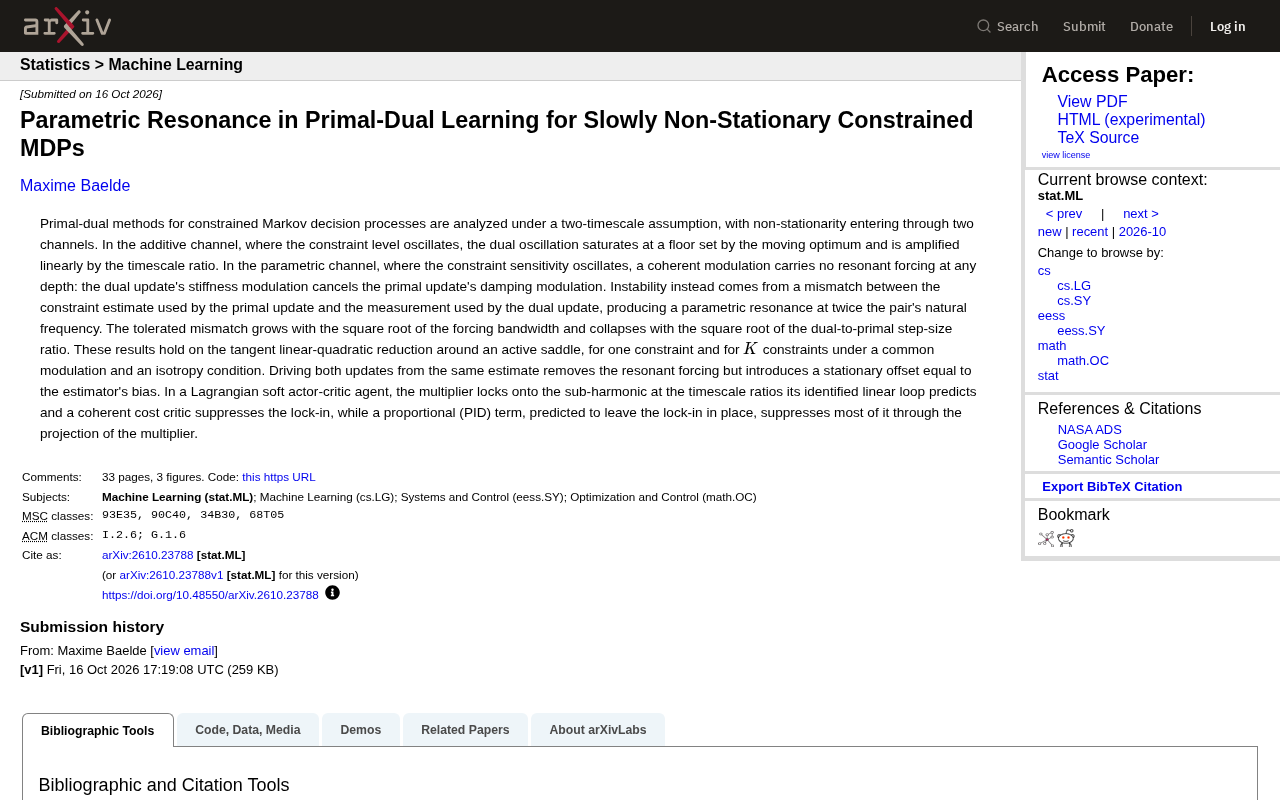
This article studies the dynamics of primal-dual methods in non-stationary constrained Markov decision processes. It distinguishes the additive channel (constraint level oscillation), which causes dual variable fluctuations scaling linearly with the step-size ratio, from the parametric channel (constraint sensitivity oscillation), which exhibits no resonance due to canceling modulations. The instability stems from estimation mismatch between primal and dual updates, triggering parameter resonance at twice the paired natural frequency. Theory shows tolerable mismatch grows with the square root of forcing bandwidth and decays with the square root of the step-size ratio. Experiments on Lagrangian SAC validate multiplier locking onto the predicted subharmonic, suppression via consistent cost critic, and PID terms effectively suppressing most locking through multiplier projection, exceeding linear predictions. The work offers theoretical guidance for safe RL algorithm design in non-stationary settings.
Title
Parameter Resonance in Primal-Dual Learning: A New Solution for Non-Stationary Constrained MDPs
Meta Description
This article analyzes the parameter resonance mechanism of primal-dual learning in constrained MDPs under non-stationary environments, covering additive and parametric channels, resonance induced by estimation mismatch, SAC experimental validation, and implications for safe reinforcement learning.
Article Content
Primal-dual methods for constrained Markov decision processes (CMDPs) typically rely on the two-timescale assumption, but when the environment is slowly non-stationary, oscillations in the constraint level or sensitivity can break convergence. A recent theoretical study provides an in-depth analysis of the dynamics under two non-stationary channels, reveals a parameter resonance mechanism, and validates the theoretical predictions in a soft actor-critic (SAC) agent.
Dual-Channel Non-Stationarity and Dual Oscillations
The paper categorizes non-stationarity into an additive channel and a parametric channel. In the additive channel, the constraint level itself oscillates, causing the dual variable to fluctuate around a moving optimal solution, with the fluctuation amplitude scaling linearly with the timescale ratio. This means that the larger the step-size ratio between primal and dual updates, the more severe the dual oscillations, though there exists a lower bound set by the moving optimal solution.
The parametric channel is different: when the constraint sensitivity oscillates, the stiffness modulation of the dual update and the damping modulation of the primal update cancel each other out, producing no resonant excitation. This coherent modulation yields no resonant forcing at any depth, so the system exhibits stronger robustness under this channel.
Constrained Markov Decision Processes (CMDPs) and Primal-Dual Methods: A CMDP introduces constraints (such as an expected cumulative cost not exceeding a threshold) on top of a standard MDP, and its optimization objective is to maximize reward subject to the constraints. Primal-dual methods transform the constrained problem into an unconstrained minimax problem via Lagrange multipliers: the primal variable (policy parameters) minimizes the Lagrangian, while the dual variable (multiplier) maximizes it. Typical implementations use two-timescale updates—a smaller step size for the primal variable and a larger step size for the dual variable—to ensure that the multiplier can quickly track the constraint while the policy changes slowly. This timescale separation is a standard assumption in convergence analysis, but in non-stationary environments where the constraint level or sensitivity changes over time, the two-timescale assumption may fail, causing the dual variable to oscillate persistently or even diverge.
The Root of Parameter Resonance: Estimation Mismatch
The instability does not arise from the constraint sensitivity oscillation itself, but from the mismatch between the constraint estimate used in the primal update and the measurement used in the dual update. This mismatch triggers parameter resonance at twice the paired natural frequency. Theory shows that the tolerable mismatch grows with the square root of the forcing bandwidth and decays with the square root of the dual-to-primal step-size ratio.
The result holds within a tangent-linear quadratic reduction framework near an active saddle point and extends to multiple constraints (under common modulation and isotropy conditions). If both updates are forced to use the same estimate, the resonant excitation disappears, but a steady-state offset equal to the estimator bias is introduced—revealing the trade-off associated with estimation consistency.
Parameter Resonance: In dynamical systems, parameter resonance refers to the phenomenon where a system parameter (such as stiffness or damping) varies periodically at twice the system's natural frequency, causing the system amplitude to grow exponentially even without external forcing. The classic example is a swing: when a person squats and stands at a rhythm twice the swing's natural frequency (changing the center of gravity, i.e., the parameter), the swing goes higher and higher. In primal-dual learning, if errors in the constraint estimate cause the effective stiffness or damping to oscillate at twice the saddle point's natural frequency, a similar resonance is excited, causing the dual variable to deviate from the optimal solution. Linear time-invariant analysis cannot capture this mechanism because parameter resonance is essentially a nonlinear instability phenomenon induced by time-varying parameters, requiring Floquet theory or averaging methods for analysis.
Experimental Validation in the SAC Agent
The study validates the theoretical predictions in a Lagrangian soft actor-critic (SAC) agent. The multiplier locks onto the subharmonic predicted by the timescale ratio, and a consistent cost critic can suppress this locking. Interestingly, although the proportional (PID) term is theoretically predicted to be unable to eliminate the locking, it actually suppresses most of the locking effect through multiplier projection. This finding suggests that practical algorithmic improvements may be more effective than linear analysis predicts.
Lagrangian Soft Actor-Critic (SAC): SAC is an off-policy algorithm based on maximum-entropy reinforcement learning that encourages exploration by simultaneously maximizing reward and policy entropy. In constrained settings, Lagrangian SAC introduces a learnable multiplier (Lagrange multiplier) that weights the constraint cost term and adds it to the reward: the objective becomes maximizing reward − λ·cost. The multiplier λ is updated via dual gradient ascent to maintain the constraint. In practice, the update frequency and step size of λ must be carefully tuned; if updated too quickly, oscillations readily occur under non-stationary cost signals. The theoretical predictions of this paper are validated precisely within this framework: the multiplier locks onto the subharmonic frequency, and a consistent cost critic (i.e., the primal and dual updates use the same cost estimate) can suppress the locking.
Implications for Constrained Reinforcement Learning
This work provides theoretical guidance for designing safe reinforcement learning algorithms in non-stationary environments. The choice of the two-timescale ratio requires balancing the amplitude of dual oscillations against convergence speed; ensuring that primal and dual updates use consistent constraint estimates can avoid resonance but requires handling estimation bias; the practical effect of the PID term exceeds linear predictions and merits further exploration. Future work can extend the analysis to more complex non-stationary patterns and deep network function approximation.
In summary, this research deepens the understanding of parameter resonance in the dynamics of primal-dual learning and provides a new perspective for stable learning of constrained MDPs in non-stationary scenarios.
One-line Summary
Parameter resonance mechanism of primal-dual learning in non-stationary CMDPs and SAC validation.
Paragraph Summary
This article studies the dynamical behavior of primal-dual methods in non-stationary constrained Markov decision processes. It distinguishes the additive channel (constraint level oscillation) from the parametric channel (constraint sensitivity oscillation): the former causes the dual variable to fluctuate around a moving optimal solution with amplitude scaling linearly with the step-size ratio; the latter exhibits no resonance because damping and stiffness modulations cancel each other. The root of instability lies in the mismatch between the constraint estimates used by primal and dual updates, which triggers parameter resonance at twice the paired natural frequency. Theory shows that the tolerable mismatch grows with the square root of the forcing bandwidth and decays with the square root of the step-size ratio. Experiments on a Lagrangian SAC agent validate that the multiplier locks onto the predicted subharmonic, that a consistent cost critic can suppress the locking, and that the PID term actually suppresses most of the locking effect through multiplier projection, exceeding linear analysis predictions. The research provides theoretical guidance for designing safe reinforcement learning algorithms in non-stationary environments.
Related articles

Free Unlimited Claude Code Solution: Agnes AI + CC Switch Setup Guide
No paid subscription needed — pair the free AI platform Agnes AI with the open-source tool CC Switch to provide a backend for Claude Code, enabling unlimited free calls to text, image, and video models. This guide covers the full setup, test results, and usage boundaries.

A Complete Zero-Cost Guide to Getting Started with Claude Code for Beginners in China
A beginner's guide to Claude Code for users in China: two installation methods (command line and IDE plugin), full configuration steps for replacing the official API with the free domestic LongCat model, and a hands-on demo of building a small tool with natural language, plus tips.

When the NSA Gets Involved: The AI Supply Chain Crisis Behind Open-Source CVEs and API Key Hijacking
Multiple open-source projects disclosed severe CVEs in one day, PHP flaws alarmed the FBI, and Railway and OpenCode were breached with API keys stolen. This article breaks down the vulnerability window, AI-accelerated exploitation, and the AI supply chain crisis behind the API key black market, with a developer defense checklist.