Path-Level Alignment: A New Approach to Hierarchical Multi-Label Text Classification

A new study uses root-to-node paths as shared units to unify structural and semantic supervision, improving hierarchical multi-label classification.
To address the disconnect between structural and semantic supervision in HMTC, this study uses the complete root-to-node label path as a shared unit to unify both signals. It introduces two auxiliary objectives: PathSimNCE provides hierarchy-aware contrastive structural supervision by aligning document representations with paths, while an LLM-generated document-conditioned semantic objective supplies dynamic fine-grained semantics. A standard classifier is kept for inference. Experiments on three benchmarks show consistent gains, with structural alignment helping more in deep hierarchies and semantic alignment benefiting fine-grained labels. PathSimNCE's graded supervision also mitigates over-constraint. The method adds training overhead but offers a simple, general supervision idea for hierarchical tasks.
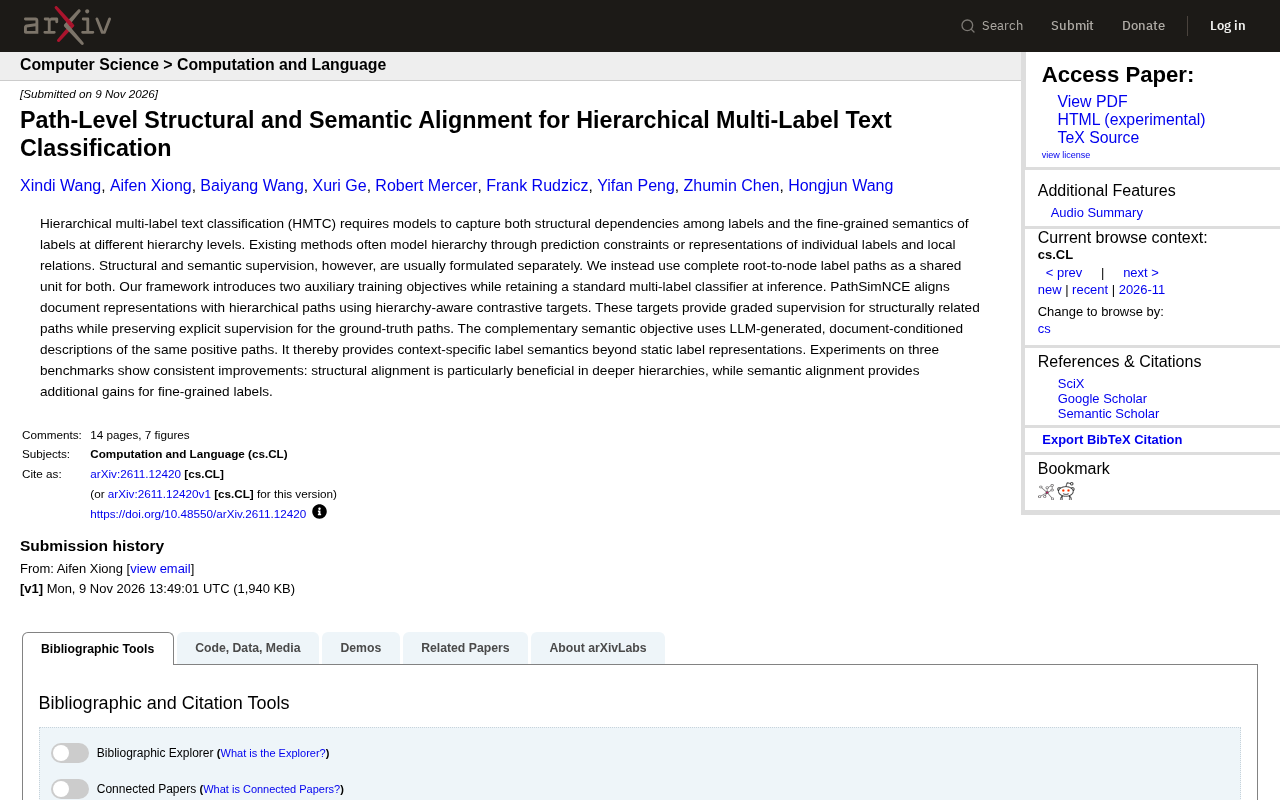
Hierarchical multi-label text classification (HMTC) requires models to simultaneously capture structural dependencies among labels and the fine-grained semantics of labels at different levels. Existing methods typically model hierarchical relationships through prediction constraints or independent label representations, but structural supervision and semantic supervision are often designed separately. A recent study proposes using the complete root-to-node label path as a shared unit to unify structural and semantic supervision, achieving consistent improvements across multiple benchmarks.
Limitations of Existing Methods: The Disconnect Between Structure and Semantics
Traditional HMTC methods fall roughly into two categories: one ensures structural consistency through hierarchical constraints (e.g., parent label probability not lower than child label), while the other focuses on learning semantic representations of labels using label text embeddings or attention mechanisms. Both approaches have their merits, but the problem is that structural supervision and semantic supervision are typically handled separately—structural constraints only care about hierarchical relationships between labels, while semantic representations often ignore path information.
This disconnect makes it difficult for models to leverage both signals simultaneously: structural constraints may be too rigid to accommodate fine-grained semantic differences, while semantic representations lack explicit modeling of hierarchical paths. The researchers point out that a unified unit is needed to bridge the two, and the complete root-to-node path provides exactly such a perspective.
Paths as Shared Units: PathSimNCE and Semantic Objectives
The framework's core innovation is introducing two auxiliary training objectives while retaining a standard multi-label classifier for inference. The first objective, called PathSimNCE, uses a hierarchy-aware contrastive objective to align document representations with hierarchical paths. Specifically, PathSimNCE provides graded supervision for structurally related paths while preserving explicit supervision for the ground-truth path. This means the model not only learns to distinguish positive from negative samples but also perceives hierarchical similarity between paths—for example, sibling paths are more similar than distant-cousin paths.
The second objective is a complementary semantic objective that uses LLM-generated, document-conditioned path descriptions. Unlike static label representations, these descriptions provide context-specific label semantics. For example, for the same label path, the LLM can generate descriptions with different emphases across different documents, helping the model capture fine-grained semantics. Together, the two objectives provide the model with both structural and semantic path-level supervision during training.
Contrastive Learning and InfoNCE Loss: The "NCE" in PathSimNCE refers to Noise Contrastive Estimation, which in contrastive learning is commonly realized as the InfoNCE loss. The core idea is to contrast one positive pair (e.g., document representation with its ground-truth path representation) against multiple negative pairs (document with other paths), learning representations by maximizing the similarity of positive pairs and minimizing that of negative pairs. PathSimNCE builds on this by introducing hierarchy-aware graded supervision: based on the structural distance between paths in the hierarchy tree, it assigns different "negative sample difficulty" or similarity targets to negatives rather than treating all negatives equally. For example, sibling paths are treated as "hard" negatives (should have some similarity to the document), while distant-cousin paths are treated as "easy" negatives (should have lower similarity). This graded mechanism enables the model to capture fine-grained structural relationships between paths, rather than merely binary positive-negative discrimination.
LLM-generated Document-Conditioned Path Descriptions: Traditional label semantic representations typically come from static label text embeddings (e.g., word vectors of label names), with the same label sharing identical representations across documents. This framework instead leverages large language models (LLMs) to generate context-specific descriptions for each document-path pair. Specifically, given document content and a root-to-node label path, the LLM is prompted to generate a natural language description explaining why that path applies to the document and highlighting the semantic details in the document relevant to that path. Since the LLM is conditioned on the document, the same path yields descriptions with different emphases across different documents, providing the model with dynamic, fine-grained semantic supervision signals. These descriptions need to be prepared offline in advance as auxiliary objectives during training; the inference stage requires no LLM involvement.
Experimental Validation: Gains on Deep Hierarchies and Fine-Grained Labels
Experiments on three benchmark datasets show that the framework delivers consistent performance improvements. Ablation analysis further reveals the distinct contributions of the two alignments: structural alignment is particularly beneficial in deeper hierarchies, where there are more paths and more complex structural relationships; semantic alignment provides additional gains for fine-grained labels, which often require richer contextual information to distinguish.
This finding aligns with intuition: structural signals are stronger in deep hierarchies, while discrimination of fine-grained labels relies more on semantic details. The researchers also note that PathSimNCE's graded supervision mechanism can alleviate the "over-constraint" problem common in hierarchical classification—traditional methods force parent label probabilities above child labels, which may harm the flexibility of fine-grained predictions.
The "Over-Constraint" Problem in Hierarchical Multi-Label Classification: In HMTC, hierarchical constraints typically require that the predicted probability of a parent label not be lower than that of its child labels (since child labels imply the parent), ensuring structural consistency of predictions. However, such hard constraints can harm the flexibility of fine-grained predictions: when the model is very confident about a fine-grained child label but has low confidence in the parent label due to competition from other child labels, forcing up the parent probability distorts the model's probability distribution, causing fine-grained labels to drop in ranking. PathSimNCE provides soft structural supervision through contrastive learning—it encourages document representations to be similar to the ground-truth path and to maintain graded similarity with structurally related paths, without directly intervening in the classifier's output probabilities. This soft supervision preserves structural awareness while avoiding the suppression of fine-grained predictions by hard constraints, thereby alleviating the over-constraint problem.
Implications and Outlook
The value of this work lies in offering a simple yet general idea: using paths to unify structural and semantic supervision. A path is both a structural unit (the hierarchical relationship from root to node) and a semantic unit (the combined meaning of labels along the way). Through contrastive learning and LLM-generated descriptions, the model obtains richer training signals without changing the inference architecture.
Of course, the method also introduces additional computational overhead—LLM-generated descriptions need to be prepared offline, and contrastive learning adds training complexity. Future directions may include exploring more efficient path sampling strategies or extending path-level alignment to other hierarchical tasks, such as hierarchical entity classification or product category prediction. For practitioners facing classification problems with deep hierarchies or fine-grained labels, it may be worth trying paths as anchors for supervision.
One-line Summary
A new study uses root-to-node paths as shared units to unify structural and semantic supervision, improving hierarchical multi-label classification performance.
Paragraph Summary
To address the disconnect between structural and semantic supervision in hierarchical multi-label text classification, this study proposes using the complete root-to-node label path as a shared unit to unify both supervision signals. The method introduces two auxiliary training objectives: PathSimNCE uses hierarchy-aware contrastive learning to align document representations with paths, providing graded structural supervision; the semantic objective uses LLM-generated document-conditioned path descriptions to provide dynamic fine-grained semantics. A standard multi-label classifier is retained for inference without changing the inference architecture. Experiments on three benchmark datasets show consistent performance improvements, and ablation analysis indicates that structural alignment yields greater gains in deep hierarchies while semantic alignment is more helpful for fine-grained labels. PathSimNCE's graded supervision can also alleviate the over-constraint problem of traditional hierarchical constraints. The method increases training overhead but offers a simple and general supervision idea for hierarchical tasks.
Related articles

Zed Editor Releases v1.29.2: Observations on a Routine Version Iteration
Zed editor releases patch v1.29.2, version bump by @JosephTLyons, commit verified via GitHub signature. This article covers the release's basic info, what a patch version means, and practical upgrade advice for users.

Anthropic IPO Questioned: Hacker News Debates Timing of Going Public
A Hacker News post titled "Just say no to Anthropic's IPO" sparks debate on the timing of Anthropic's public listing and AI capitalization, touching on valuation bubbles and mission independence.

Hands-On with the Genie 4 World Model: Directing Worlds in Real Time Like a Puppeteer
Google DeepMind's Genie 4 world model in depth: Special Guest X's hands-on demo of real-time scene direction via prompts, custom interactive apps in Project Genie, and prompts-as-seeds reproducibility.