Peas and Pans: A White-Label Meal Planning Tool for Nutrition Coaches

Peas and Pans connects recipe import, USDA nutrition matching, drag-and-drop scheduling, and white-label delivery for nutrition coaches.
Peas and Pans is an early-stage SaaS tool on Product Hunt designed for nutrition coaches, aiming to streamline the full workflow from recipe organization to branded client delivery. It supports multi-source recipe import (links, photos, PDFs, plain text), auto-matches ingredients against USDA FoodData Central, and flags uncertain matches for manual review. Coaches can drag meals into a client's weekly schedule with real-time nutritional gap tracking, then deliver the final plan as a web page or PDF under their own logo. The product is in very early stages, with no third-party reviews or pricing details available, and accuracy for non-English recipes remains unverified.
Nutrition coaches face a recurring pain point in their daily work: how to organize recipes scattered across various sources into structured, deliverable meal plans that carry their own brand identity. Peas and Pans, a new tool appearing on Product Hunt, targets exactly this scenario — attempting to connect the full chain from "importing recipes → matching nutritional data → scheduling a client's weekly plan → delivering the final product."
Import Recipes from Any Source
Peas and Pans' most immediate value lies in reducing the cost of data entry. Coaches can import a recipe from a link, photo, PDF, or plain text, and the system will automatically parse the ingredient items within. For nutrition professionals who frequently need to pull content from social media, client photos, or older documents, this multi-source import capability eliminates a significant amount of manual transcription.
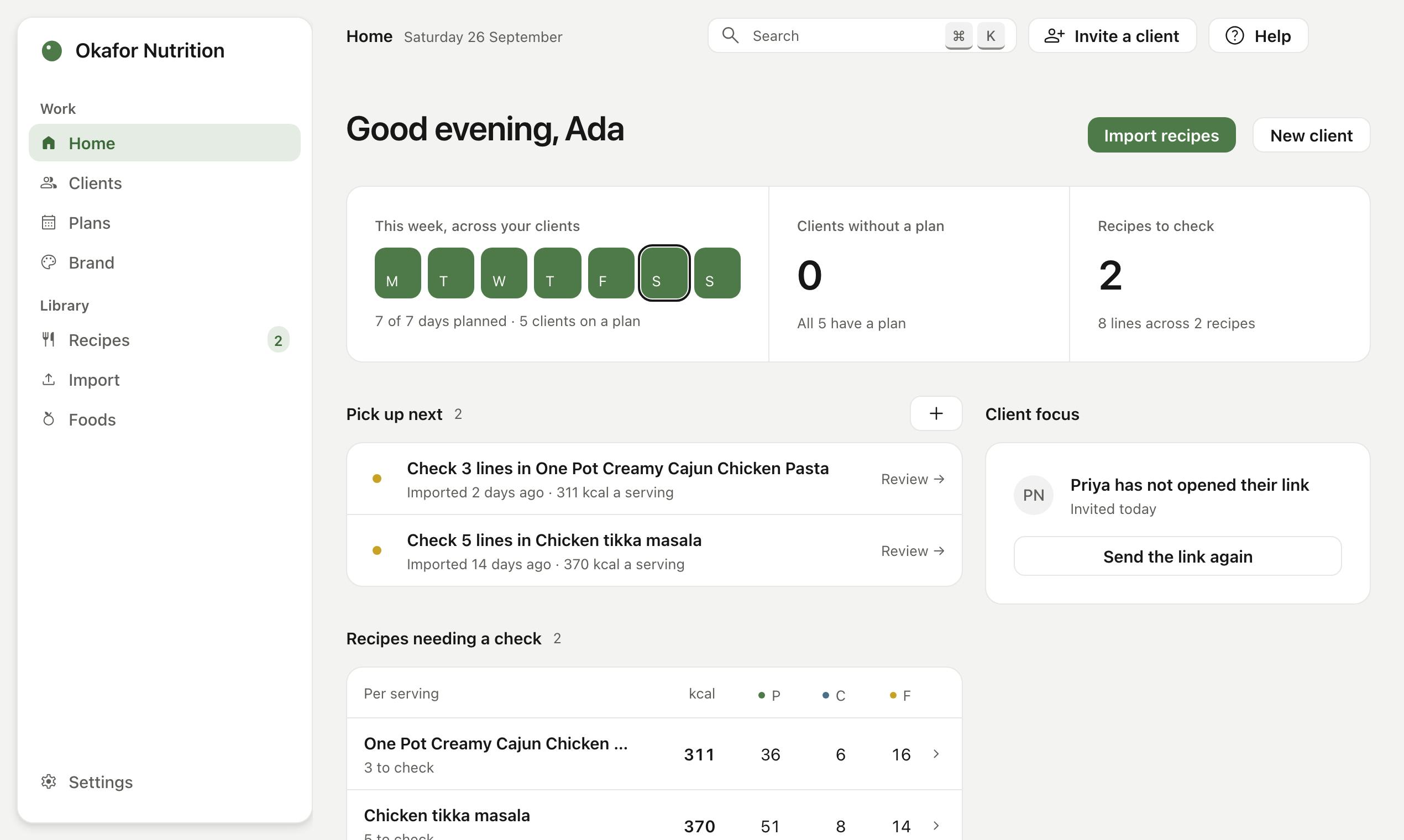
Also worth noting is how the tool handles recognition uncertainty. Each ingredient is matched against the USDA FoodData Central — an authoritative nutritional database maintained by the U.S. Department of Agriculture. Rather than forcing a guess on items it can't confidently match, the system explicitly flags them for the coach to confirm manually. This "flag it red when uncertain" design avoids the silent errors that automated tools so often introduce, and aligns with the precision requirements of nutritional calculation.
USDA FoodData Central is an open nutritional database maintained by the U.S. Department of Agriculture, integrating multiple sub-datasets including the Standard Reference Legacy (SR Legacy), branded food data (FNDDS), and laboratory-analyzed data (Foundation Foods). As of 2024, the database contains over one million food entries, covering dozens of dimensions including energy, macronutrients, vitamins, and minerals. Because its sources span U.S. commercially available branded foods and laboratory measurements, it is widely used as a benchmark data source by nutritional calculation software and academic research. That said, the database is primarily English-language and North America-centric, with limited coverage of local ingredients from East Asia, South Asia, and Latin America — which is the underlying reason for the note at the end of this article about "the extent of support for non-English recipes and localized nutritional data remaining to be verified."
Schedule Weekly Plans Around Client Goals
Once recipes are entered, coaches can drag individual meals directly into a client's weekly schedule. The system tallies each day's total nutritional intake in real time and displays the gap relative to that client's defined targets.
This drag-and-drop interaction with instant daily total feedback transforms meal planning from a static spreadsheet exercise into a visual, iterative process. When assembling a weekly menu, coaches can immediately see whether targets like protein and calories are being hit — without having to calculate everything after the fact. For results-oriented nutrition coaching businesses, this kind of real-time comparison is a key efficiency driver.
White-Label Delivery: Giving the Brand Back to the Coach
Peas and Pans' most distinctive positioning is captured in its tagline — "Send it in your own brand." Once a plan is complete, coaches can deliver it to clients as both a web page and a PDF, with the coach's own logo on the finished product.
For independent dietitians, personal trainers, and small studios, brand consistency is directly tied to professional credibility and client trust. Many comparable tools leave their own platform branding on deliverables, whereas Peas and Pans chooses to step aside and let the user's brand take center stage. In essence, it positions itself as "invisible infrastructure" rather than a consumer-facing brand. This trade-off defines its target audience as B-side practitioners who use tools as a backend productivity layer.
White label is a business model common in SaaS, where the software provider removes its own branding so that the purchasing party can present the product or service under their own brand. For independent practitioners like nutrition coaches and fitness studios, the value of a white-label tool is that clients always perceive the coach's professional identity — not some third-party platform. This stands in contrast to "high-visibility" platform tools like Notion or Canva, whose watermarks or platform branding can inadvertently redirect a user's clients toward the platform itself. White-label tools typically command higher pricing than standard subscriptions, because they absorb the implicit cost of brand endorsement — and they also mean the tool provider is deliberately forgoing the growth channel of reaching end users through deliverables.
Positioning and Early-Stage Observations
Based on publicly available information on Product Hunt, Peas and Pans is categorized under Health & Fitness, Productivity, and SaaS. At the time of writing it sits at #18, with 4 upvotes and 1 comment — numbers that indicate it is still in a very early stage of exposure, with no large-scale community discussion yet.
This warrants transparency: the information currently available comes primarily from the product's own description. Third-party reviews, real user feedback, and key details such as pricing and accuracy rates are all absent. The feature set it describes — multi-source import, USDA data matching, drag-and-drop meal scheduling, white-label delivery — logically forms a coherent end-to-end workflow that is clearly conceived and well-matched to the real needs of nutrition coaches. However, the tool's actual parsing accuracy, its support for non-English recipes and localized nutritional data, and its reliability in real-world business use all remain to be validated.
For nutrition professionals currently looking for a meal plan delivery solution, Peas and Pans is worth adding to the shortlist for trial evaluation — with particular attention to the accuracy of its ingredient matching and whether its white-label delivery genuinely meets your branding needs.
Related articles

Cursor AI Programming in Practice: Build a Student Management System from Scratch in 30 Minutes
A Bilibili creator demonstrates Cursor AI programming: generating a student management system in 30 minutes with natural language. Details on Agent mode, Claude selection, prompt techniques, and thresholds.

Top 20 AI Coding Tools Ranking: From Rock-Solid to Lackluster, a Scored Matrix
Bilibili creator releases top 20 AI coding tools ranking, tiered T0–T4 from rock-solid to lackluster, with Claude Code and Codex tied at T0. This article details the scoring dimensions (capability, reliability, robustness, durability, cost, domestic availability) and tool performances to help developers choose the right AI coding assistant.

Vibe Coding Systematic Tutorial: Master AI-Assisted Programming from Zero
A three-month Vibe Coding tutorial from a Bilibili creator covering Codex, ClaudeCode, and Cursor, from core logic to commercial project practice for beginners.