Pentagon Seeks $30 Million to Build an AI-Powered Lie Detector — How Worried Should We Be?

The Pentagon wants $30M to build an AI lie detector with remote sensing — raising accuracy and privacy alarms.
The U.S. Department of Defense is seeking roughly $30.3 million over five years to develop an AI-enhanced polygraph system called "Polygraph+." The project targets two areas: replacing subjective human scoring with machine learning, and "standoff sensing" that captures physiological signals without physical contact. But traditional polygraph technology has long faced scientific skepticism, and layering AI on top won't fix its core flaws — data bias and black-box algorithms may make errors harder to catch. The covert nature of standoff sensing also raises serious privacy and surveillance ethics concerns.
The Pentagon's 'Polygraph Upgrade' Plan
The U.S. Department of Defense has revealed in a budget request document that it plans to invest approximately $30.3 million over the next five years to develop an upgraded lie detector system. The project, dubbed "Polygraph+" or "Polygraph Next," aims to leverage artificial intelligence and machine learning to push the boundaries of traditional polygraph capabilities.
Lie detection technology is nothing new to the military and intelligence community. Traditional polygraphs measure physiological indicators — heart rate, blood pressure, respiration, and galvanic skin response — to infer whether a subject is being deceptive. Yet these technologies have long faced scrutiny from the scientific community, with their accuracy and reliability never fully validated. The Pentagon now hopes to use AI to overcome the limitations of legacy polygraph methods.
Two Core Technical Directions
According to the budget documents, the Polygraph+ project focuses on two main technical areas.
The first is intelligent scoring algorithms. The project will use AI and machine learning to analyze and score data collected during polygraph sessions. Traditional polygraph examination relies heavily on the subjective judgment of the examiner, and the introduction of AI algorithms is intended to provide a more "objective" quantitative assessment while reducing human error.
The second is a technology known as "standoff sensing." The core concept here is remotely capturing a subject's physiological or behavioral signals without any physical contact. This means future lie detection may no longer require attaching sensors directly to the subject — instead, signals could be captured and analyzed from a distance.
Together, these two directions sketch out the blueprint for a more automated, more covert, and potentially more scalable lie detection system.
Standoff sensing is not an entirely new concept — its technical underpinnings have been explored in academia and defense research for years. Common implementation approaches include: using microwave or millimeter-wave radar to detect subtle chest movements and heartbeat vibrations (i.e., contactless vital sign detection); capturing microscopic changes in facial skin tone via high-resolution cameras to estimate heart rate (optical heart rate detection / rPPG technology); and analyzing behavioral cues such as gait and facial micro-expressions. DARPA has previously funded similar "remote vital sign monitoring" projects, primarily for battlefield situational awareness. Integrating these sensing technologies into a polygraph context means that, in theory, covert physiological data collection could be conducted on unsuspecting individuals in airport security corridors, outside interrogation rooms, or even in public spaces — and that is precisely the core of the widespread ethical concern it has generated.
The Controversy Behind AI Lie Detection
Bringing AI into the polygraph space is, in itself, a double-edged sword.
From a technical standpoint, the performance of machine learning models depends heavily on the quality and representativeness of training data. If that data contains biases, the algorithm may produce systematic errors for specific populations or contexts. Polygraph testing is already a field with contested scientific foundations — wrapping it in AI does not automatically fix the underlying reliability problem. In fact, the "black box" nature of algorithms may make erroneous judgments harder to detect and attribute.
Standoff sensing technology touches on even more sensitive privacy and ethical boundaries. If lie detection can be conducted remotely without the subject's knowledge or consent, individuals lose further control over their own physiological data. If misused, this capability could evolve into a large-scale, invisible surveillance tool.
The credibility problem with traditional polygraphs is long-standing. In 2003, the National Academy of Sciences (NAS) released a report explicitly stating that the scientific basis for using polygraphs in security screening was "extremely weak," with false positive rates — innocent people judged as deceptive — at troubling levels. In high-stakes security vetting contexts, false positives can destroy innocent careers, while genuine spies or deceivers can evade detection through training or pharmacological countermeasures (so-called "countermeasure" techniques). For this reason, polygraph results are generally inadmissible as direct evidence in U.S. federal courts. Layering machine learning on top of this already scientifically disputed foundation does not resolve the core flaw — the unclear causal relationship between physiological signals and deceptive behavior. It may instead cloak inherently unreliable judgments in the authority of algorithmic objectivity.
The Deeper Questions Worth Asking
The $30 million price tag is not enormous, but the signal it sends is significant: the DoD is attempting to use the hottest AI technology of the moment to extend the life of — and upgrade — a technique whose credibility has long been in question.
This raises several critical questions: What level of accuracy can AI-powered lie detection actually achieve? Will its judgments be used in security clearance reviews, personnel vetting, or even legal proceedings? And in the absence of transparency and external oversight, who bears the cost of the system's mistakes?
Publicly available information remains limited. The project's specific technical roadmap, validation standards, and intended scope of application have yet to be disclosed. But one thing is clear: when a state-level institution ties AI to polygraph testing and remote sensing, the public and regulators have every reason to remain vigilant. Technological progress should not come at the expense of scientific rigor or individual rights.
Related articles

M&M's Spent Millions Replacing Artificial Blue Dye — Why Is It So Hard?
Mars spent millions trying to replace artificial blue dye in M&M's with spirulina, but thick material clogs pipes and residue risks mold, forcing a full production-line rebuild. Here's the engineering behind the reformulation.

Teammate Wanted for Meta Global AI Developer Hackathon: Computer Vision & Medical AI
A Reddit developer seeks teammates for the Meta Global AI Developer Hackathon, focusing on computer vision and medical AI. This article analyzes the track logic, skills-complementarity needs, and topic selection strategy behind this teaming signal.
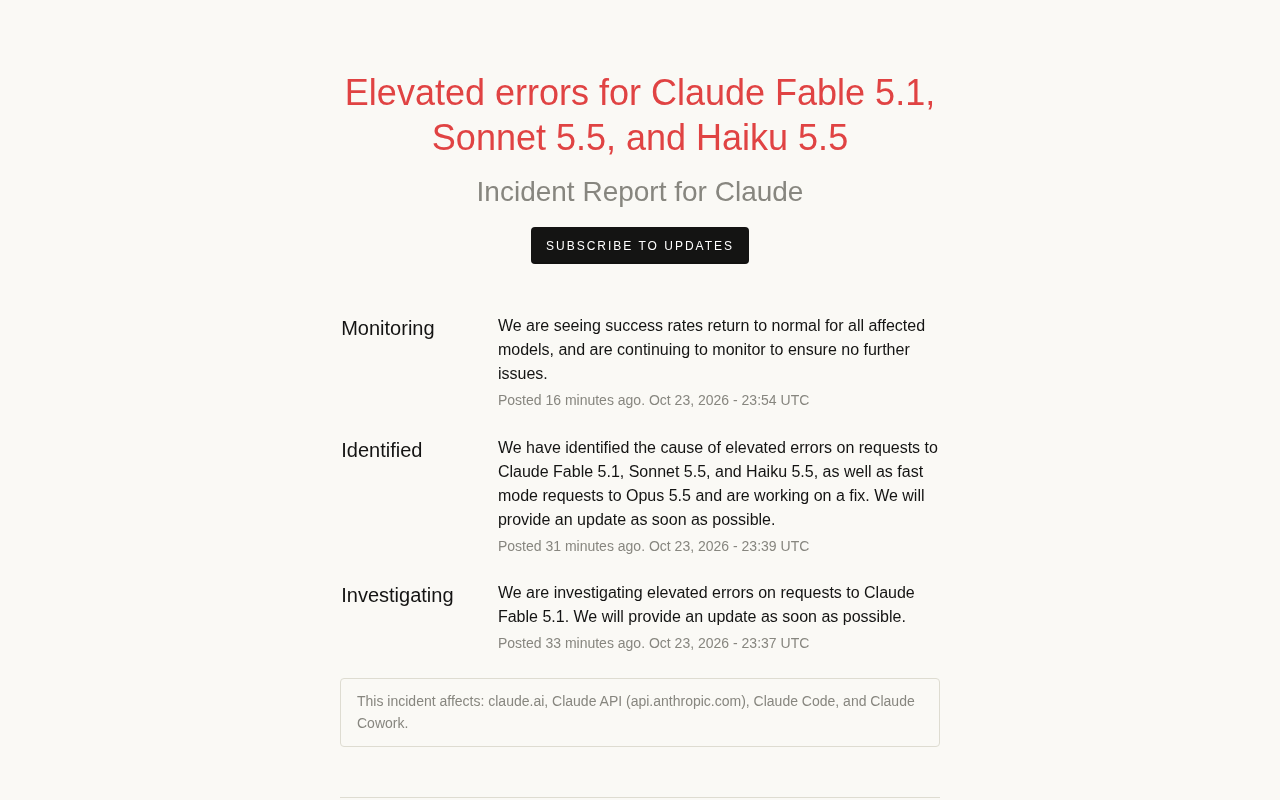
Multiple Claude Models Hit by Errors: A Postmortem of Fable 5.1, Sonnet 5.5, and Haiku 5.5
Claude Fable 5.1, Sonnet 5.5, Haiku 5.5, and Opus 5.5 fast mode saw elevated errors; Anthropic identified and resolved the issue in 17 minutes. This postmortem covers the timeline, the technical reasons for the multi-model cascading failure, and practical lessons for retry and degradation strategies.