Perit Marketplace: Selling Data and RL Tasks to Frontier AI Labs

Perit Marketplace lets individuals and teams sell data and RL tasks directly to AI labs; YC-incubated, over $11M revenue in 4.5 months.
Perit Marketplace, No. 11 on Product Hunt and incubated by YC F26, generated over $11M in revenue in 4.5 months. It offers two supply paths: submitting your own data (audio, video, code, documents, CAD, etc., 29 datasets listed) and building RL tasks and benchmarks using platform-provided VMs and model credits, with approved experts scaling to hundreds of tasks weekly. The platform handles review and promotion to labs, reducing matching costs. But data ownership compliance, RL task quality standards, and supplier revenue shares remain undisclosed. The platform solves a channel problem, not a value problem—scarcity remains the core of bargaining power.
When Data Becomes Hard Currency for AI Training
Frontier AI labs' demand for high-quality data and reinforcement learning tasks is growing rapidly, but the supply side is highly fragmented—people who possess specialized data or domain knowledge often have no direct channel to reach the labs. Perit Marketplace, ranked No. 11 on Product Hunt, aims to solve this problem: letting individuals or teams sell their own data and the RL tasks they build directly to AI labs in need of training material.
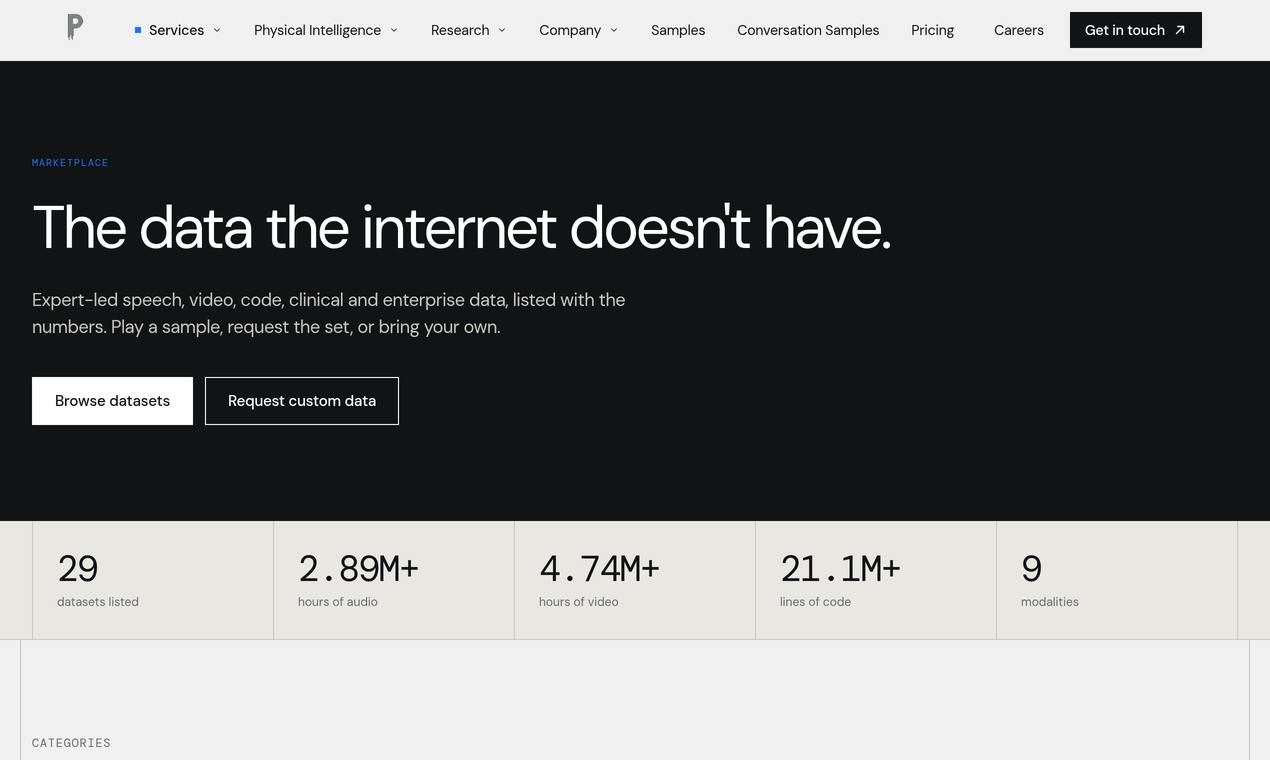
According to its Product Hunt page, Perit is incubated by YC F26 and generated over $11 million in revenue within 4.5 months. That number alone shows that trading data and training tasks is not a niche need but a business that is scaling up.
Two Paths to Participate: Sell Data, or Sell Tasks
Perit Marketplace offers two ways to get involved, covering different types of suppliers.
Submit Data You Own
The first path suits people who hold specific types of data. The categories listed by the platform include audio, video, code, documents, CAD, and more, with 29 datasets currently listed. The barrier to entry here is relatively low; the key lies in data ownership and uniqueness—labs need material that fills gaps in their training, not public content that is available everywhere.
Build RL Tasks and Benchmarks on the Platform
The second path is for people with the expertise to build reinforcement learning tasks and evaluation benchmarks. Perit provides virtual machines and model credits, and suppliers build their tasks on the platform, which then promotes them to labs. The page mentions that approved experts can scale to an output of hundreds of tasks per week. This path turns "expertise" itself into a sellable commodity, not just static data.
RL Tasks & Benchmarks: In the context of AI training, RL tasks usually refer to interactive learning environments designed for models, in which the model receives reward signals through trial and error; typical applications include agent tool use, multi-step reasoning, code execution, and game playing. A benchmark is a standardized evaluation set used to compare model capabilities across the board. In recent years, frontier labs have generally faced a scarcity of high-quality RL environments—unlike static text that can be scraped, RL tasks require manually designed state spaces, action interfaces, and reward functions, which demand high expertise and long build cycles. As a result, commodifying domain experts' task-design capabilities has become a new growth area for data markets.
What Role Does the Platform Play in the Middle
Perit positions itself not as a simple data marketplace but as an intermediary with screening and promotion mechanisms. The data or tasks submitted by suppliers must pass platform review, after which the platform pitches them to labs. The value of this model lies in reducing matching costs for both sides: labs don't have to seek out data sources one by one, and suppliers don't have to figure out on their own how to reach buyers.
From a business perspective, the platform controls both the demand side (labs) and the supply side (data and task providers), and controls quality through its review mechanism. The YC background and revenue figures indicate that this matchmaking logic has already been validated in practice.
YC F26 and the Incubation Background: YC refers to Y Combinator, a globally renowned startup incubator whose batches are named with a letter plus a year (e.g., F26 represents the Winter 2026 batch, W26 the Summer batch). Being accepted into YC usually means obtaining seed funding, a mentor network, and investor exposure. The article uses the YC background to support Perit's credibility, but note that YC endorsement reflects early screening and resource support, not that the platform's trading mechanisms or data compliance are already mature. Details such as the revenue-sharing structure behind the $11 million and whether it includes the platform's own business still need further verification.
Several Questions Worth Noting
Data Ownership and Compliance: The platform emphasizes "submit data you own," but details such as the scope of authorization involved in selling data and subsequent usage restrictions are not elaborated on the Product Hunt page. For data such as audio and video that may contain personal information, whether the compliance chain is clear is something suppliers need to confirm themselves.
How Task Quality Is Measured: Assessing the quality of RL tasks and benchmarks is more complex than for static data. The platform mentions "approved experts" and a review mechanism, but the specific evaluation dimensions and pass rates are not disclosed.
The Relationship Between Revenue and Supplier Earnings: The $11 million in revenue is a platform-level figure; the page does not provide information on how much of a cut suppliers can earn from transactions.
Data Ownership and the Authorization Chain: In data trading, ownership only indicates that the supplier claims to own the data, but selling also involves the license scope—whether the buyer can resell it, use it for commercial models, or redistribute derivative data. For data such as audio and video that may contain people's likenesses, voices, or personal information, constraints from informed consent and privacy regulations (such as GDPR and personal information protection laws) must also be considered. The platform's emphasis on "submit data you own" is a necessary but not sufficient condition; suppliers should confirm for themselves that the data source is legal and the authorization is transferable.
Who Should Pay Attention to This Platform
If you hold scarce domain data—such as documents from a specific industry, professional CAD drawings, or audio in a minority language—Perit offers a path to reach frontier labs directly. If you have the ability to build RL tasks, the platform's virtual machines and model credits lower the startup cost, and the room to scale to hundreds of tasks per week is also worth evaluating.
What you need to keep in mind is that the core bargaining power in data trading still depends on scarcity. The platform solves a channel problem, not a value problem. Before submitting, it's more important to think clearly about what training gap your data or tasks actually fill than to rush to list them.
One-line Summary
Perit Marketplace lets individuals and teams sell data and RL tasks directly to AI labs; YC-incubated, it generated over $11 million in revenue in 4.5 months.
Paragraph Summary
Perit Marketplace is the No. 11 product on Product Hunt, incubated by YC F26, which generated over $11 million in revenue within 4.5 months. The platform offers two supply paths: first, submitting your own data (audio, video, code, documents, CAD, etc., with 29 datasets already listed); second, using the platform's virtual machines and model credits to build reinforcement learning tasks and benchmarks, with approved experts able to scale to hundreds of tasks per week. The platform acts as an intermediary handling review and promotion to labs, reducing matching costs for both sides. However, key details such as data ownership compliance, RL task quality evaluation standards, and supplier revenue-sharing ratios have not yet been disclosed. The article argues that the platform solves a channel problem rather than a value problem, and data scarcity remains the core of bargaining power.
Related articles

Gemini 4 Neon Review: Benchmark Scores Rival Carbon, API Pricing and Quota Breakdown
Google Gemini 4 Neon is now live, benchmark scores closely tracking Carbon, API pricing 3/15 at twice Hydrogen's rate. This article compiles Bilibili creator testing: Neon can replace 90% of Carbon scenarios, AntiGravity quota consumption is only one-third of Carbon, plus subscription channel restrictions and 2API ban risks.

Gemini 4 Helium Coming Soon? Signals of Google Loosening Subscription Restrictions
Google team member hints releases will continue; community speculates Gemini 4 Helium (Flash Lite) may be next. Subscription ban controversy gets a response as product lead says "Soon," suggesting restrictions may be lifted. This article covers Gemini developments, OpenAI Coding Agent and risk management, Doubao real-time audio-video API, and compute business dynamics.

AI-Assisted React Development in Practice: Optimizing a Video App and Handling Errors
A 14-year veteran developer demonstrates AI-assisted React video app optimization: compressing video from 80MB to 5MB (~94%) via ImageKit, plus reliable error handling and retry mechanisms. Includes planning, code understanding, and verification methods for working with AI.