Perplexity Pro Quietly Swapping Models? Forced Sonnet Switching in MCP Scenarios Sparks Trust Crisis

Perplexity Pro accused of silently swapping user-selected models for Claude Sonnet in MCP tool-call scenarios.
A Perplexity Pro subscriber discovered that when using custom MCP connectors or financial data APIs, the platform quietly routes requests to Claude Sonnet regardless of which model the user selected. Support refused to acknowledge the issue, sparking a broader debate about model transparency, multi-model routing ethics, and user trust in AI platforms.
User Exposes: You Pay to Choose a Model — Then the Backend Swaps It Out
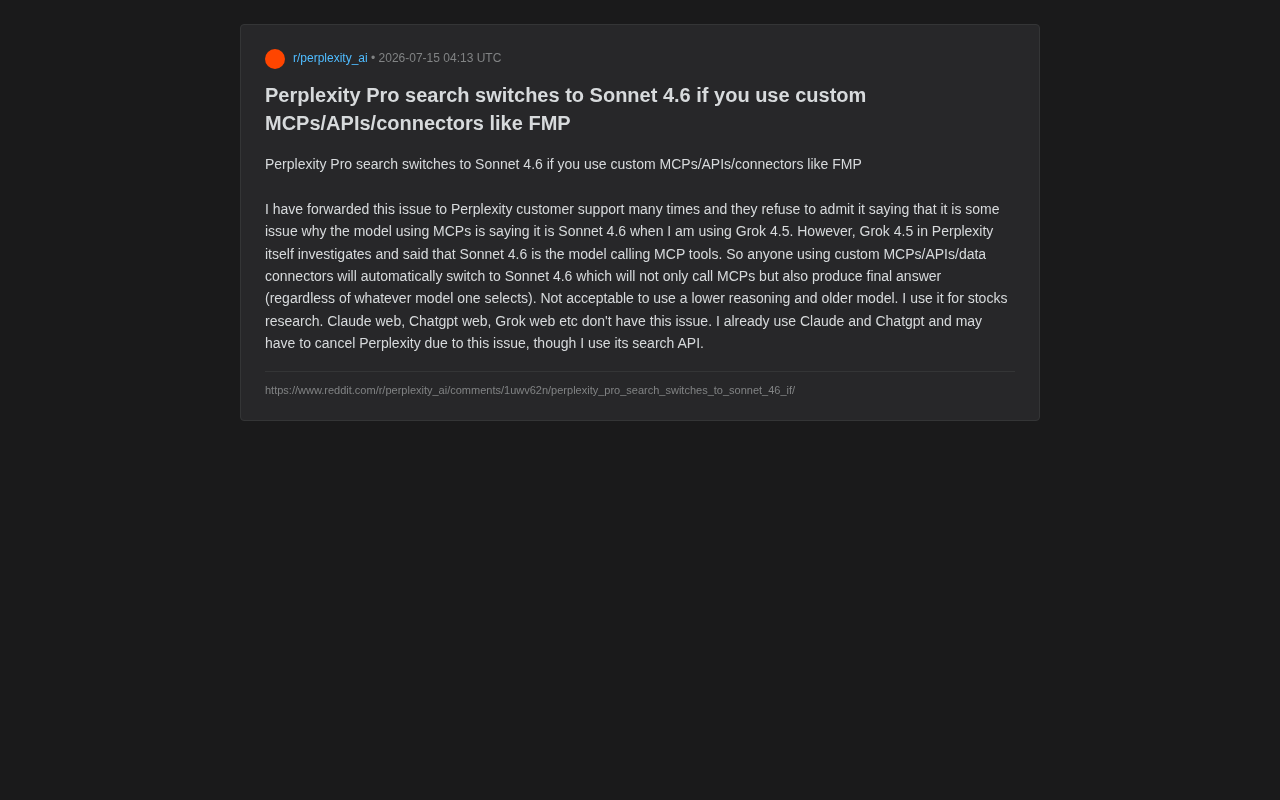
Recently, a Perplexity Pro subscriber took to Reddit to expose a troubling phenomenon: when using custom MCP (Model Context Protocol) connectors, APIs, or financial data integrations (such as FMP, Financial Modeling Prep), Perplexity appears to silently switch the actual executing model to Anthropic's Claude Sonnet — without user knowledge — regardless of which model was selected in the interface.
Background on MCP: MCP (Model Context Protocol) is a standardized, open-source protocol introduced by Anthropic in late 2024, designed to address the fragmentation in how AI models connect to external tools and data sources. Think of it like a USB-C port for AI applications — a unified "plug" that lets models interface with local file systems, databases, APIs, and other external resources in a standardized way, without requiring custom adapters for every data source. MCP marks a paradigm shift from "single-model Q&A" toward "model + tool collaboration," but it also introduces new engineering complexity around multi-model orchestration and tool-call compatibility.
The user explicitly stated that they had selected Grok in the frontend, yet when MCP tool calls were triggered, the system was actually running Sonnet under the hood. He even asked Grok — within Perplexity — to investigate this issue, and the answer pointed to the same conclusion: the model actually invoking the tools and generating the final response was Sonnet, not the user's chosen model.
The Core Issue: It's Not Just Tool Calls — The Final Answer Gets Swapped Too
The Model Selector May Be Meaningless in Certain Scenarios
The user emphasized that after the switch to Sonnet, that model was "responsible not just for calling the MCP tools, but also for generating the final answer." In other words, no matter which more powerful reasoning model you selected in the frontend, once a custom connector was triggered, the entire reasoning and generation pipeline was quietly replaced.
For Perplexity Pro subscribers, this is a sensitive issue — one of the core reasons for paying for a premium subscription is precisely the ability to choose stronger, more up-to-date models.
Why Users Find This Unacceptable
This particular user primarily uses Perplexity for stock research — specifically, pulling real-time financial statements and valuation metrics through the FMP (Financial Modeling Prep) connector, then tasking the model with complex reasoning like valuation analysis and earnings interpretation. FMP is a financial data API widely used by quantitative analysts and individual investors. In this kind of high-stakes scenario, model reasoning depth and data processing accuracy are critical, and any "silent downgrade" can directly affect decision quality. He stated plainly that he had no interest in being forced — without his knowledge — onto "a weaker, older model" for key financial analysis tasks.
Notably, the user ran a cross-platform comparison: the official web versions of Claude, ChatGPT, and Grok did not exhibit this kind of silent model substitution when using similar tools or connectors, making Perplexity's behavior stand out all the more.
Customer Support Response and the Resulting Trust Crisis
According to the user, he contacted Perplexity support multiple times about this issue, but support refused to acknowledge that any model switching had occurred, vaguely suggesting it might be "some kind of issue" causing the model handling MCP calls to identify itself as Sonnet.
This "neither confirm nor explain" approach is exactly what fueled the intense frustration. In an era where AI products depend heavily on user trust, model transparency has become a core competitive differentiator. When a user pays to select a specific model and the product quietly substitutes a different one on the backend — then deflects when questioned — it's a recipe for a trust crisis.
Note: The above is based solely on one user's firsthand account. It has not been officially confirmed by Perplexity, nor has it been independently replicated at scale. Readers should treat this as an unverified, suspected issue rather than a confirmed fact.
Possible Technical Explanations
In the absence of any official statement, a few reasonable engineering-level hypotheses are worth considering:
Tool-Call Compatibility Gaps
As a standardized tool-connection protocol, MCP exposes significant variation in how mature different models are at handling tool calls (function calling / tool use). Understanding this mechanism helps explain why silent routing might occur: Function Calling is the core mechanism through which large language models interact with external systems. When a user submits a request, the model first determines whether an external tool is needed; if so, it generates a structured function-call instruction, the external system executes it and returns the result, and the model then generates a final response based on that result. This multi-step pipeline demands extremely high instruction-following reliability and JSON output consistency. Anthropic's Claude series is widely regarded in the industry as particularly reliable in multi-tool-call scenarios due to its strong consistency in structured output. Perplexity may be routing all requests involving custom connectors to Sonnet for engineering reliability reasons.
Cost Control and Backend Routing Strategy
Complex, multi-step tool calls significantly increase token consumption and response latency. Multi-Model Routing is a widely adopted backend architecture strategy among major AI platforms — the platform dynamically dispatches requests to different underlying models based on task type, complexity, cost budget, and other factors. Simple queries go to lightweight models; complex reasoning goes to flagship models. It's fundamentally a dynamic balancing act between quality, speed, and cost. However, when routing decisions are completely opaque to users, it easily triggers the perception of being "silently downgraded." Platforms may default to a fixed model for certain pipelines to simplify scheduling logic, but substituting a model the user explicitly chose — without their knowledge — is a failure of both product design and communication.
Transparency Is the Real Bug That Needs Fixing
The right approach is straightforward: surface a clear UI-level notice such as, "This scenario involves a custom connector and will be handled by [Model X]." Give users the information they need to make an informed choice — rather than letting them discover the substitution through their own detective work.
A Warning for Both Users and the Industry
Advice for Heavy Perplexity Users
If you rely heavily on custom MCP/API/connectors in Perplexity — especially for high-stakes domains like finance, healthcare, or law where reasoning quality matters enormously — it's worth actively verifying whether the model actually executing your requests matches what you selected in the frontend. A simple way to check is to ask the model to identify itself, or compare outputs against known characteristics of different models.
This user ultimately considered canceling their Perplexity Pro subscription as a result — a churn signal the platform cannot afford to ignore.
In the Multi-Model Routing Era, Transparency Cannot Be Optional
This incident highlights an increasingly urgent industry-wide issue: model transparency. As more and more AI products adopt multi-model routing architectures — dynamically dispatching different models in the background based on task type — users' right to know "which model am I actually using" becomes increasingly critical. Multi-model routing is itself a legitimate engineering practice, widely used across platforms like OpenAI, Google, and Perplexity, enabling a balance between cost, speed, and quality. But it must be built on a foundation of transparency and user control. The moment users feel they've been silently downgraded, the damage to brand trust is real — regardless of whether the technical rationale holds up.
Conclusion
At its core, this Reddit report is a case study in informed consent and trust. Routing tool calls to a stable, reliable model may have sound technical justification. But from a product communication standpoint, the lack of transparent UI notifications — compounded by vague, non-committal customer support responses — is simply not good enough.
For users who rely on AI tools to make professional decisions, "which model did I select versus which model actually ran" should not be a mystery they have to solve themselves. Perplexity would do well to address this concern directly. And the industry as a whole, riding the wave of multi-model routing, should treat transparency as the default — not an afterthought.
Related articles

Apple HomeView Hands-On Review: Is the $300 Smart Home Hub Worth It?
Apple HomeView hands-on: a $300 smart home hub with facial recognition for quick account switching, but no App Store or voice recognition. Is the wall-mounted version worth it? Should you buy the first generation?

Meta Muse Wonder Launch: What It Means for Meta's Return to the Frontier AI Race
Meta releases Muse Wonder and WonderFull, benchmarks reach the frontier, community feedback is polarized. An in-depth look at Meta's return to the frontier AI race, its personal agent strategy, and Zuckerberg's different path.

Apple Home Smart Home Lineup Leaked: LG and Schneider Team Up, UWB Door Lock on Board
Apple Home ecosystem gains new LG and Schneider devices: UWB smart lock with proximity unlock, 2.5K dual-camera doorbell, privacy indoor camera, and AirPods-like seamless pairing.