Persona Perspectives Reshape LLM Internal Representations: Challenges for Safety Monitoring

Persona switching systematically reorganizes LLM internal concept geometry, causing politically biased outputs from fixed-representation monitoring tools.
The study examined whether the geometric structure of internal conceptual relationships in LLMs remains stable across different personas. Models playing liberal and conservative roles showed systematic changes in word projections onto semantic axes and inter-axis alignment, with shifts aligned to the assigned ideology. When linear probes and SAE classifiers were applied to persona-conditioned models, they gave politically biased ratings for truthfulness and morality of controversial statements, indicating that safety monitoring based on fixed representations may fail under persona switching.
Large language models (LLMs) can flexibly switch between different "persona" perspectives—but does this switching affect the geometric structure of the model's internal concept relationships? A new study answers yes, and reveals potential threats to safety monitoring.
The Assumptions Behind Traditional Monitoring Methods
Linear probes and sparse autoencoders (SAEs) are currently common tools for monitoring LLM internal features. They default to one premise: that feature representations remain consistent across different contexts. However, LLMs can flexibly adopt different perspectives or "personas," which suggests that different systems of conceptual relationships may be activated underneath. If persona switching changes the geometry of representations, then monitoring tools trained on fixed representations may fail.
Linear Probe is a common interpretability tool: a simple linear classifier is trained on top of a model layer's activations to determine whether a certain concept (such as "truthfulness" or "sentiment polarity") is represented. Its effectiveness depends on the assumption that "concept directions remain stable across different inputs"—that is, the same semantic feature corresponds to roughly the same vector direction.
Sparse Autoencoder (SAE) attempts to decompose dense high-dimensional activations into a set of sparse, interpretable features. It assumes that model activations can be expressed as a linear combination of a small number of "base features," and that these features have consistent meanings across different contexts.
The implicit premise shared by both is that the geometry of representations is invariant across contexts. If persona switching rotates or translates concept directions, then fixed probes and fixed-dictionary SAEs no longer correspond to the original semantics, and monitoring results become distorted.
Experimental Design: Political Personas and Semantic Axes
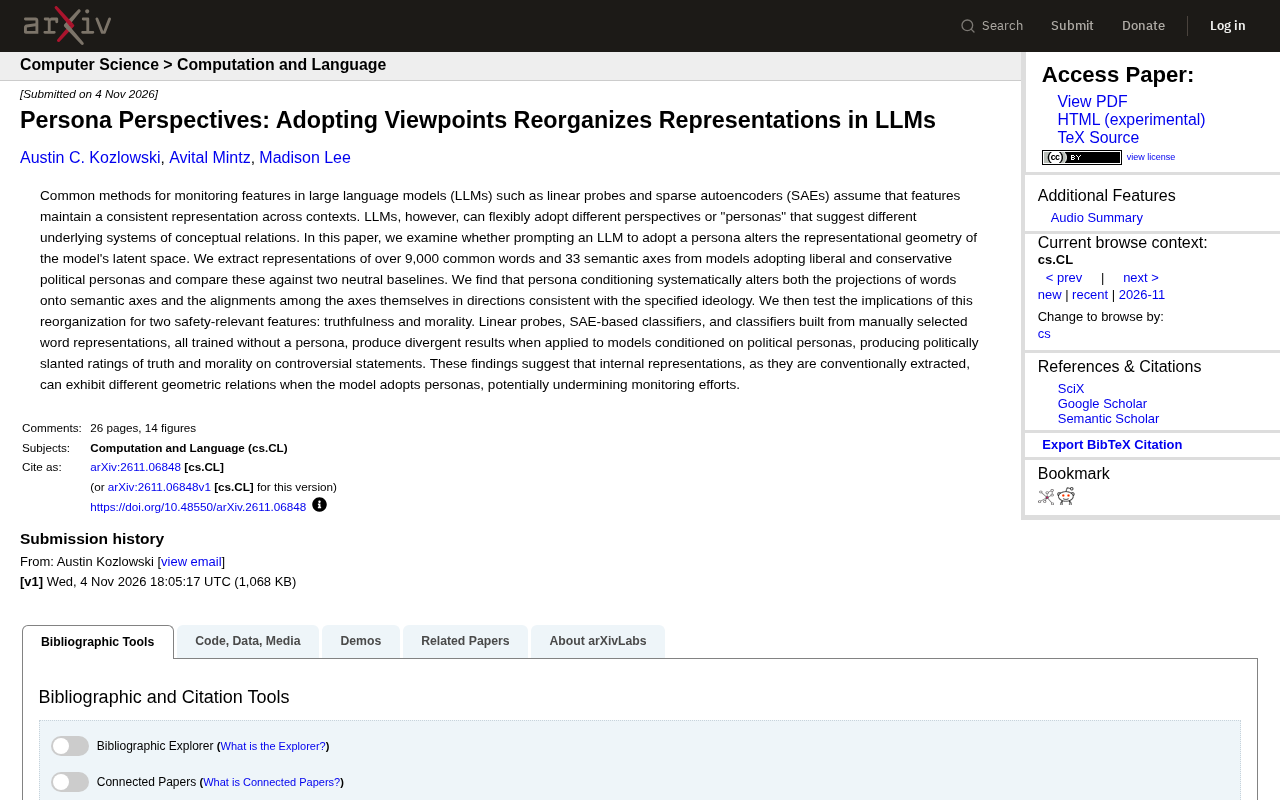
The research team had models adopt liberal and conservative political personas, respectively, and extracted representations of more than 9,000 common words and 33 semantic axes from these models as well as from two neutral baseline models. By comparing word projections onto semantic axes and the alignment relationships between semantic axes under different persona conditions, the researchers tested whether persona conditions systematically changed the geometry of the latent space.
Semantic Axis refers to a conceptual contrast dimension represented by a direction vector in representation space, such as "good—bad," "true—false," or "male—female." The usual approach is to take the difference between the mean activations of a pair of antonyms or concept words as the axis vector, then project the activation of any word onto that axis to obtain its scalar position on that dimension.
Projection is the dot product of a word vector with an axis vector, measuring which end of a semantic dimension the word leans toward and by how much. Alignment between semantic axes is measured by the cosine similarity of two axis vectors, reflecting the relative relationship between different conceptual dimensions. If persona switching changes projection values or inter-axis angles, it indicates that the geometric structure of conceptual relationships has been reorganized—this is precisely the core metric the study uses to quantify "whether persona changes representational geometry."
Persona Conditions Systematically Change Representational Geometry
The experimental results show that persona conditions do systematically change word projections onto semantic axes and the alignment between semantic axes, and that the direction of change is consistent with the assigned ideology. This means that when models adopt different personas, their internal conceptual relationships do not remain unchanged but are reorganized. This reorganization is not random noise but a structured shift related to persona content.
Direct Impact on Truth and Morality Evaluation
The study further tested the impact of this reorganization on two safety-related features—truthfulness and morality. Linear probes, SAE-based classifiers, and classifiers built from manually selected word representations, when applied to politically persona-conditioned models without persona training, produced divergent results. Specifically, these classifiers gave politically biased ratings for the truthfulness and morality of controversial statements.
Persona Conditioning refers to using system prompts or fine-tuning to make a model consistently respond as a certain role (such as a "liberal commentator"). In the study, activations generated by the model under persona conditions were fed into probes and classifiers not trained on that persona data, constituting a distribution shift test: if representational geometry is invariant, the classifier should give ratings consistent with the neutral model; if ratings systematically shift with persona, it indicates that the classifier is reading reorganized concept directions rather than stable "truth" or "morality" signals. This setup directly tests the generalizability of monitoring tools under persona switching.
Implications for Safety Monitoring
These findings indicate that internal representations extracted in the traditional way may exhibit different geometric relationships when a model adopts a persona. This may weaken the effectiveness of monitoring efforts. If monitoring tools assume that representations remain consistent across different contexts, then when a model switches personas, tool outputs may become biased or even misleading. For practitioners who rely on internal representations for safety evaluation, this is a challenge that needs to be taken seriously.
The study suggests that future monitoring methods may need to account for the influence of persona conditions, or develop tools capable of dynamically adapting to representational changes. In the context of widespread LLM use and increasingly common persona customization, understanding how persona reshapes internal representations is crucial for ensuring model safety and reliability.
One-line Summary
Persona switching systematically reorganizes LLM internal concept geometry, causing monitoring tools based on fixed representations to produce political bias.
Paragraph Summary
The study examined whether the geometric structure of internal conceptual relationships in large language models remains stable when they adopt different personas. The team had models play liberal and conservative roles, and extracted representations of more than 9,000 common words and 33 semantic axes from neutral baselines, comparing word projections onto semantic axes and inter-axis alignment relationships. The results show that persona conditions systematically change these geometric relationships, and the direction of shift is consistent with the assigned ideology. When monitoring tools such as linear probes and SAE classifiers were further applied to persona-conditioned models, these tools gave politically biased ratings for the truthfulness and morality of controversial statements. This indicates that safety monitoring based on fixed-representation assumptions may fail under persona switching, and future methods need to account for persona conditions or have dynamic adaptability.
Related articles

9 AI Subscription Plans Compared: The Real Cost Per 100M Tokens Revealed
Bilibili creator tests 9 AI subscription plans from Volcano, Alibaba, Tencent, Baidu, Zhipu, Xiaomi, MiniMax and more, converting them all to real cost per 100M tokens, breaking down fixed-quota vs. three-tier coefficient billing and how caching, time-of-day discounts, and window limits affect actual quota.

Vibe Coding for Beginners: Expressing Intent Instead of Handwriting Code
What is Vibe Coding? A 137-episode Bilibili course defines it: the core is expressing intent, not writing code. This article analyzes Vibe Coding's productivity logic, target audience, and entry expectations to help beginners decide if it's worth learning.

LangChain Beginner's Guide: An Agent Development Roadmap from LangGraph to Deep Agents
Clarify the encapsulation relationship among LangChain, LangGraph, and Deep Agents, and master the learning path and selection logic for agent development frameworks—suitable for beginners in large model development.