PewDiePie Banned Twice by OpenAI: An Accidental Ad for Local AI Models

PewDiePie got banned twice by OpenAI building a local AI model, accidentally becoming open-source's biggest ad.
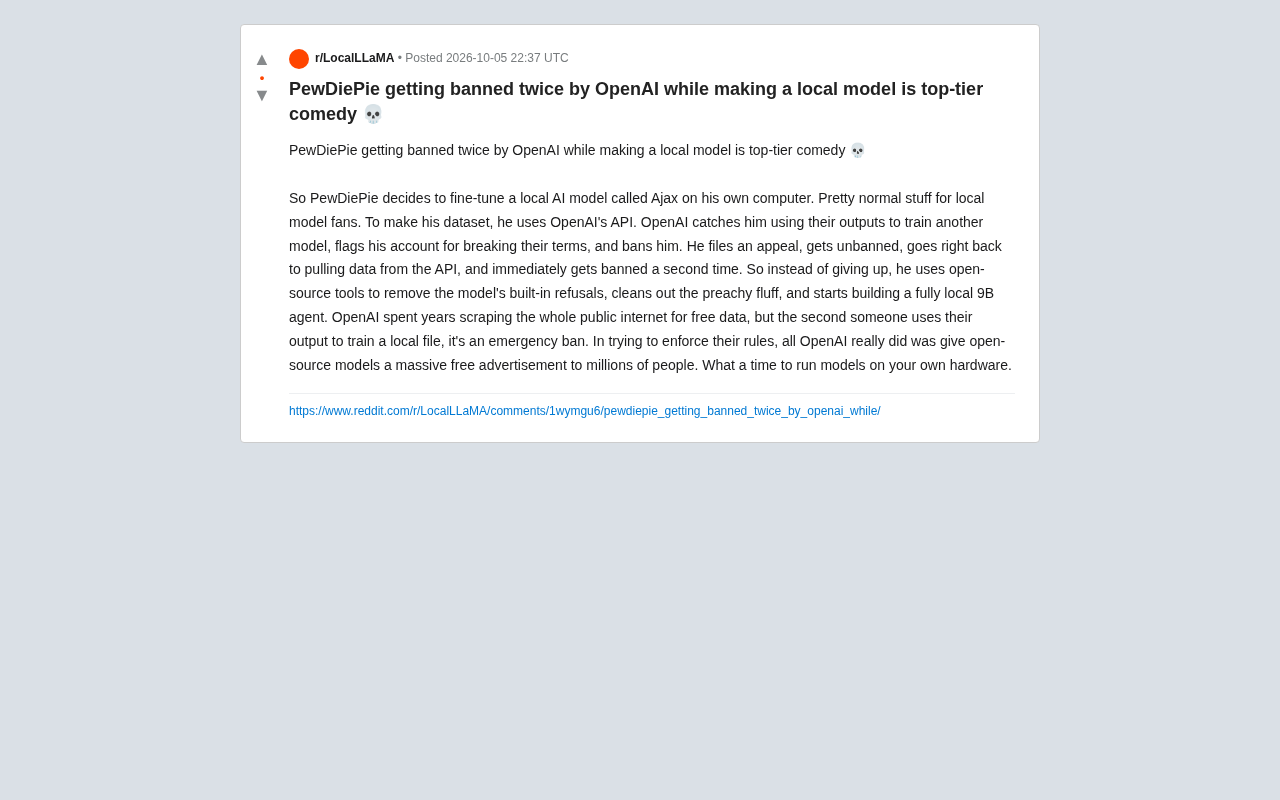
PewDiePie attempted to fine-tune a local AI model called Ajax, using OpenAI's API to generate training data — violating terms that prohibit using model outputs to train competing models. Banned, then reinstated on appeal, he did it again and was banned a second time. The incident ignited Reddit debate over AI giants' data double standards, while simultaneously exposing millions of his subscribers to the case for local deployment, making it an unexpected viral moment for the open-source model community.
A Local AI Experiment Sparked by a Ban
YouTube's biggest creator PewDiePie has recently become a hot topic in the local AI model community. The story is straightforward enough: he decided to fine-tune a local AI model called Ajax on his own machine. For anyone following local deployment, this is about as routine as it gets — running a model on your own hardware, no cloud API dependency, full control over your data.
The problem came down to how he built the dataset. To prepare training data for Ajax, PewDiePie called OpenAI's API to generate samples. OpenAI's terms of service explicitly prohibit using its model outputs to train competing AI models. Once the system detected this behavior, his account was banned immediately.
The Ban → Appeal → Ban Again Cycle
Most people would pull back after getting banned. PewDiePie submitted an appeal, got his account reinstated — and then promptly went right back to pulling data from the API, resulting in a completely predictable second ban. The sheer audacity of this "fool me twice" move carries its own dark comedy, which is exactly why Reddit dubbed it "peak comedy."
Rather than abandoning his local model plans, the double ban pushed him toward open-source tooling. He turned to open-source solutions to strip out the model's built-in refusal mechanisms, clean up the preachy filler responses, and build a fully local 9B-parameter agent.
Fine-tuning refers to taking a pre-trained base model and running a second round of training on a domain-specific or style-specific dataset, nudging the model's output behavior toward a target direction. A 9B-parameter model (roughly 9 billion trainable parameters) can already be fine-tuned at reduced precision on consumer-grade GPUs like the NVIDIA RTX 4090 (24GB VRAM), typically using parameter-efficient methods like LoRA (Low-Rank Adaptation) that significantly alter model behavior without updating all weights. Refusal removal is one specific application of fine-tuning — commercial models ship with extensive safety filters that return refusal responses to certain types of requests; by fine-tuning on data without such restrictions, you get a more "direct" local version. This entire technical path is well-established in the open-source community, and tools like Ollama and LM Studio have dramatically lowered the barrier for everyday users.
The Double-Standard Debate Around Data
The reason this story resonated so widely in the community is that it touched a long-running sore spot: the double standard around data usage.
The original poster's framing was pointed — OpenAI spent years freely scraping the entire public internet to train its models, but when someone tried to use OpenAI's outputs to train a local file, it was treated as an emergency warranting immediate account termination. That asymmetry sparked real skepticism about how AI giants apply their own rules.
To be fair, scraping publicly available web data and violating explicit terms of service are legally distinct issues, and the former remains an ongoing legal debate in its own right. But in the court of public opinion, the comparison landed hard for people already frustrated by a "rules for thee, not for me" double standard from major players.
The Ban Accidentally Became a Free Ad for Open-Source Models
From a communications standpoint, the ban produced an unintended outcome. PewDiePie commands tens of millions of subscribers, and his entire journey from cloud API to local open-source models effectively demonstrated an alternative path to a massive general audience — you can run AI on your own hardware, completely free from any platform's terms of service or ban threats.
As the original post put it, in trying to enforce its own rules, OpenAI inadvertently gave open-source models one of the largest free advertising campaigns they've ever received. For the local deployment community, this was a rare moment of breaking into the mainstream.
The fundamental difference between local deployment and cloud APIs comes down to where the computation happens. With a cloud API, your input data is sent to the provider's servers, inference runs remotely, and the provider has complete visibility and control over your usage — bans, rate limits, and terms changes can all be applied unilaterally. Local deployment downloads the model weights to your own device; inference runs entirely offline, with no external network involved. The provider has no awareness of — and no ability to interfere with — what you're doing. This core distinction gives local models inherent properties: censorship resistance, zero ongoing usage costs, and no data leakage. The tradeoff is that you need sufficient local compute and must handle model maintenance yourself. The transmission value of the PewDiePie incident lies precisely here: it used a famous person's real-world experience to concretely illustrate why "control" itself is a reason to choose local models.
A Signal for the Local Model Era
Stripping away the drama, this episode reflects a broader trend in the AI ecosystem: the barrier to running models locally is falling fast. Consumer hardware can now handle fine-tuning and deploying 9B-class models, open-source toolchains are maturing rapidly, and ordinary creators can build their own agents out of sheer curiosity.
When a top-tier content creator starts personally experimenting with local AI and broadcasts the whole process in an entertaining, public format, local models stop being a niche hobby for technical enthusiasts. That may be the real takeaway here — one that goes well beyond the comedy.
It's worth noting that this article is based on a single Reddit post. The specific details around the bans have not been officially confirmed or corroborated by multiple sources. Treat this as community discussion rather than verified reporting.
Related articles
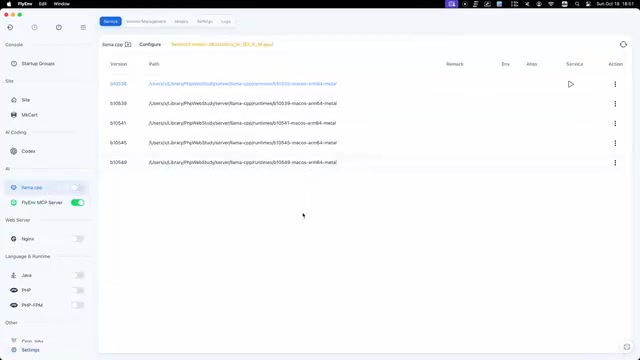
FlyEnv Plugin Review: Visually Running llama.cpp and Managing GGUF Models
FlyEnv launches the official llama.cpp plugin with side-by-side Metal runtime management, public GGUF repository indexing with file type labels, and visual configuration of context, threads, and GPU layers—saving templates and speculative decoding with each model for one-click local LLM inference.
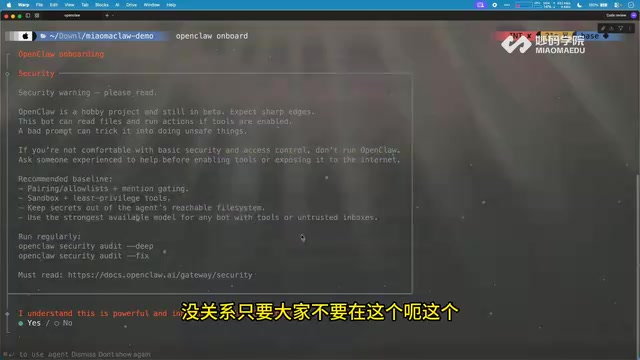
How Can Frontend Developers Advance into AI Agent Development? Deconstructing System-Level Agent Architecture from OpenClaw
Starting from the OpenClaw demo in a Bilibili open class, this article breaks down the three-layer architecture and universal formula of system-level AI agents, and analyzes the path for frontend developers to enter agent development based on TypeScript, including plugin-based design and security/memory layer challenges, with an interview answer framework.
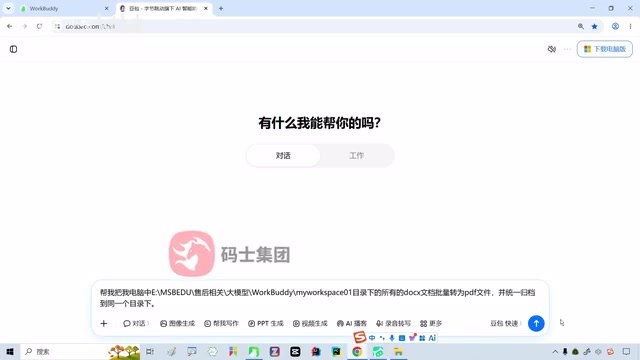
WorkBuddy in Action: How AI Agents Automate Batch File Conversion and Archiving
Bilibili creator Teacher Shanyao tests WorkBuddy vs. Doubao on batch file conversion, showing how AI Agents move from "giving solutions" to "direct execution," with a full workflow and credit cost reference.