PGX Framework: Physical Predicate Hierarchies Solve Long-Horizon Humanoid Manipulation Challenges

PGX decouples long-horizon loco-manipulation into predicate state machine, VLA skill execution, and world-coordinate locking layers, boosting phase progression and success rates.
To address temporal confusion, unstable skill switching, and precision loss in VLA models during long-horizon loco-manipulation, PGX proposes a three-layer decoupled architecture: a physical predicate-based state machine for phase progression and recovery, a VLA model that outputs actions only during active manipulation, and world-coordinate locking to suppress spatial drift from base movement. Predicate semantics are shared across offline segmentation, online execution, and phase-wise evaluation. Validated on three simulation tasks and the Unitree G1 real robot, PGX improves both phase progression and success rate. The article considers this physically grounded modular approach more pragmatic than pure end-to-end solutions, though predicates still rely on manual definition.
Introduction
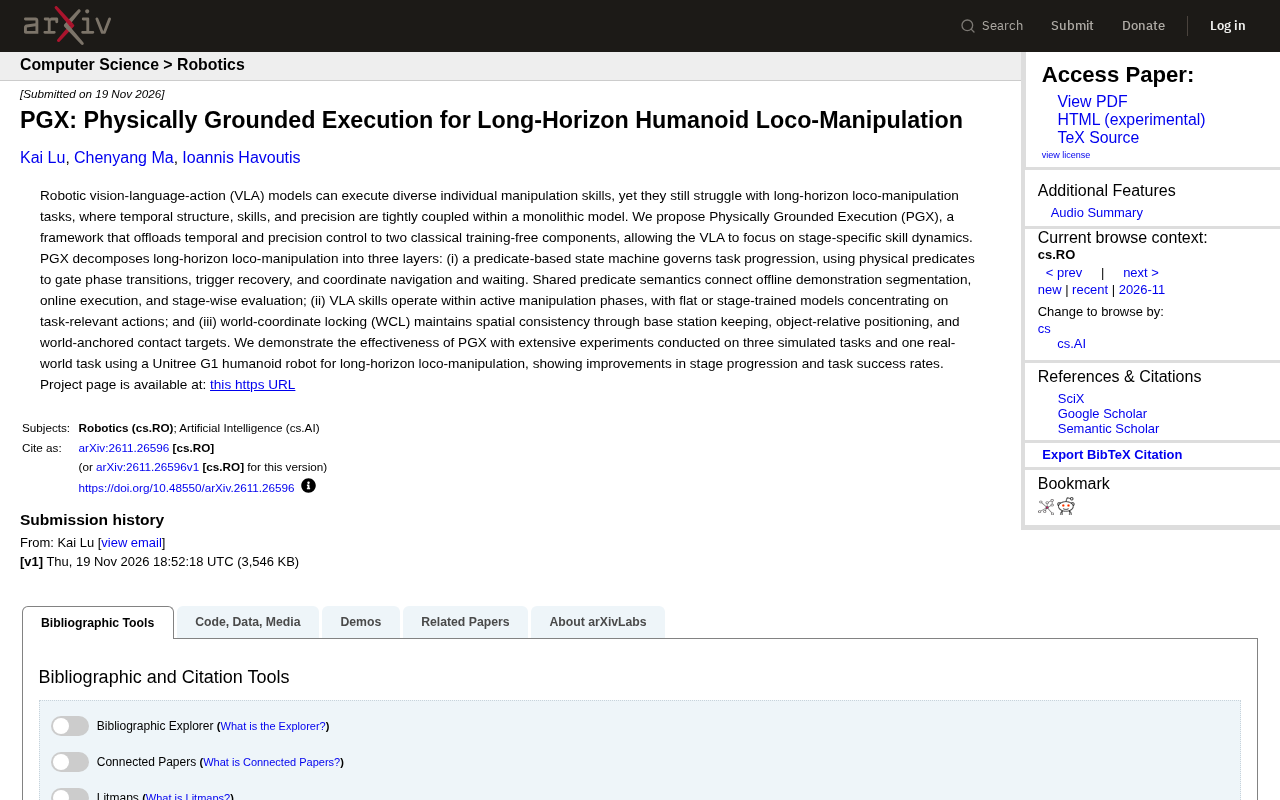
Vision-Language-Action (VLA) models have demonstrated impressive generalization on individual manipulation skills, but when tasks stretch into composite sequences like "navigate-manipulate-navigate again," these models often struggle to balance temporal structure, skill switching, and precision maintenance. To address this pain point, a research team proposes the PGX (Physically Grounded Execution) framework, which offloads temporal and precision control to two classical training-free components, allowing the VLA to focus on phase-specific skill dynamics and thereby achieving notable improvements on long-horizon loco-manipulation tasks for humanoid robots.
Why Long-Horizon Loco-Manipulation Defeats VLA
Long-horizon loco-manipulation requires robots to complete coupled "move-position-manipulate" tasks over continuous time spans. The difficulty lies in three dimensions being compressed into a single monolithic model: the temporal logic of phase progression, the skill combinations required at each phase, and the millimeter-level precision of contact and positioning. Existing VLA models excel at short-horizon "see-and-act" skills but struggle to remain stable when handling multi-phase workflows like "walk to the table, align with the cup, grasp, turn, and place"—phase transitions lack clear signals, errors accumulate across phases, and tasks ultimately fail.
PGX's core idea is decoupling: rather than having a single VLA model handle everything, it delegates temporal state management and spatial precision maintenance to traditional modules that require no training, leaving the VLA to do what it does best—output task-relevant actions within active manipulation phases.
Vision-Language-Action (VLA) models are embodied intelligence models that unify visual perception, natural language instructions, and action outputs into a single neural network. A typical approach pre-trains a multimodal backbone (such as a vision encoder plus a language model) on large-scale robot demonstration data or video data, then uses an action decoding head to output joint positions, end-effector poses, or discrete action tokens. The advantage of VLA lies in cross-task generalization: the same model can accept different language instructions and manipulate unseen objects. But its shortcomings are also obvious—training data is mostly concentrated on short-horizon manipulation segments, and the model lacks explicit memory and reasoning capabilities for long-horizon states. Therefore, when tasks require continuous progression over tens of seconds or even minutes, end-to-end VLA is prone to phase forgetting and error accumulation.
Three-Layer Architecture Breakdown
PGX decomposes long-horizon loco-manipulation into three collaborating layers, each with clear responsibility boundaries.
Layer 1: Predicate State Machine
Task progression is governed by a predicate-based state machine. Physical predicates serve as gating signals for phase transitions, while also handling recovery behavior triggering and coordinating navigation and waiting. The key is that predicate semantics are shared across three components: offline demonstration data segmentation, online execution phase determination, and phase-wise evaluation metrics. This shared semantics ensures consistent understanding of "which step the task has reached" between training and deployment, avoiding drift in phase determination criteria between training and inference.
Predicates in robot task planning refer to decidable Boolean descriptions of world states, such as "the robot has reached the table," "the gripper is closed," or "the cup is above the tray." Unlike traditional finite state machines, predicate state machines do not directly bind to fixed time steps or fixed action sequences; instead, they continuously evaluate whether current observations satisfy a certain predicate, triggering phase transitions when satisfied. The advantage of this design is that phase progression is driven by physical facts rather than clocks, providing natural robustness to execution speed variations and execution failures. Meanwhile, predicates are also the common foundation of classical planning methods such as Hierarchical Task Networks (HTN) and behavior trees, facilitating the embedding of learning modules into interpretable symbolic frameworks.
Layer 2: VLA Skill Execution
The VLA model intervenes only during active manipulation phases, and can be either a flat-trained model or a phase-wise trained model, focusing on outputting actions relevant to the current task. After stripping away non-manipulation behaviors such as navigation, waiting, and phase switching, the VLA's modeling burden is significantly reduced, and the precision of skill dynamics modeling is improved.
Layer 3: World-Coordinate Locking
World-Coordinate Locking (WCL) is responsible for spatial consistency through three mechanisms: base station keeping, object-relative localization, and world-anchored contact targets. These ensure that the robot does not lose spatial reference to key objects when alternating between movement and manipulation. This layer directly targets the root cause of error accumulation in long-horizon tasks—coordinate frame drift caused by base movement.
World-Coordinate Locking addresses the reference frame drift problem caused by mobile bases. When a robot moves and manipulates simultaneously, its own base coordinate frame constantly changes. If the policy network relies solely on local coordinates from its egocentric view, previously memorized object positions become invalid as the base moves. WCL's approach is to maintain position anchors for key objects and contact targets in the world coordinate frame: base station keeping provides the robot's own global pose estimation, object-relative localization continuously updates target poses during movement, and world-anchored contact targets fix grasp points in global coordinates during the approach-to-manipulation phase. The combination of these three enables the VLA to recover spatial reference after phase transitions, suppressing cumulative errors in long-horizon tasks from the source.
Experimental Validation: Dual-Track Simulation and Real-Robot Testing
The research team validated PGX's effectiveness on three simulation tasks and one real-world task, with real-robot experiments using the Unitree G1 humanoid robot. Results show that PGX improves both phase progression and task success rate. Although the original paper does not disclose specific success rate values, "phase progression" being listed as a separate evaluation metric indicates that the framework's value lies not only in final success or failure but also in enabling the robot to more stably complete each intermediate phase—which is equally important for the diagnosability and recoverability of long-horizon tasks.
It is worth noting that the real-robot experiments chose the Unitree G1, a mass-production humanoid platform rather than a custom experimental prototype, which to some extent indicates that the method targets practically deployable hardware conditions.
Opinion: Modular Decoupling Is a Pragmatic Path for Long-Horizon Robot Tasks
PGX's design philosophy is worth considering for domestic embodied intelligence teams. Currently, many works tend to use larger-scale end-to-end models to directly swallow long-horizon tasks, but the data sparsity and error accumulation characteristics of long-horizon tasks make the robustness of pure end-to-end approaches on real robots difficult to guarantee. PGX chooses to draw a clear line between "what should be learned by the model and what should be managed by classical methods": temporal logic uses state machines, spatial precision uses coordinate locking, neither requires training, and the VLA only handles the skill execution portion for which it has the most abundant data.
This "physically grounded" approach also echoes an old lesson from robotics—reliability comes from interpretable constraints, not black-box generalization. Of course, predicate design currently still relies on manual definition, and how to give predicates themselves learning or adaptive capabilities is a question that such frameworks need to answer as they move toward broader tasks. The project page has been made public, and future progress is worth following.
One-line Summary
PGX decouples long-horizon loco-manipulation into three layers—predicate state machine, VLA skill execution, and world-coordinate locking—improving phase progression and success rates in simulation and on the Unitree G1 real robot.
Paragraph Summary
To address the problems of temporal confusion, unstable skill switching, and precision loss in vision-language-action models during long-horizon loco-manipulation, the PGX framework proposes a three-layer decoupled architecture: a physical predicate-based state machine handles task phase progression and recovery triggering, the VLA model outputs actions only during active manipulation phases, and world-coordinate locking suppresses spatial drift caused by base movement through base station keeping, object-relative localization, and world-anchored contact targets. Predicate semantics are shared across offline demonstration segmentation, online execution, and phase-wise evaluation, ensuring consistent determination between training and deployment. The team validated the method on three simulation tasks and a Unitree G1 humanoid real-robot task, with improvements in both phase progression and task success rate. The article argues that this "physically grounded" modular approach is more pragmatic than pure end-to-end solutions, but predicates still rely on manual definition, and their adaptive capability is a remaining question to be addressed.
Related articles
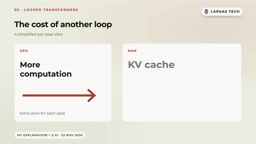
China's New GLM Model Adopts Loop Transformer: Will ChatGPT Follow Suit?
Zhipu's GLM adopts the Loop Transformer architecture, iterating multiple times to improve output quality as the first model to publicly confirm this design. This article explains the principles, KV cache cost, and surrounding developments in Google AI search and coding agent benchmarks.
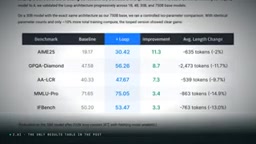
GLM-5.4 Is 5x Cheaper Than Claude — But at What Cost?
GLM-5.4 offers near-Claude coding ability at $18/month, about one-fifth the cost, but lacks flagship benchmarks and max effort can exhaust quotas on a single 7-hour task. This article combines the official paper and three independent reviews to explain the recurrent Transformer architecture and offer practical advice.
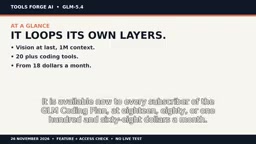
GLM-5.4 Open-Source Coding Model Tested: The Strongest, But It Takes 7 Hours
Z.AI releases GLM-5.4 coding model with Loop Transformer architecture, called the strongest open-source coding model by independent review, but it takes over 7 hours and ~15x tokens on the same benchmark. Here's the architecture, test scores, pricing, and competitive landscape.