Phonable: Reimagining the iPhone Missed Call Experience with AI Voicemail
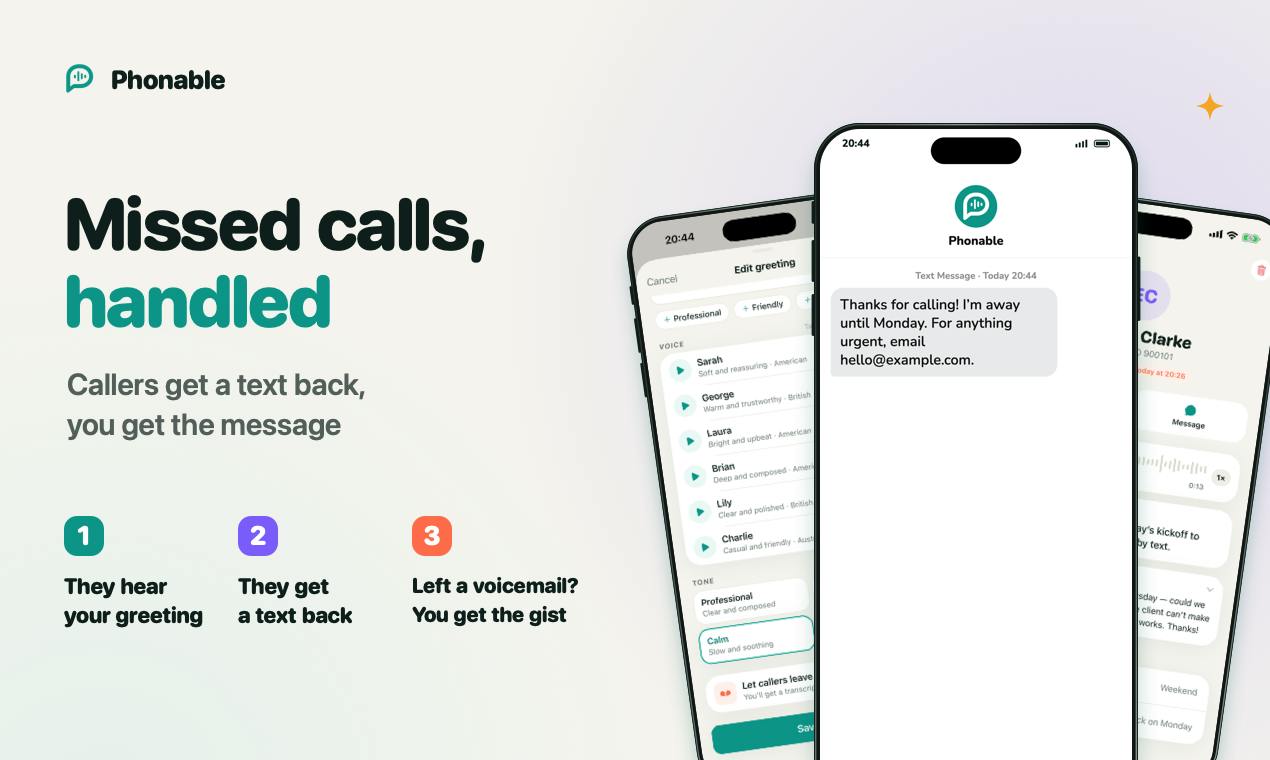
Phonable uses AI transcription and summaries to reinvent iPhone voicemail for both callers and recipients.
Phonable is an iPhone app launched on Product Hunt that aims to replace traditional carrier voicemail. It tackles the missed call problem from both sides: callers automatically receive an explanatory text when you don't pick up, even if they hang up without leaving a message; recipients get voice messages transcribed to text with an AI summary, so they can grasp the key point without listening through recordings. The app also supports one-tap or scheduled switching between contextual modes like Workday, Driving, and Gym, and lets users keep their existing phone number.
The Overlooked Pain Point: The Two-Sided Awkwardness of Missed Calls
Missed calls represent a persistent experience gap in modern communication that has long gone unaddressed. For the caller, an unanswered phone leaves them in the dark — is the other person busy, driving, or just not looking at their phone? For the recipient, the traditional carrier voicemail experience is notoriously painful: dialing in, listening through messages one by one, and wasting time — so much so that many people never check their voicemail at all.
Phonable, a new product launched on Product Hunt, targets exactly this two-sided problem. It's positioned as a replacement for the carrier voicemail on iPhone, aiming to fix the communication breakdown on both ends of a missed call. Developed by Frits Polman, the product earned 74 upvotes after launch and ranked 18th on the day's leaderboard, listed under the iOS, Productivity, and Artificial Intelligence categories.
How Phonable Fixes Both Sides of a Missed Call
For Callers: An Explanatory Text Even After They Hang Up
One of Phonable's core ideas is caring about the caller's experience. When someone calls and you can't answer, they automatically receive a text message explaining why you weren't available — even if they hung up without leaving a voicemail.
This addresses a common communication gap: callers are often left uncertain about the other person's situation, which can lead to misunderstandings or repeated callbacks. A timely, automated text transforms a failed call into a meaningful exchange of information.
For Recipients: Transcription Plus AI Summary to Get the Gist
On the recipient's side, Phonable fully digitalizes the voicemail experience. Incoming voice messages are automatically transcribed into text and accompanied by a short AI-generated summary, so you can instantly grasp the key point of any message — what the product tagline calls "you get the gist."
Compared to the inefficient experience of listening through traditional carrier voicemails one by one, a transcription-plus-summary approach dramatically lowers the effort of processing messages — especially in situations where listening to audio isn't convenient, like during meetings or while driving.
Speech-to-Text (STT) technology has matured significantly with the rise of deep learning in recent years. Models like OpenAI's Whisper and Google's Speech-to-Text API now exceed 95% accuracy on everyday conversational speech. Layering a large language model (LLM) on top for summarization is the technical pipeline Phonable and similar products follow: convert audio to text, then compress it into one or two key sentences. This combination is already well-established in use cases like podcast summaries and meeting transcripts — applying it to voicemail is simply a vertical implementation of the same pipeline. The key challenges lie in accents, background noise, and the vague phrasing common in voicemails (e.g., "you know what I mean," "that thing we talked about"), all of which can affect transcription quality and, in turn, lead to inaccurate AI summaries.
Contextual Modes and Personalized Greetings
Phonable offers situational mode switching, allowing users to toggle between modes like Workday, Driving, and Gym with a single tap or on a schedule. The explanatory message sent to callers adjusts accordingly, making automated replies feel more genuine and contextually appropriate.
For greetings, users can record their own voice or opt for a natural-sounding AI voice to greet incoming callers — a flexibility that balances personal expression with convenience.
Notably, Phonable doesn't require you to change your phone number. You keep your existing number, which significantly lowers the barrier to trying it out.
Since iOS 10, iPhone has opened up the Call Directory Extension and the CallKit framework, allowing third-party apps to intercept call handling flows — this is the underlying foundation that enables products like Phonable to operate without replacing the default dialer. However, carrier-level Visual Voicemail protocols remain under each carrier's control, so third-party apps typically need to work around this. The common approach is to use Call Forwarding to redirect unanswered calls to the app's own servers for recording and subsequent processing. This method works broadly on major carriers like AT&T and Verizon, but compatibility varies across different countries and MVNOs (Mobile Virtual Network Operators) — which is precisely why "carrier compatibility" is flagged as something users should verify.
Product Positioning and Industry Observations
Phonable represents a growing category of "AI-enhanced communication tools." Rather than reinventing the phone call, it layers AI transcription and summarization onto one of the weakest links in traditional telephony — voicemail — bringing a feature that hasn't meaningfully evolved in decades into the intelligent era.
From a product design perspective, Phonable gets several things right: first, it solves the problem on both sides rather than optimizing only for the recipient; second, contextual mode switching makes automated replies feel smarter and more human; third, retaining your existing number keeps the cost of trying it low. These are all practical design choices that improve user adoption.
That said, as a newly launched product, many details about Phonable remain limited. The accuracy of its AI summaries, compatibility with different carriers for automated SMS, and how it handles user privacy are all critical questions that will need real-world validation. For iPhone users who have long suffered through the carrier voicemail experience, tools like this offer a compelling alternative worth keeping an eye on.
Summary
Phonable reimagines voicemail — a legacy feature that has been inefficient for decades — using AI, while thoughtfully addressing the experience for both callers and recipients. The combination of transcription, AI summaries, contextual modes, and customizable greetings forms a complete solution for the missed call scenario. Whether it becomes a new standard for iPhone users will depend on how well it performs on accuracy and reliability over time, but its product approach clearly targets a genuine, everyday pain point.
Related articles

Free Unlimited Claude Code Solution: Agnes AI + CC Switch Setup Guide
No paid subscription needed — pair the free AI platform Agnes AI with the open-source tool CC Switch to provide a backend for Claude Code, enabling unlimited free calls to text, image, and video models. This guide covers the full setup, test results, and usage boundaries.

A Complete Zero-Cost Guide to Getting Started with Claude Code for Beginners in China
A beginner's guide to Claude Code for users in China: two installation methods (command line and IDE plugin), full configuration steps for replacing the official API with the free domestic LongCat model, and a hands-on demo of building a small tool with natural language, plus tips.

When the NSA Gets Involved: The AI Supply Chain Crisis Behind Open-Source CVEs and API Key Hijacking
Multiple open-source projects disclosed severe CVEs in one day, PHP flaws alarmed the FBI, and Railway and OpenCode were breached with API keys stolen. This article breaks down the vulnerability window, AI-accelerated exploitation, and the AI supply chain crisis behind the API key black market, with a developer defense checklist.