PHP Releases Security Update: Foundation Explains How It's Strengthening Security

PHP Foundation publicly discloses security patch releases alongside security system building, sparking heated community discussion.
The PHP Foundation released security updates and simultaneously disclosed security hardening measures, earning 313 points and 158 comments on Hacker News. The article analyzes why this release sparked discussion: by putting the patch release and security roadmap in the same announcement, the Foundation shifted the focus from "which holes were fixed" to "how do we have fewer holes in the future," improving predictability and transparency. For developers, this means understanding the causes and remediation thinking behind patches rather than mechanically upgrading versions. The article suggests users of the PHP tech stack pay attention to upgrade cadence, dependency chain audits, and institutionalizing vulnerability response processes, and notes that follow-up observation should focus on whether the Foundation's security hardening measures can form a stable cadence with quantifiable metrics.
Title
PHP Releases Security Update: Foundation Explains How It's Strengthening Security
Meta Description
PHP Foundation releases security update and details security hardening measures, earning 313 points and 158 comments on Hacker News. This article analyzes the practical impact of this release on developers' upgrade cadence, dependency audits, and enterprise tech stack evaluation.
Article Content
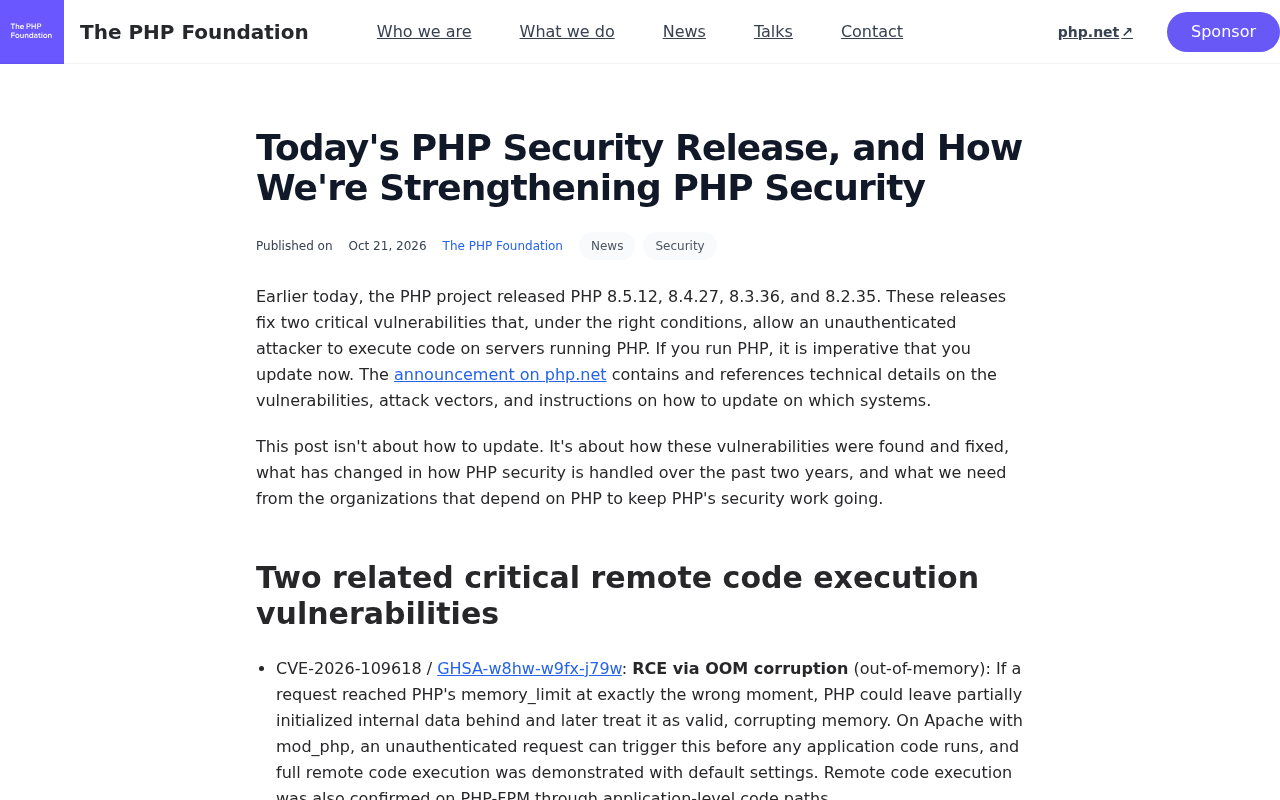
The PHP Foundation has released a round of security updates and published a companion post explaining how the team is systematically strengthening PHP's security capabilities. On Hacker News, the topic earned 313 points and 158 comments—far more engagement than a routine patch release would typically generate. That in itself shows the developer community's sustained interest in how PHP's security is governed.
Why a Security Release Sparked Community Discussion
On the surface, this is just a routine security version update. But the Foundation chose to publicly explain its security hardening measures alongside the patch release, shifting the discussion focus from "which holes were fixed" to "how do we have fewer holes in the future."
High engagement on Hacker News typically occurs around two types of topics: infrastructure changes with extremely broad impact, and transparency actions at the governance level. As a language powering a large number of web applications, PHP's security strategy adjustments inherently carry a public dimension. By putting the patch release and the security roadmap in the same announcement, the Foundation synchronized two things with the community: how immediate risks are being addressed, and how long-term capabilities will be built up.
For teams using PHP, the value of this release approach lies in predictability. Operations and security personnel need to judge not only "whether to upgrade immediately," but also "whether the handling cadence for similar issues going forward will be stable."
CVE (Common Vulnerabilities and Exposures) is a standardized identification system for publicly disclosed information security vulnerabilities. Each vulnerability receives a unique number, making it easier to track across projects and tools. Open source projects typically center their security advisories on CVE lists, describing affected versions and fixed versions. However, CVE itself only records the technical facts of a vulnerability—it does not include the project's security governance thinking, remediation strategy choices, or long-term improvement plans. By merging patch notes with the security roadmap, the PHP Foundation is effectively supplementing governance-level context beyond CVE information, which is the main difference from conventional security advisories.
The Significance of Synchronizing Security Releases with Security Building
Security advisories from traditional open source projects are often limited to CVE lists and affected versions—complete information but lacking context. The PHP Foundation's approach this time is to present patches as one link in a security system.
The practical impact of this narrative shift is that developers can understand the triggering causes and remediation thinking behind patches, rather than mechanically executing version upgrades. For teams building long-term projects on PHP, understanding the causes of security issues has more reusable value than memorizing a version number—similar coding patterns or configuration issues are likely to reappear in other code paths.
Transparency also means clearer responsibility sharing. The Foundation demonstrates its investment in security processes in the announcement, and the community can respond with more specific feedback accordingly, rather than guessing about the project's security priorities in an information vacuum.
Dependency chain security is a core concept in recent discussions of software supply chain security. PHP projects typically introduce numerous third-party libraries through Composer, and frameworks and libraries often lag behind core releases in adapting to PHP core security fixes. This means that even after upgrading the PHP runtime, upper-layer dependencies may still contain unpatched code paths. Assessing dependency chain status requires checking each dependency package's version constraints, update records, and known vulnerability advisories—not just confirming the core version number. For long-term maintained projects, incorporating dependency chain audits into regular processes is more reliable than ad-hoc investigation after a security incident.
Practical Impact on Developers and Enterprises
The value of security updates ultimately comes down to action. The following areas deserve attention from users of the PHP tech stack:
- Upgrade cadence: Security versions typically need to be evaluated and deployed as soon as possible, especially for internet-facing services.
- Dependency audits: There is a time lag in how frameworks and third-party libraries follow up on core version security fixes, so the status of the entire dependency chain needs to be confirmed.
- Process institutionalization: Incorporating the handling approach of this security release into the team's vulnerability response process yields more long-term benefit than a one-off fix.
For enterprises, the Foundation's publicly disclosed security building explanations can serve as a reference for evaluating the maintenance quality of a tech stack. An open source project willing to continuously invest in security processes and capable of explaining them clearly to the outside world is generally more controllable in terms of long-term maintenance risk.
Community Reaction and Follow-up Observations
The volume of 158 comments reflects the community's willingness to participate in PHP security governance. Discussion tends to concentrate on two levels: scrutiny of specific security mechanisms, and evaluation of the Foundation's resource investment and response speed. This feedback is itself part of the open source security system—public discussion will push the project to provide clearer explanations in the next round of releases.
What's worth watching going forward is whether the security hardening measures mentioned by the Foundation can form a stable cadence: whether there will be periodic security building updates, and whether the remediation process has quantifiable improvement metrics. For users, continuously tracking this kind of information is more effective than passively responding after each security incident.
One-line Summary
The PHP Foundation publicly disclosed security patch releases alongside its security system building, sparking heated community discussion.
Paragraph Summary
The PHP Foundation released security updates and simultaneously disclosed security hardening measures, earning 313 points and 158 comments on Hacker News. The article analyzes why this release sparked discussion: by putting the patch release and security roadmap in the same announcement, the Foundation shifted the discussion focus from "which holes were fixed" to "how do we have fewer holes in the future," improving predictability and transparency. For developers, this means understanding the causes and remediation thinking behind patches rather than mechanically upgrading versions. The article suggests that users of the PHP tech stack pay attention to upgrade cadence, dependency chain audits, and institutionalizing vulnerability response processes, and notes that follow-up observation should focus on whether the Foundation's security hardening measures can form a stable cadence with quantifiable metrics.
Related articles

Free Unlimited Claude Code Solution: Agnes AI + CC Switch Setup Guide
No paid subscription needed — pair the free AI platform Agnes AI with the open-source tool CC Switch to provide a backend for Claude Code, enabling unlimited free calls to text, image, and video models. This guide covers the full setup, test results, and usage boundaries.

A Complete Zero-Cost Guide to Getting Started with Claude Code for Beginners in China
A beginner's guide to Claude Code for users in China: two installation methods (command line and IDE plugin), full configuration steps for replacing the official API with the free domestic LongCat model, and a hands-on demo of building a small tool with natural language, plus tips.

When the NSA Gets Involved: The AI Supply Chain Crisis Behind Open-Source CVEs and API Key Hijacking
Multiple open-source projects disclosed severe CVEs in one day, PHP flaws alarmed the FBI, and Railway and OpenCode were breached with API keys stolen. This article breaks down the vulnerability window, AI-accelerated exploitation, and the AI supply chain crisis behind the API key black market, with a developer defense checklist.