Pi Agent in Practice: From Zero to One, Surpassing Claude Code
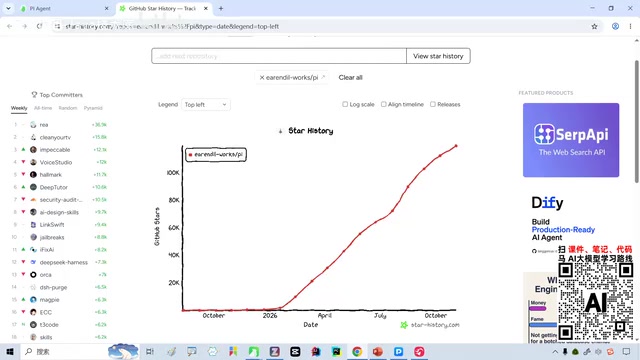
Pi Agent's stars climbed steadily from thousands to nearly 70,000, reflecting real demand for lightweight Agent frameworks.
The article centers on Pi Agent's GitHub star growth, noting a four-stage curve: early slow accumulation, traction in the thousands, a breakthrough near 20,000, and a sustained climb to nearly 70,000 with further acceleration. This staircase-like sustained growth rather than a one-off explosion shows structural developer interest. Positioned as a "minimalist Agent" and compared with Claude Code and Codex, minimalism means lower configuration cost, a lighter runtime, and a gentler learning curve. The article cautions that fast star growth does not equal comprehensive functional superiority, and selection should be based on use cases. It also stresses that AI coding tools iterate extremely fast, and staying information-sensitive matters more than chasing a single project; starting with Pi Agent now still benefits from rich community experience.
Why Pi Agent Deserves Attention
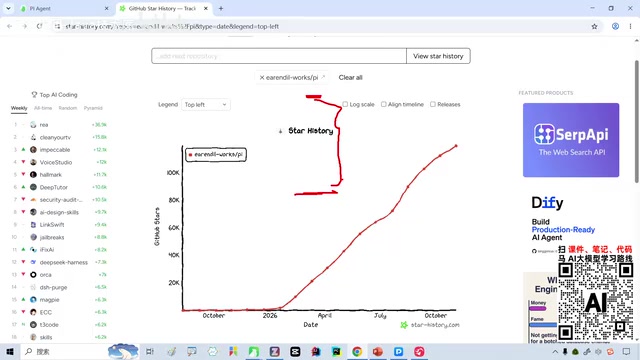
If you haven't been paying attention to AI coding tools lately, you might have missed a project that is rapidly rising—Pi Agent. According to a Bilibili creator's share, Pi Agent's GitHub star growth follows a very clear four-stage pattern: from early slow accumulation, to initial traction in the thousands, to a breakthrough near 20,000 stars, then a sustained climb to nearly 70,000, and it is currently still accelerating. This kind of continuous rather than one-off viral growth curve shows that the developer community's interest in it is structural, not a passing fad.
The creator also admitted that content like Agent Scope and Codex recorded two months ago already counts as "long ago" topics, while Pi Agent is something new that only came into view in the past two or three months. This reminds us: AI coding tools iterate extremely fast, and to keep up, you either need to follow the news regularly or rely on information channels from professional organizations.
Pi Agent's Positioning: Minimalist but Not Simple
As the title suggests, Pi Agent's core selling point is the "minimalist Agent," and it is being compared with Claude Code and Codex. Minimalist means lower configuration cost, a lighter runtime, and fewer abstraction layers. For developers, this often means faster onboarding and easier understanding of the internal logic.
That said, it should be noted that this material mainly focuses on Pi Agent's popularity trend and project background, and does not dive into specific installation steps or code details. The creator positions it as a "nanny-level hands-on tutorial," but the public content is more about building a cognitive framework: what this project is, why it is popular, and what stage of development it is in. For readers who want to get hands-on immediately, it is recommended to practice alongside the official repository documentation.
The Developer Signal Behind the Star Curve
A GitHub star history chart is an intuitive window into the health of an open-source project. The Stars History visualization tool used by the creator shows that Pi Agent's star count jumped significantly in 2026, climbing from the early thousands to around 20,000, and then continuing to nearly 70,000.
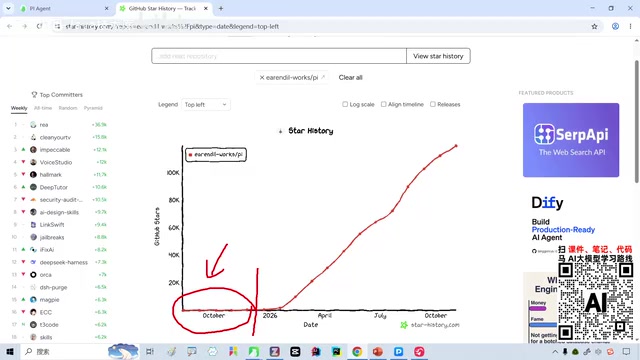
This curve has several notable features. First, the growth is not a single vertical spike but a sustained rise with a staircase feel, indicating that while the project keeps attracting new users, it also maintains retention and discussion heat. Second, the three stages—from "lag phase" to "sustained rise" to "further acceleration"—connect naturally, consistent with the typical path of a tool-type project moving from community validation to mainstream adoption. Third, the creator specifically emphasizes that it is "not a single sudden explosion," which is precisely an important yardstick for distinguishing short-term marketing projects from projects with real engineering value.
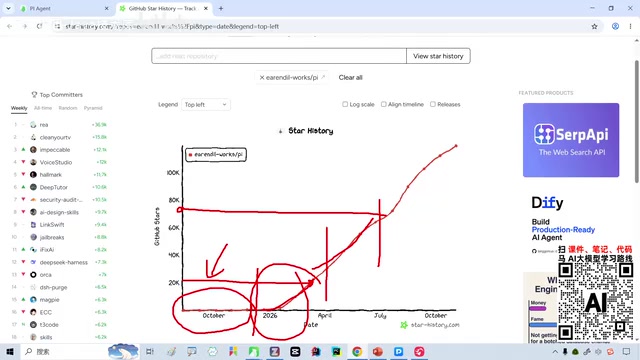
GitHub stars are users' bookmark markers for repositories and are often used as a rough indicator of a project's popularity. But star counts themselves are easily influenced by marketing activities, social media exposure, and other factors, so what is more worth watching is the temporal shape of the star growth curve. Tools like Stars History periodically scrape star counts and plot time series, making it possible to distinguish "single-point explosion" (a short vertical spike followed by a rapid decline) from "sustained growth" (staircase-like rise with retention). The latter often means that while the project keeps attracting new users, there is no large-scale churn—a signal of higher community health. However, stars are not equivalent to code quality or production readiness; they are merely a window into developer attention.
A Comparative Perspective with Claude Code and Codex
The phrase "surpassing Claude Code and Codex" in the title is worth unpacking. Claude Code and Codex represent two different routes: the former relies on the official capabilities of a major model vendor, while the latter has deep historical accumulation in code generation. Pi Agent, as a latecomer, is given the "minimalist" label, suggesting it may have made reductions in architectural complexity, startup barriers, or interaction style.
What needs to be viewed objectively is that fast star growth does not equal comprehensive functional superiority. The advantage of minimalist tools often lies in focusing on specific scenarios rather than covering all needs. When choosing, developers should judge based on their own workflow: do they need an out-of-the-box all-purpose assistant, or a lightweight, embeddable Agent framework that is easy to further develop? The creator's tutorial is positioned as "starting from zero," which also indirectly shows that Pi Agent's learning curve is relatively gentle.
Claude Code is the official coding Agent tool launched by Anthropic, deeply integrated with the Claude model, emphasizing direct code understanding, modification, and task execution in the terminal. Codex originates from OpenAI's code generation model series, early on widely known as the underlying capability of GitHub Copilot, representing historical accumulation in code completion and generation. The two reflect two routes: "model vendor official Agent" and "code generation model capability." Pi Agent, as a latecomer, is labeled "minimalist," which may mean it reduces abstraction layers and configuration complexity in its architecture, making it easier for developers to understand and extend. But minimalism often comes with focused functionality and may not cover all scenarios of Claude Code or Codex.
Is It Still Worth Starting Now
The creator made a very practical reminder in the video: if you have never heard of Pi Agent, it means there is still a bit of distance between you and new AI technology. This is not meant to create anxiety but to state a fact—the dissemination window for AI coding tools is shrinking. Judging from the position of the star curve, Pi Agent has already passed the earliest cold-start period, and community documentation and case studies should be much richer than in the early days. Starting now actually lets you stand on more prior experience.
For developers who want to learn systematically, the suggested path is: first run through the official examples, understand the Agent's scheduling logic, then compare and migrate against the usage habits of Claude Code or Codex. The value of minimalist tools is not to replace your thinking but to help you turn ideas into runnable prototypes faster.
An Agent framework usually refers to a scheduling system built around large language models, responsible for managing task decomposition, tool invocation, context passing, and result aggregation. The design philosophy of a minimalist Agent is to minimize the abstraction layers of the framework itself, letting developers face the model and tools directly rather than learning a complex DSL or configuration system. The advantages of this approach are low startup barriers, short debugging paths, and easy embedding into existing workflows; the cost is that some advanced features (such as complex memory management and multi-Agent collaboration orchestration) may need to be implemented yourself. Understanding this helps determine whether Pi Agent suits your project: if you need to quickly validate ideas and integrate lightly, a minimalist framework may be more suitable; if you need out-of-the-box full-pipeline capabilities, an official all-purpose tool may be more worry-free.
Conclusion
Pi Agent's rise is no accident. The sustained climb of its star curve from thousands to nearly 70,000 reflects developers' real demand for a lightweight Agent framework. Whether it truly "surpasses" Claude Code and Codex depends on your use case, not a simple comparison of buzz. Staying sensitive to tools like this is more important than chasing any single specific project.
Related articles

Gemini 4 Neon Review: Benchmark Scores Rival Carbon, API Pricing and Quota Breakdown
Google Gemini 4 Neon is now live, benchmark scores closely tracking Carbon, API pricing 3/15 at twice Hydrogen's rate. This article compiles Bilibili creator testing: Neon can replace 90% of Carbon scenarios, AntiGravity quota consumption is only one-third of Carbon, plus subscription channel restrictions and 2API ban risks.

Gemini 4 Helium Coming Soon? Signals of Google Loosening Subscription Restrictions
Google team member hints releases will continue; community speculates Gemini 4 Helium (Flash Lite) may be next. Subscription ban controversy gets a response as product lead says "Soon," suggesting restrictions may be lifted. This article covers Gemini developments, OpenAI Coding Agent and risk management, Doubao real-time audio-video API, and compute business dynamics.

AI-Assisted React Development in Practice: Optimizing a Video App and Handling Errors
A 14-year veteran developer demonstrates AI-assisted React video app optimization: compressing video from 80MB to 5MB (~94%) via ImageKit, plus reliable error handling and retry mechanisms. Includes planning, code understanding, and verification methods for working with AI.