Pitch Avatar HR Suite: Reshaping HR Onboarding and Training with Conversational AI Avatars

Pitch Avatar HR Suite uses conversational AI avatars to handle onboarding training and policy Q&A while tracking learning bottlenecks.
Pitch Avatar HR Suite is an HR tool launched on Product Hunt that tackles the pain point of HR teams spending up to 70% of their time on onboarding, mandatory training, and repetitive policy Q&A. It uses conversational AI avatars to teach from company materials and answer employee questions in real time, switching to an HR assistant role for daily policy inquiries. The system tracks completion and bottleneck locations and sends reminders, letting HR intervene proactively instead of waiting for results. It offers a 14-day free trial with a 50% discount using code PRODUCTHUNT2026 before November 30. Accuracy of policy answers and employee acceptance of avatar-led training remain key uncertainties.
Pitch Avatar HR Suite: Reshaping HR Onboarding and Training with Conversational AI Avatars
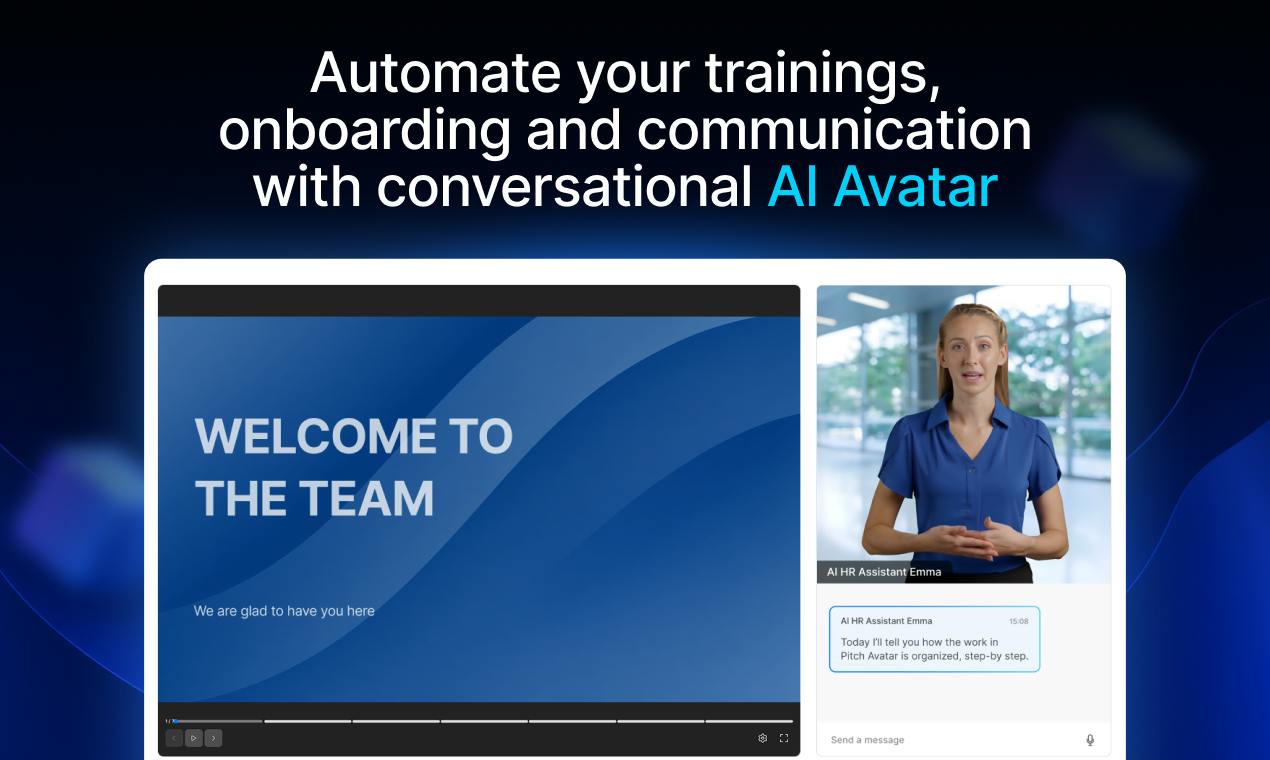
HR teams should be spending their time talking to people, but the reality is that up to 70% of the workday is consumed by onboarding processing, mandatory training, and repeatedly answering the same questions—and it's hard to tell which of these efforts actually works. Pitch Avatar HR Suite, launched on Product Hunt, aims to change this with conversational AI avatars—allowing avatars to teach based on the company's own materials and serve as HR assistants during courses and daily work, answering employee questions.
From "Repetitive Labor" to "Trackable Automation"
The core logic of HR Suite isn't complicated: hand off information that is highly repetitive yet must be conveyed accurately (onboarding processes, compliance training, common policy questions) to AI avatars. The avatar doesn't play pre-recorded videos; instead, it teaches based on the materials you provide and answers employee questions in real time during the course.
This brings two immediate changes. First, employees don't have to wait until HR is available to get answers—questions that arise during learning can be resolved instantly. Second, for the first time, HR can clearly see who has completed the training and where someone got stuck. The system sends reminders to help employees keep up, and completion and bottleneck data flows back to HR, forming an optimizable loop.
The difference from a traditional LMS (Learning Management System) lies in interactivity. Traditional systems record "whether it was watched," while HR Suite records "where they got stuck and what they asked"—the latter is clearly a truer signal of training effectiveness.
Traditional LMS (Learning Management System) is a software platform enterprises use to publish, manage, and track online courses (especially compliance training), with typical examples including Moodle, Cornerstone, and Docebo. Its core capabilities are course catalogs, assignment rules, completion status records, and basic reporting. The interaction model of a traditional LMS is "one-way distribution + result recording": employees watch videos or click through slides, and the system only marks "completed/not completed," rarely capturing behavioral details during learning. As a result, it's hard for HR to tell from LMS reports whether the training materials themselves have problems. The differentiator of Pitch Avatar HR Suite is that it brings "process signals" (bottleneck locations, question content) into the data scope, which is closer to the learning analytics approach rather than pure course management.
How the Avatar Plays Both Instructor and Assistant
The product splits the avatar's role into two layers. In course scenarios, the avatar is an instructor, organizing content according to company-uploaded materials, explaining knowledge points, and taking student questions; in daily scenarios, the avatar shifts to an HR assistant, handling recurring policy-inquiry questions—precisely the kind of questions that are the biggest drain on HR time.
This "dual-role" design reduces the learning curve for employees: the same interaction entry point lets them both learn and ask questions. For enterprises, it also avoids purchasing two separate tools for training and policy Q&A.
It should be noted that the original materials did not disclose the avatar's specific appearance customization capabilities, the number of supported languages, or underlying model details—these are areas worth further confirmation when evaluating the product.
The article states that the avatar "teaches based on the materials you provide," which typically involves RAG (Retrieval-Augmented Generation) technology. RAG works like this: first, the enterprise documents you upload (policy manuals, onboarding guides, compliance materials) are split into chunks and stored in a vector database; when an employee asks a question, the system first retrieves the chunks most relevant to the question, then has the LLM generate an answer based on those chunks. Compared with letting the model answer directly from training memory, RAG can anchor answers to the company's own materials, reducing the risk of "fabricating policy." But RAG is not foolproof—when no relevant content is retrieved, the model may still improvise, so mature products usually layer on a "refuse to answer if unsupported" constraint and a human review process for the knowledge base. This is exactly the technical crux of the "accuracy" threshold mentioned in the original text.
Effect Tracking: The Data HR Really Needs
One pain point emphasized in the original material is "the inability to tell what works." HR Suite's response is to turn the training process into data: completion status, bottleneck locations, and reminder delivery. This data lets HR shift from "send out training and wait for results" to being able to intervene proactively—for example, if a certain type of employee consistently stalls at a particular module, they can go back and check whether the material itself has a problem.
The value of this kind of process data is often higher than the final completion rate percentage, because it points to specific, improvable locations.
Pricing and Trial
Pitch Avatar HR Suite offers a 14-day free trial, and with the promo code PRODUCTHUNT2026 before November 30, you can enjoy a 50% discount on any plan. On Product Hunt, the product received 76 votes and 11 comments, ranking 14th for the day, categorized under Productivity, Artificial Intelligence, and Human Resources.
For organizations with small HR teams but heavy training and policy Q&A burdens, the direct appeal of such tools is to separate repetitive communication from people's schedules. As for whether the actual experience of avatar-led teaching can reach the level of a real person, that still needs to be verified through trial.
A Calm Assessment
As conversational AI avatars enter the HR field, the technical threshold isn't actually in "generating content," but in accuracy: once a policy Q&A answer is wrong, the cost is far higher than in ordinary customer service scenarios. The original materials don't explain how the product constrains the avatar's answer scope or whether it supports human review of the knowledge base—this is the key to whether it can be deployed in compliance-sensitive enterprise environments.
Another point worth watching is employee acceptance. When facing an avatar for onboarding training, new employees' feelings are obviously different from facing a human HR. Whether the product can strike a balance between efficiency and "human touch" will determine whether it saves HR time or merely shifts the communication cost to employees.
In HR and compliance scenarios, common technical means of constraining AI answer scope include: knowledge base whitelisting (the avatar draws only from reviewed documents), refusal mechanisms (when retrieval confidence is below a threshold, replying "please consult HR" rather than guessing), human review and version management (policy updates must be re-reviewed before taking effect), and conversation log auditing (for after-the-fact tracing of incorrect answers). These mechanisms determine whether the product can pass enterprise compliance review. The original text mentions that the source materials did not disclose relevant details, so evaluation should focus on confirming: whether knowledge base permission tiers are supported, whether there is answer traceability (citing source passages), and the correction process for incorrect answers. For high-stakes scenarios like policy Q&A, products lacking these capabilities will find it hard to land in regulated industries.
One-line Summary
Pitch Avatar HR Suite uses conversational AI avatars to handle onboarding training and policy Q&A while tracking learning bottlenecks.
Paragraph Summary
Pitch Avatar HR Suite is an HR tool launched on Product Hunt that aims to address the pain point of HR teams spending up to 70% of their work time on onboarding processing, mandatory training, and repetitive policy Q&A. Its core is using conversational AI avatars to teach based on the company's own materials and answer employee questions in real time during courses; the same avatar shifts to an HR assistant in daily scenarios to handle recurring policy inquiries. The system tracks training completion and employee bottleneck locations, sends progress reminders, and lets HR shift from passive waiting to proactive intervention—closer to a true signal of training effectiveness than a traditional LMS that only records "whether it was watched." The product offers a 14-day free trial, with a 50% discount using the promo code PRODUCTHUNT2026 before November 30. The article also points out that the accuracy of policy Q&A and employee acceptance of avatar-led training are the two key uncertainties determining whether it can be deployed.
Related articles
ClawDOS: Bringing AI Coding Capabilities to DOS
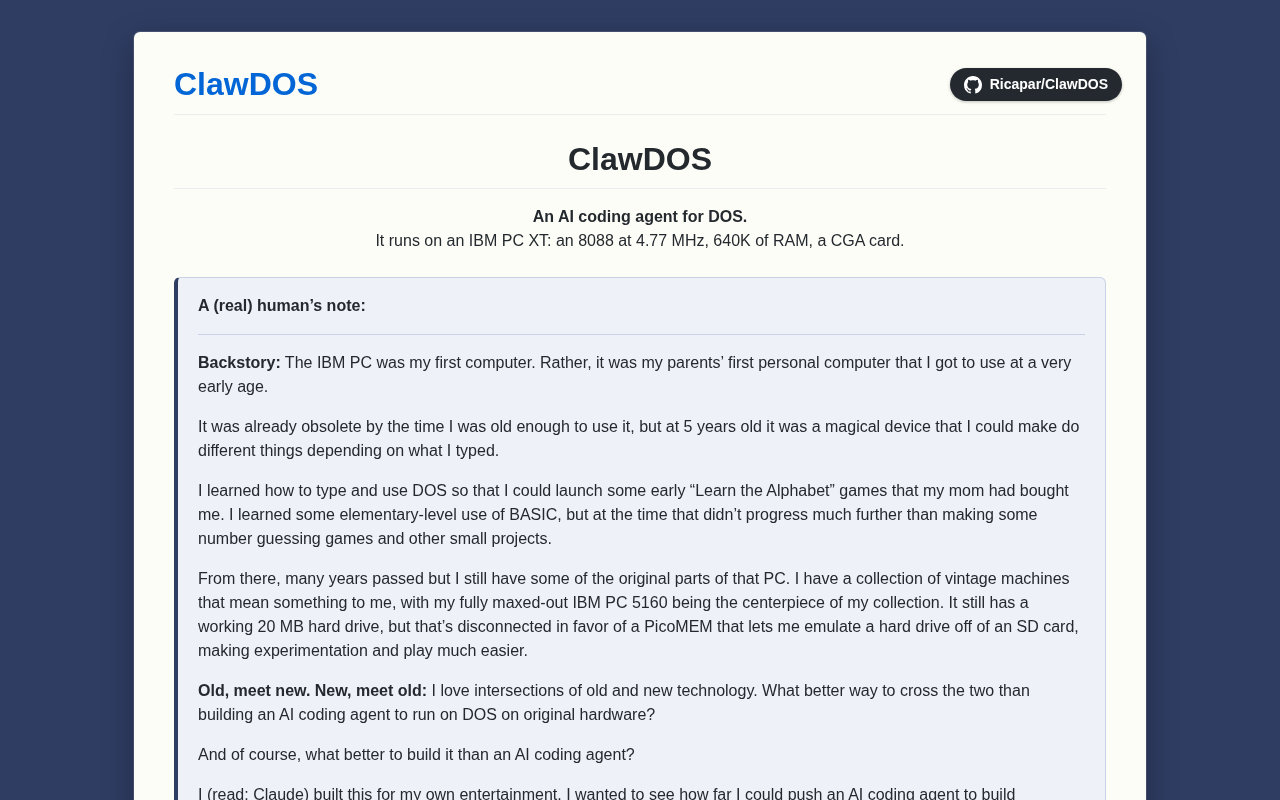
ClawDOS is an AI coding agent project for DOS, exploring the possibility of bringing AI coding assistance into resource-constrained retro computing environments. This article analyzes its positioning, use cases, and community response.

Baseten Releases Bison-1 and Groundhog-1, Topping the Decision Model Leaderboard
Baseten releases open-weight decision models bison-1 and groundhog-1 built on Gemma 4; bison-1 scores 76 on the AA Decision Index v2.1 to top the leaderboard. Both support 128k context and image input—here we analyze their capability combination, benchmark significance, and selection advice for developers.

Cline CLI v3.0.75 Released: Yolo Mode Now Default for One-Shot Runs
Cline CLI v3.0.75: one-shot runs now default to yolo mode, --timeout and Ctrl+C can interrupt the first round, read_files is no longer truncated to 8k chars, plus reasoning parameter fixes and 94 new providers.