PitPro Tire-Changing Robot Debuts in Canada: Four Tires in 15 Minutes

PitPro's automated tire-changing robot launches in Canada, promising a full four-tire swap in 15 minutes.
Startup PitPro has launched its automated tire-changing robot in Canada, claiming the system can complete a full four-tire swap in 15 minutes. The process involves lifting, dismounting, balancing, and torque tightening — all precision-critical steps requiring deep integration of robotic arm control, computer vision, and torque feedback. Canada's high labor costs and concentrated seasonal tire-change demand make it a natural first market. Key unknowns — including cross-vehicle compatibility, handling of edge cases, and commercial pricing — will determine whether the system can scale beyond a single proof-of-concept.
PitPro Tire-Changing Robot Goes Live in Canada
Startup PitPro has announced that its first automated tire-changing robot is now operational in Canada. According to official figures, the system can complete a full four-tire swap on a single vehicle in just 15 minutes — marking a meaningful step toward automation and reduced human dependency in the automotive aftermarket service industry.
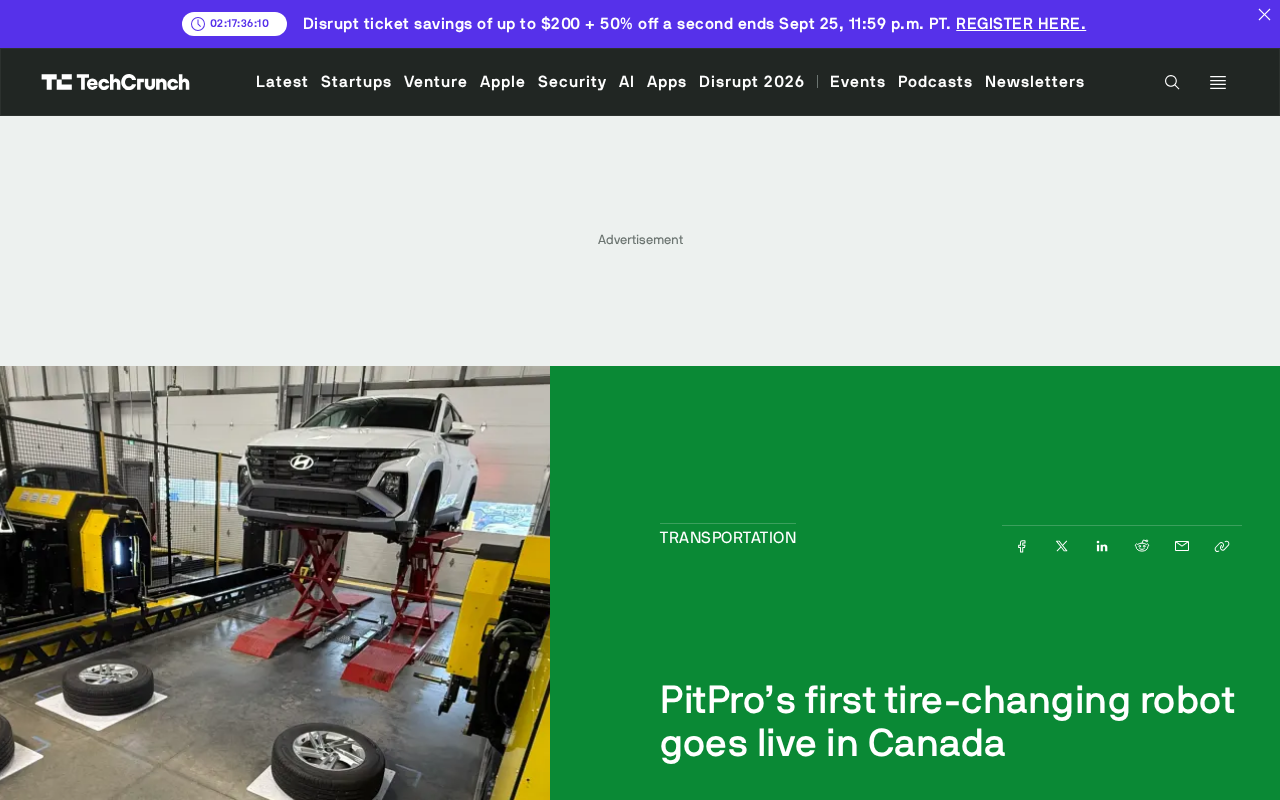
For a sector that has long relied on manual labor, that efficiency figure carries real weight. At a traditional shop, a technician completing a four-wheel tire change can take considerably longer depending on skill level and vehicle type, and the process is heavily dependent on staffing. PitPro aims to standardize and replicate this workflow through robotics.
What Automated Tire Changing Actually Involves
Tire changing may seem straightforward, but it encompasses multiple precision- and safety-critical steps: lifting the vehicle, removing lug nuts, dismounting and mounting tires, dynamic balancing, and torque tightening. Handing this entire sequence over to a robot requires extensive engineering integration across robotic arm control, computer vision, and torque feedback systems.
PitPro's choice of Canada as its launch market reflects some practical realities: high local labor costs and concentrated seasonal tire-change demand — the annual switch between winter snow tires and summer tires. During peak changeover periods, long wait times and technician shortages are widespread pain points across the industry. If an automated system can reliably deliver "four tires in 15 minutes," it has direct value in alleviating capacity bottlenecks.
Beyond Speed: The Broader Considerations
Raw speed isn't the whole story. Whether the market will embrace a robotic solution also depends on compatibility with different vehicle models and wheel hub specifications, the ability to handle edge cases (such as seized lug nuts or non-standard modifications), and the return-on-investment timeline for a single unit. These details will determine whether PitPro remains a demonstration project or achieves genuine scale.
Robotic arm control, computer vision, and torque feedback integration represent the core technical challenges for this type of system. The vision system must locate lug bolt holes in real time and adapt to the geometric differences across vehicle types. Torque feedback ensures bolts are tightened to the safety-standard values specified for each vehicle — typically in the 100–150 N·m range depending on the model — avoiding both under-torquing (a safety hazard) and over-torquing (which can damage threads). Dynamic balancing after installation is equally non-negotiable: if a tire is out of balance, it causes steering wheel vibration at highway speeds — a step that traditionally relies on a balancing machine and a technician's judgment. Fully integrating all of these steps into a single automated pipeline demands highly coordinated, real-time control across every subsystem.
Industry Outlook
Automation in automotive services isn't a new idea, but tire changing — with its high-frequency human-machine interaction and complex motion requirements — has always been one of the harder nuts to crack. PitPro's deployment at least demonstrates that the technical approach is viable.
Zooming out, this type of robot is a snapshot of a broader wave of automation in physical service industries. As labor costs rise and skilled technician shortages deepen, more repetitive, standardized in-person services are looking to machine-based alternatives. Tire changes, car washes, and routine maintenance are all candidates for the next round of reinvention.
That said, publicly available information remains limited. PitPro has yet to disclose detailed technical specifications, deployment scale, or commercial pricing. Whether this robot represents a single proof-of-concept or a production-ready system is still an open question. Its real-world performance will serve as a useful reference point for gauging the maturity of physical service automation.
In academic and industrial circles, this category of work typically falls under "unstructured environment robotics" — distinct from factory-floor industrial robots that operate with fixed positions and standardized parts. In automotive service settings, vehicle placement, model specifications, and component wear all introduce significant variability, demanding stronger perceptual generalization and fault tolerance from the robot. This is precisely why industrial automation has been highly mature for decades while in-person service automation remains in its early stages — the technical barrier isn't mechanical execution itself, but robust handling of non-standardized inputs. If PitPro can consistently validate system stability in real operational environments, the technical depth it accumulates will represent a meaningful competitive moat.
Related articles

GPT-Next Leak, Gemini 4 Argon Imminent: AI News Roundup
GPT-Next leak suggests extreme efficiency; OpenAI's 28-day shipping pledge boosts speed 50%; Gemini 4 Argon nears release; Anthropic subscription value report sparks debate.

GPT-Next Leaked, Gemini 4 Argon Speeds Up, Fable 5.5 May Launch Today
OpenAI's GPT-Next model leaks, expected to be extremely low-cost and possibly part of the 28-day release plan; Gemini 4 Argon internal testing accelerates, NanoBanana 2.1 is live; Semi Analysis tests show Claude Max's equivalent API value is about 5 times that of ChatGPT Pro; Fable 5.5 may launch today.

Gemini 4 Argon Launches Globally: Key Highlights from the AI Daily Brief
Google opens Gemini 4 Argon globally across Pro and Ultra subscriptions and the API, and demonstrates robot control. This article rounds up open-source models, Agent infrastructure, cost transparency, and safety governance updates.