Plannotator: Make AI Agents Get Their Plan Approved Before Writing Code
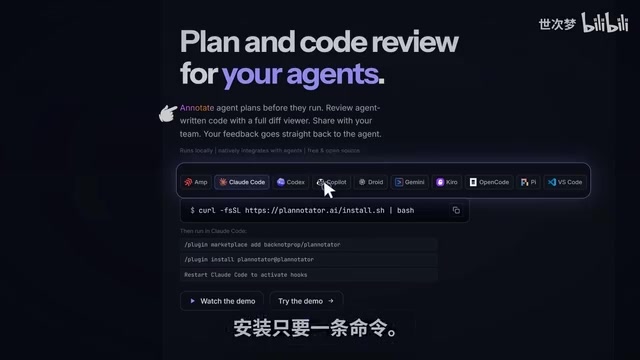
Plannotator puts AI agents' coding plans into a standalone review interface, reviewing plans before greenlighting code to avoid rework.
Plannotator is an open-source tool on GitHub Trending that solves rework from derailed plans in AI agent coding. It moves review before agent execution with a standalone plan review interface supporting delete/add/replace annotations sent back as structured feedback, then offers code review mode with diff and line-by-line suggestions. Plans have versions, reviews have history, and annotations are traceable. It integrates with Cloud Code, Codex, Copilot, Open Code, and VS Code, runs locally, is open source, and installs with one command.
AI writes code faster and faster, but the real headache is when it goes off track on the plan before it even starts. Plannotator puts the agent's plan into a real review interface, letting you check the plan first and then greenlight the code. The project surfaced on GitHub Trending today and is being discovered by more developers.
What problem it solves: a derailed plan costs more than a code error
The typical agent coding workflow is: you give a one-line requirement, and the agent immediately starts producing code. The problem is that if its understanding of the task was off from the start, you end up with a large chunk of code that needs to be thrown out and redone. Plannotator's approach is to move the review point forward—review the agent's plan before it executes.
According to a Bilibili video introduction, Plannotator "brings the agent's plan close to a real review interface." "Real" here means it doesn't rely on back-and-forth conversation in a chat box, but instead provides a standalone review entry point. Installation takes just one command, and the official website entry is straightforward: install first, then review the plan, then review the code.
The judgment behind this design is clear: a chat box is good for conversation, not for review. A plan needs to be examined item by item, annotated, and modified—operations that get drowned out in a conversational stream. Plannotator extracts review into a workspace where you can linger and trace back.
Core features: A two-stage process of plan review and code review
Plannotator supports two modes—plan review and code review—and the command features are integrated onto a single page for easy comprehension.
Plan review: before execution, delete, add, or replace
Plan review happens before the agent executes. You can select a sentence in the plan to delete, add content, replace wording, or ask the agent to take a different approach. These annotations don't just sit in the interface—they're sent back to the agent as structured feedback, and the agent adjusts its plan accordingly.
Versions and annotations are traceable: plans have versions, and reviews have history. This means you can see how the plan evolved step by step, and trace back which version a given annotation was raised in.
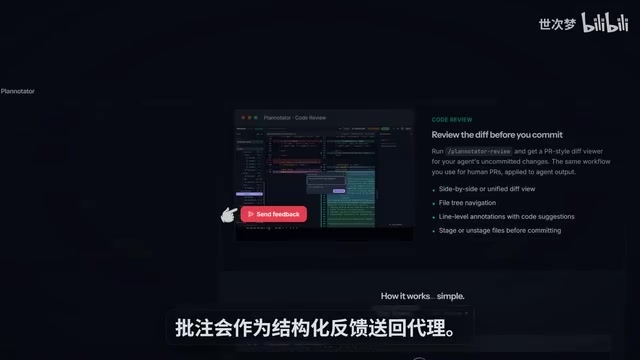
Code review: view the diff after completion, suggest line by line
Once the code is written, you enter code review mode to view the diff, inspect file changes, and make line-by-line suggestions. One workflow, one switch—from plan review into code review.
Whether to approve or send back is still up to the human. The agent works as usual, review happens in a real interface, and feedback is returned automatically. The division of labor is clear: the agent produces, the human gates, and the interface carries the review actions.

"Structured feedback" means annotations aren't a block of free text, but machine-readable data carrying position, type (delete, add, replace, change approach), and specific content. Compared to natural language like "change this here" in a chat box, structured feedback lets the agent know exactly where and how to change things, reducing second-round misunderstandings. Annotations are bound to plan versions: after the agent adjusts the plan it generates a new version, and old annotations remain on their corresponding versions, forming a traceable review chain. This design encodes the human's modification intent directly into the agent's input, rather than relying on the agent to guess from conversation history.
A diff (difference) is how version control displays file changes, typically presented with line-level add/delete markers, and is the core vehicle for code review. In AI agent coding scenarios, the agent produces a large amount of code at once, and reading complete files directly makes it hard to quickly locate changes. Code review mode diffs the agent's output against a baseline version, so reviewers can inspect additions, deletions, and modifications file by file and line by line, and leave suggestions on specific lines. Line-by-line suggestions are more precise than overall assessments—they point directly to the code that needs adjustment, avoiding vague feedback like "something feels off overall."
Multi-agent integration, local and open source
Plannotator can integrate with multiple agents, including Cloud Code, Codex, Copilot, Open Code, and VS Code. One product integrating with multiple workflows means you don't need to switch review tools for each agent.
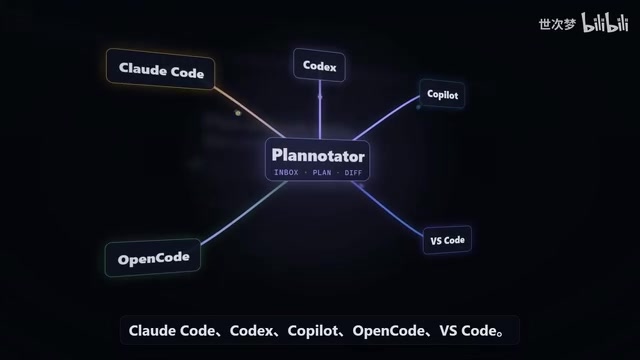
It runs locally and is open source, so you can keep modifying it. For teams that care about code controllability and keeping data local, these two points matter more than a feature list. Open source also means the review interface's behavior can be audited, and the annotation feedback logic can be verified.
Why it's worth watching
Competition among agent coding tools is currently focused on generation capability and tool calling, and the review step is often reduced to a single "looks good" in the chat box. By making review a standalone product, Plannotator is effectively filling in a neglected link: the decision interface between humans and agents.
The two-stage design—review the plan first, review the code after—inserts human judgment at the lowest-cost point. Changing one sentence during the planning stage is far cheaper than throwing out and redoing finished code. Structured annotation feedback means review isn't just "agree/disagree," but feedback that can carry specific modification intent.
The project surfaced on GitHub Trending today, indicating that a substantial number of developers have already felt the cost of derailed plans. For your next agent-written code: check the plan first, then greenlight—this workflow may become a common configuration for agent coding.
One-line Summary
Plannotator puts AI agents' coding plans into a standalone review interface, reviewing the plan before greenlighting code to avoid rework.
Paragraph Summary
Plannotator is an open-source tool that hit GitHub Trending, aimed at solving the rework caused by derailed plans in AI agent coding. It moves the review point forward to before the agent executes, providing a standalone plan review interface that supports annotating the plan via delete, add, and replace, and sends structured feedback back to the agent. After the code is written, you enter code review mode to view the diff and make line-by-line suggestions. Plans have versions and reviews have history, making annotations traceable. The tool integrates with multiple agents including Cloud Code, Codex, Copilot, Open Code, and VS Code, runs locally, is open source and modifiable, and installs with just one command. Its core value is inserting human judgment at the lowest-cost point, forming a "review the plan first, then greenlight the code" workflow.
Related articles

Figma Workplace Scandal: Employee Sues CEO for Forcing Confrontation with Harasser
Figma and its CEO are sued by a current employee alleging sexual harassment and discrimination, and forcing the victim to confront her harasser. This article outlines the background, potential impact, and industry reflection.

Jensen Huang and Nvidia: Elite Privilege Behind the Revolving Door of Business and Politics
An opinion piece uses Jensen Huang's reappointment as Nvidia CEO to examine business-government ties and elite impunity, questioning free-market ideals and AI industry governance.
AI Gateway Launches Extraction Models: Precisely Pull Structured Fields from Invoices and Contracts
AI Gateway adds extraction models, debuting with ScaleDown Extract-1, which pulls fields like invoice numbers and contacts from text, images, and PDFs, returning confidence scores and character offsets via AI SDK's experimental_extract.