Plug-in Solar: A New Wave of DIY Photovoltaics Is Rising in America
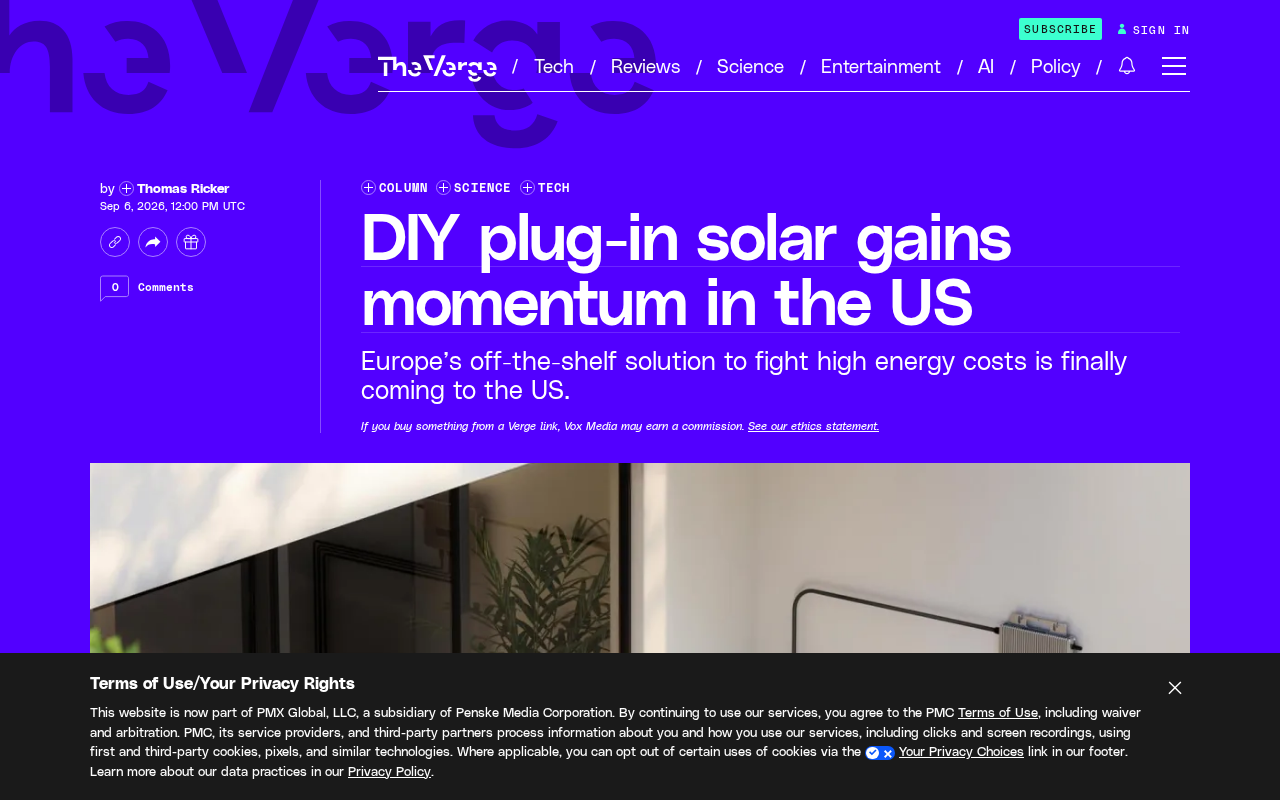
Plug-in solar panels are making the leap from European balconies to American homes, fueled by rising energy costs and DIY culture.
Plug-in solar — popularized in Germany as "balcony solar" — is gaining traction in the U.S. as rising electricity prices, growing energy independence awareness, and America's DIY culture converge. While regulatory hurdles like NEC compliance and fragmented grid interconnection policies have slowed adoption, evolving standards and an expanding product ecosystem suggest the market is nearing a tipping point toward mainstream consumer adoption.
A Quiet Revolution in Energy Autonomy
In Europe — especially Germany — a solar solution known as "Balcony Solar" has been wildly popular for years. Users simply mount a solar panel on their balcony railing, plug it into their home circuit via a standard outlet, and start generating green electricity for self-consumption. Germany is the pioneer and benchmark market in this space — as of 2024, over 4 million balcony solar systems are operating across the country. The government has continuously relaxed policies, raising the permit-free grid connection threshold from 600W to 800W, simplifying meter requirements, and even allowing legal installation with traditional analog meters. The German Association for Electrical, Electronic & Information Technologies (VDE) has developed the dedicated VDE-AR-N 4105 standard, clearly defining the technical parameters and safety requirements for small-scale PV systems, creating a well-established product standard and market ecosystem. Now, this trend is gradually making its way to the U.S. market, and a quiet revolution around energy autonomy is unfolding.
Unlike traditional rooftop solar systems, the defining feature of plug-in solar is the elimination of professional expertise. It doesn't require a professional installation crew or complex electrical engineering modifications — an ordinary user can complete deployment in just a few hours. The technical core of these systems is the microinverter. Solar panels produce direct current (DC), while household circuits use alternating current (AC). Microinverters, integrated directly into the back of the panel or the connecting cable, handle the DC-to-AC conversion. Unlike the centralized inverters used in traditional rooftop PV, microinverters also have built-in critical safety features: anti-islanding protection ensures the system automatically stops outputting power when the grid goes down, preventing electrocution of maintenance workers; power-limiting functions ensure output doesn't exceed the circuit's capacity. Leading microinverter brands currently on the market include Enphase, Hoymiles, and Deye. This low barrier to entry is the core reason plug-in solar spread so rapidly across Europe — and it signals enormous potential in the U.S. DIY solar market.
Why Did the U.S. Plug-in Solar Market Get a Late Start?
Despite balcony solar being well-established in countries like Germany, the U.S. market has been slow to catch up. The core obstacles lie in differences in regulatory frameworks and electrical standards.
The Regulatory and Standards Gap
U.S. electrical codes — such as the NEC (National Electrical Code) — impose strict requirements on home circuit connections. Plugging power-generating equipment directly into a standard wall outlet has long existed in a compliance gray area. The NEC is published by the National Fire Protection Association (NFPA) as NFPA 70. First published in 1897, it has over a century of history and is the legally adopted electrical installation standard in the vast majority of U.S. states and local jurisdictions, with a core focus on preventing electrical fires and electrocution. The NEC is revised every three years, and NEC 2023 has begun discussing simplified provisions for small-scale PV system connections. However, states adopt new versions at different paces, creating a noticeable compliance timeline gap across the country. By contrast, countries like Germany have already issued clear, simplified standards that allow plug-in PV devices under a certain power threshold to be connected without cumbersome approvals — a policy head start that has put the European market far ahead of the U.S.
The Complexity of Grid Interconnection
Interconnection policies vary enormously across U.S. states and utility companies. Grid interconnection — the process of connecting distributed generation equipment to the public grid — is regulated at both the federal and state levels in the U.S. At the federal level, FERC (Federal Energy Regulatory Commission) has established a framework for interconnecting small generation facilities. In practice, however, state Public Utility Commissions (PUCs) and local utilities have significant autonomy. This means that in states actively promoting clean energy, like California and New York, the interconnection process is relatively streamlined; in more conservative states, even small-capacity systems may require engineering assessments, liability insurance, and formal interconnection agreements. Any device that "backfeeds" power to the grid typically requires utility approval and registration — a significant psychological and practical hurdle for consumers seeking a "buy-and-use" experience. Notably, Net Metering policies — where users' surplus electricity is fed back to the grid in exchange for bill credits — also vary by state, and several states have been reducing net metering compensation in recent years. Ironically, this has actually pushed some users toward the "self-consumption" model that plug-in solutions are designed for.
The Tipping Point Has Arrived: Three Driving Forces
According to The Stepback — a hardware and lifestyle column under The Verge — this situation is changing. An increasing number of American consumers are experimenting with DIY plug-in solar, driven by several deep-rooted factors.
The Real-World Pressure of Rising Electricity Prices
U.S. residential electricity prices have been climbing steadily in recent years, prompting more and more households to seek alternatives for reducing energy costs. According to data from the U.S. Energy Information Administration (EIA), the average residential electricity rate rose from approximately 13.2 cents/kWh in 2020 to about 16.6 cents/kWh in 2024 — an increase of over 25%. Some regions have seen even more dramatic increases: California's residential rates have surpassed 30 cents/kWh, and New England states like Massachusetts and Connecticut are above 25 cents. Drivers of these increases include natural gas price volatility, aging grid infrastructure requiring massive investment to upgrade, and extreme weather events raising power system operating costs. Compared to whole-home rooftop solar systems costing tens of thousands of dollars, a plug-in balcony or patio solar kit costing a few hundred dollars looks extremely attractive. Take a 400W plug-in system as an example: it costs around $300–500, can generate approximately 500–600 kWh per year in sunny areas, and at the national average rate of 16 cents/kWh, saves roughly $80–100 annually — paying for itself in 3–5 years. In higher-rate areas like California or New England, the payback period can shrink to just 2–3 years.
The Awakening of Energy Autonomy Awareness
Beyond the financial calculus, there's a growing demand for "energy independence." Frequent power outages caused by extreme weather events have made American households acutely aware of the importance of distributed, controllable home solar power generation. Paired with portable power stations, plug-in solar can form a micro-scale home energy system that provides electricity during critical moments. Portable power stations are a rapidly growing consumer electronics category. At their core are high-capacity lithium battery packs — most using lithium iron phosphate (LiFePO4) chemistry, which offers higher safety and over 3,000 charge cycles — combined with built-in inverters. They're noiseless, emission-free, and safe for indoor use. Leading brands include EcoFlow, Bluetti, Jackery, and Anker, with capacities ranging from a few hundred watt-hours to several kilowatt-hours. When paired with plug-in solar panels, they charge during the day and discharge at night or during outages, forming a micro energy system capable of operating independently from the grid. Multiple large-scale outage events in 2022 and 2023 — from the Texas winter storms to Florida hurricanes — significantly boosted market demand for this combination.
A Natural Fit with DIY Culture
America has a deep-rooted DIY tradition. From customizing RVs to building workbenches, the pool of hands-on consumers is enormous. Plug-in solar hits this demographic squarely in their sweet spot — it saves money while delivering the satisfaction and sense of accomplishment that comes from building something yourself.
Challenges and Opportunities for DIY Solar in the U.S.
Despite strong momentum, several real-world challenges remain before plug-in solar can achieve widespread adoption in the U.S.
First is the issue of safety and compliance. The lack of unified standards means product quality varies widely, and user-installed circuit connections carry potential safety risks, including circuit overload and insufficient grounding protection. Industry voices are broadly calling for the U.S. to quickly learn from Germany's experience and introduce simplified certification standards for low-power plug-in PV. Notably, UL (Underwriters Laboratories) is already working on safety standards specifically for plug-in PV systems, and the NEC 2026 revision cycle is expected to incorporate clearer small-scale PV connection provisions.
Second is the maturity of the product ecosystem. Currently, products specifically designed for plug-in scenarios remain relatively limited in the U.S. market. Most users need to assemble components themselves — purchasing solar panels, microinverters, mounting brackets, and cables separately, then putting it all together. As demand grows, more manufacturers are expected to release "out-of-the-box" all-in-one kits with pre-configured components and detailed installation guides, further lowering the barrier to entry. In fact, some European brands have already begun testing the U.S. market, and domestic startups are quickly following suit.
The Era of Democratized Distributed Energy Is Dawning
The rise of plug-in solar is, at its core, a microcosm of energy production shifting from centralized grids to individual hands. For the first time, it allows ordinary people to participate in clean energy production at minimal cost and with maximum simplicity. This trend aligns with the broader Energy Democratization movement — from rooftop PV to community solar farms to today's balcony plug-in systems, the threshold for power generation keeps falling and the pool of participants keeps expanding.
For the U.S. market, the current moment represents a critical inflection point — the transition from "early adopter experimentation" to "mass consumer adoption." Once regulatory barriers are cleared and the product ecosystem matures, this wave of DIY solar originating in Europe could very well see a true explosion in America. For consumers interested in green energy and smart home technology, plug-in solar is undoubtedly a space worth watching closely.
Key Takeaways
Related articles

Frontend to AI Agent Development: A Frontline Architect Explains Career Paths and Opportunities
A frontline AI architect explains the industry changes and practical paths for frontend developers transitioning to AI Agent development: why pure frontend jobs are disappearing, why Agent + full-stack has become mainstream in hiring, and three transformation routes—Agent development engineer, FDE, and remote contracting—along with corresponding learning strategies.

How to Choose an AI Agent Development Course: Five Pitfall-Avoidance Guidelines
A mechanical-engineering career changer's two-year pitfall-tested checklist for screening AI Agent development courses: complete delivery pipeline, resume-worthy projects, real development perspective, update frequency, and coaching feedback—with concrete judgment methods and pitfall-avoidance tips.

Coze AI Agent Building for Beginners: A Zero-Code AI Agent Development Guide
Coze, ByteDance's one-stop AI application development platform, supports zero-code drag-and-drop AI agent building. This article outlines Coze's core concepts, three advantages, differences between the domestic and international versions, and the distinction between agents and apps, helping beginners quickly get started with AI Agent development.