PNOĒ Launches Self-Administered Respiratory Analysis Mask: VO₂ Max in 8 Minutes

PNOĒ's new self-administered mask lets gym users measure VO₂ max in 8 minutes without a specialist.
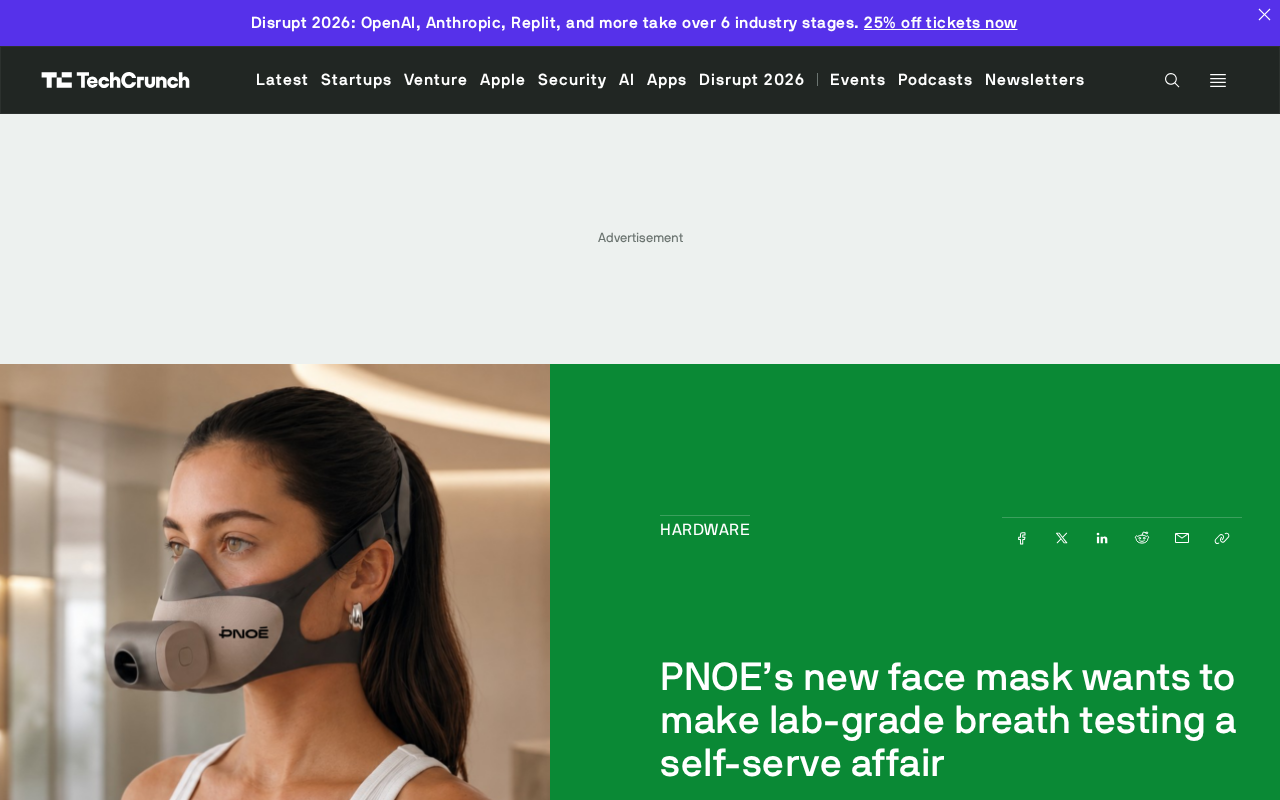
US startup PNOĒ has launched a redesigned self-administered respiratory analysis mask that allows gym users to independently measure VO₂ max and other metabolic markers in just 8 minutes — no professional operator required. The new design is a significant aesthetic upgrade from earlier versions that were widely compared to Bane's mask from The Dark Knight Rises. VO₂ max is a gold-standard predictor of cardiovascular health and longevity, but traditional testing is costly and inaccessible. PNOĒ's approach uses hardware miniaturization and automated protocols to bring clinical-grade CPET testing to the gym floor, though independent validation of its accuracy claims remains pending.
Bringing Lab-Grade Metabolic Testing to the Masses
PNOĒ, a startup based in Malden, Massachusetts, is turning what once required a trained professional into something anyone can do on their own. The company has launched a sleeker, more consumer-friendly self-administered respiratory analysis mask that lets users measure their VO₂ max and other metabolic markers in just eight minutes — no specialist required.
It's worth noting that earlier versions of PNOĒ's mask drew plenty of jokes for their appearance — many said it looked uncomfortably similar to the breathing apparatus worn by Bane, the villain from The Dark Knight Rises. This new iteration has clearly prioritized aesthetics, making the product far more suited to an everyday gym setting.
Why VO₂ Max Matters
VO₂ max — maximum oxygen uptake — is the gold standard for measuring cardiorespiratory fitness and aerobic endurance. It reflects the body's maximum capacity to consume oxygen during intense exercise, and is widely used by athletes to evaluate training progress. Increasingly, it's also recognized as a meaningful predictor of overall health and longevity.
Traditionally, VO₂ max testing requires a professional laboratory or sports physiology facility, specialized equipment, and a trained operator to administer the test. The cost and accessibility barriers have kept it out of reach for most everyday fitness enthusiasts. PNOĒ is directly targeting this gap.
VO₂ max is typically expressed in mL/kg/min. Average adults fall in the 35–50 range, while elite endurance athletes can exceed 80 or even 90. Several large-scale epidemiological studies — including research published in JAMA and the Journal of the American College of Cardiology — have found that cardiorespiratory fitness is one of the strongest single predictors of all-cause mortality, second only to smoking history. Individuals in the lowest fitness tier face significantly higher mortality risk than those in the highest tier, a gap that outpaces traditional risk factors like hypertension and diabetes.
Mainstream wearables like Apple Watch, Garmin, and Polar already include VO₂ max estimation features, but these rely on algorithms that extrapolate from heart rate and movement data — introducing meaningful error margins. They cannot replace the gold standard of directly measuring oxygen and CO₂ concentrations in exhaled breath. PNOĒ's approach uses cardiopulmonary exercise testing (CPET) — the direct measurement method — which is fundamentally more accurate than wearable estimation.
What Self-Administered Testing in 8 Minutes Actually Means
According to PNOĒ, the key breakthrough of the new mask is the "self-administered" experience. Gym users can complete the entire testing protocol independently, without professional assistance, in just eight minutes — receiving VO₂ max and a suite of metabolic markers as output.
The value of this model lies in bringing "lab-grade" testing capabilities down to the gym floor. For gym operators, it means offering high-value health assessments to members without hiring additional specialist staff. For users, it means being able to track metabolic and cardiovascular changes more frequently and at a lower barrier to entry.
Traditional CPET testing requires subjects to wear a mask while performing incremental exercise on a treadmill or cycle ergometer until exhaustion, with an exercise physiologist monitoring and adjusting parameters in real time. A single test typically costs $200–500 at a medical facility — and many cities simply don't have accessible providers.
PNOĒ's self-administered model hinges on standardizing the testing protocol — using fixed step-by-step instructions and automated calibration to shift decision-making from the operator to the device itself. The technical challenges here are non-trivial: ensuring consistent mask seal integrity, processing real-time airflow and gas concentration data, and identifying whether the user has reached a valid test state without human intervention.
The 8-minute duration also suggests the protocol may be submaximal — using mathematical modeling to estimate true VO₂ max rather than requiring the user to exercise to exhaustion. If that's the case, the impact on measurement accuracy is a critical variable that outside reviewers will need to scrutinize carefully.
The Broader Trend in Consumer Health Testing
PNOĒ's product update reflects a major directional shift in consumer health and sports technology: moving capabilities once confined to professional settings into users' own hands, through hardware miniaturization, process automation, and simplified interfaces. From heart rate variability and blood oxygen estimates on wearables to self-administered metabolic analysis, access to professional-grade health data is becoming increasingly democratized.
That said, self-administration raises new questions. Without professional oversight, how do you ensure measurement accuracy, meaningful result interpretation, and appropriate handling of potential health risks? These are areas where products like this will need to continue proving themselves. The available information does not disclose pricing, accuracy specifications, or distribution channels — all of which will be critical to assessing the product's real-world value.
Summary
PNOĒ's self-administered respiratory analysis mask is a concrete example of sports physiology testing going mainstream. It compresses what was once a scheduled, specialist-operated lab procedure into an eight-minute self-service experience at the gym. Whether the product can truly deliver on its "lab-grade" accuracy promises will require more independent validation — but the direction itself represents a clear and compelling trend toward the consumerization of health diagnostics.
Related articles

Build an AI Super Employee System at Zero Cost: A Full Breakdown of Automated Agent Workflows
A deep breakdown of the AI super employee system demoed on Bilibili: agent orchestration, digital human voiceovers, map and enterprise lead generation, 24/7 customer service, and legal modules. We analyze the business logic and compliance risks behind zero-cost signup to help entrepreneurs judge the real ROI of this AI digital employee system.

The Essential Difference Between Chatbots and AI Agents: Crossing from Conversation to Execution
What's the difference between a chatbot and an AI agent? Based on the MCP series on the Learn Tech channel, this article uses examples like booking flights and summarizing notes to explain: a chatbot only gives answers, while an agent actually completes tasks through a think-act-observe loop. It breaks down the four core components—model, tools, memory, and goal—as well as MCP's role as a bridge, and discusses agents' applicable boundaries and permission risks.

Free GitHub Repo: 342 Hours of AI Courses, from Math to MCP Servers
A free GitHub repo offers 342 hours of AI courses: 523 lessons across 20 phases, from math fundamentals to agent building and MCP servers. Nearly 100,000 learners have started.