Pollen Create: The AI Assistant That Generates Interactive Training in One Minute
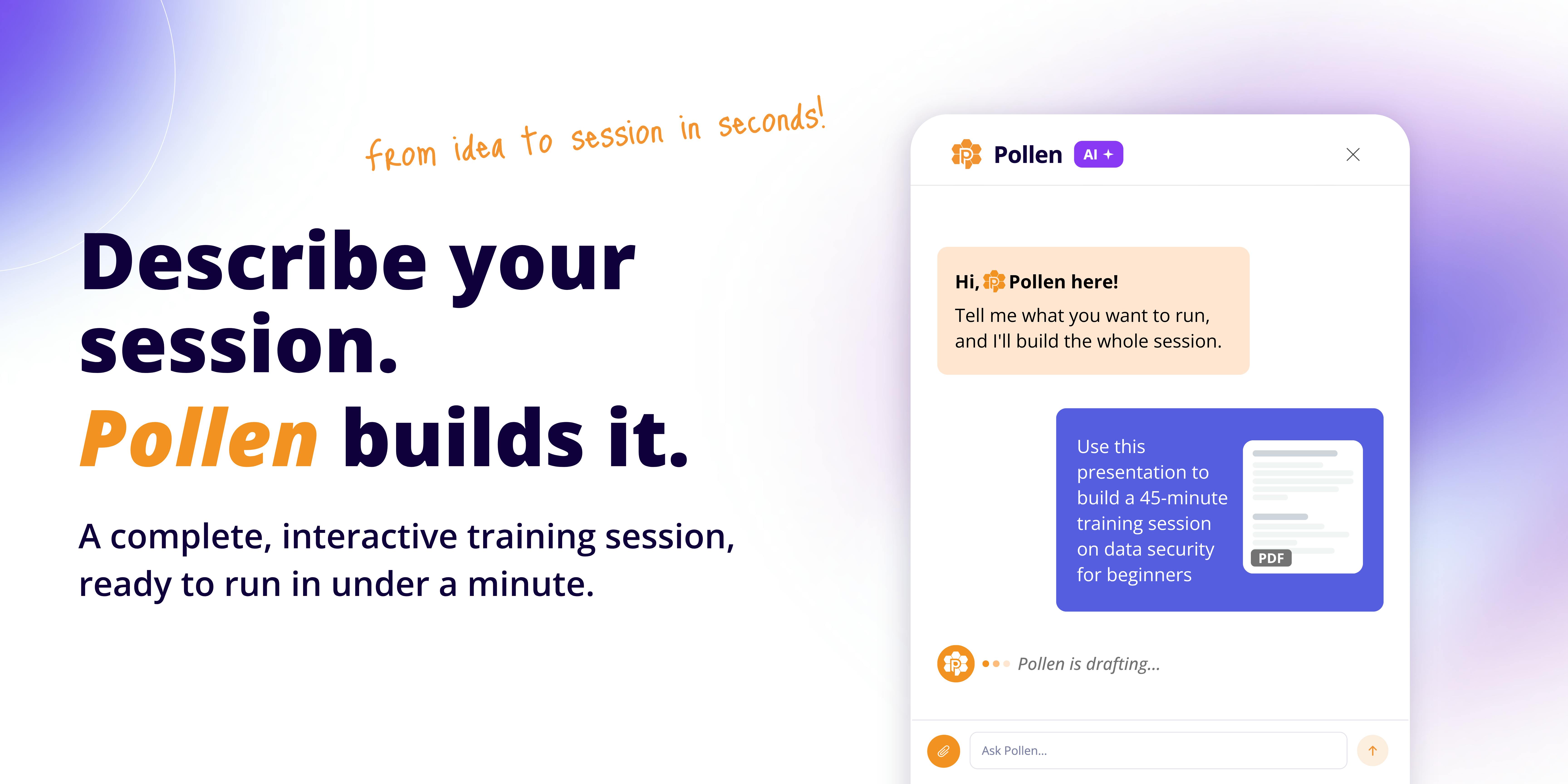
Pollen Create generates complete interactive training sessions in one minute from a description or document.
Pollen Create is an AI training assistant embedded in the Beekast collaboration platform, designed to compress hours of traditional course design into under a minute. Users input a natural language description or upload existing slides/PDFs, and the system generates a full session with structure, timing, and interactive activities — ready to host on Microsoft Teams, Zoom, Webex, or in person. Unlike generic AI tools, it explains its design choices and learns personal preferences over time. The product is currently in early stages, and its effectiveness across diverse audiences remains to be validated in real-world use.
In corporate training and online education, designing a well-structured, well-paced course that genuinely engages participants can take a trainer hours. Pollen Create, an AI assistant integrated into the collaborative platform Beekast, aims to solve that problem in under a minute.
What Problem It Solves
Traditional training design is a lengthy process: define the topic, break down the knowledge points, plan the timing, design interactive elements, and prepare presentation materials. Every step relies on the trainer's experience — and designing interactive activities is especially demanding. A training session that lacks engagement quickly turns into one-way information delivery.
Pollen Create is built to compress this entire process to an absolute minimum. According to its Product Hunt page, users simply describe the course they want in natural language, or upload an existing presentation deck or PDF. The system then generates a complete interactive training plan in under one minute, covering three core dimensions: course structure, timing, and interactive activities.
Core Features and How It Works
One-Click Generation from Description or Document
Pollen Create supports two input methods: start from scratch by describing your training session in a sentence, or reuse existing materials by uploading prepared slides or a PDF and letting the AI automatically restructure them into an interactive format. This "dual entry point" design reduces migration friction — trainers don't have to abandon their existing materials; instead, the AI injects interactivity into them.
The output isn't a static outline. It's a live Beekast session ready to be facilitated directly — meaning the deliverable is immediately executable, not a rough draft that requires further rework.
Cross-Platform Hosting
Generated training sessions can be run on major video conferencing tools including Microsoft Teams, Zoom, and Webex, as well as in-person meeting rooms. This is particularly valuable for hybrid work and remote training scenarios, as trainers don't need to prepare separate content for different platforms.
Explainability and Personalized Learning
What sets Pollen Create apart from generic generation tools is that it explains its own design choices — why it structured the session a certain way, why it inserted an interactive element at a particular point. This transparency transforms the tool from a black box into a conversational assistant, and subtly helps trainers improve their own design skills in the process.
Going further, it remembers user habits and delivers increasingly personalized suggestions over time. The official pitch is "the more you use it, the smarter it gets" — reflecting a product philosophy centered on continuous optimization based on personal preferences.
A Noteworthy Product Positioning
Pollen Create is not a standalone product — it's a capability embedded within Beekast, an interactive collaboration platform. This "platform + AI assistant" combination reflects a broader direction many SaaS products are moving in: rather than treating AI as a gimmicky add-on, it's woven directly into the core workflow to produce immediately usable outputs.
According to Product Hunt data, the product currently has 18 upvotes, 3 comments, and ranks 17th. Built by Clara Plançon and categorized under Productivity, Artificial Intelligence, and Online Learning, the numbers indicate it's still in early stages and market validation will take time.
Beekast is a French interactive collaboration platform whose core product revolves around real-time polls, Q&As, word clouds, quizzes, and other interactive modules — primarily targeting corporate training and meeting scenarios. Its business model follows a typical SaaS subscription approach, where users create "sessions" and participants join via browser or mobile to interact in real time. Embedding the AI assistant as a "co-creator" rather than a separate entry point means AI-generated content is natively compatible with the platform's interactive components — no format conversion needed. This is the core advantage vertical platforms have over general-purpose tools (like using ChatGPT to design training plans from scratch) when it comes to AI integration.
What This Means for the Training Industry
The AI-ification of interactive training design points to a broader trend: the "design burden" on knowledge workers is increasingly being shared with AI. For L&D (Learning & Development) teams, corporate trainers, and educators, if a tool can reliably compress hours of lesson preparation into one minute with usable output quality, the time it frees up can be invested in higher-value activities — such as live facilitation and learner feedback.
That said, whether AI-generated training plans can truly replace human experience and judgment remains an open question. Designing interactive activities isn't just about logical structure — it also requires a nuanced read of a specific audience's psychology. Pollen Create's "explainability" and "habit memory" mechanisms are, in some ways, attempts to bridge that gap. But how well they hold up in practice still needs to be tested across more real-world use cases.
For teams that regularly need to design training sessions, workshops, or interactive meetings, Pollen Create is worth trying as a productivity tool — especially for users already working within the Beekast ecosystem.
L&D (Learning & Development) is the function within enterprise HR systems dedicated to building employee capabilities, encompassing training needs analysis, course design, delivery, and effectiveness evaluation. Large organizations typically face a "high demand, limited resources" challenge — business units frequently request training, but dedicated instructional designers are scarce. The value of AI-assisted generation tools for this group goes beyond saving time: it lowers the design barrier for non-specialist trainers (such as subject matter experts serving as part-time instructors), enabling them to independently complete work that would otherwise require L&D specialist involvement. This trend is especially worth watching as more companies champion a culture of continuous, organization-wide learning.
Related articles

AI Agent Fundamentals: The Three Core Components — Brain, Memory, and Tools
A beginner's guide to AI Agents: covering the three core components (brain, memory, tools), four stages of LLM deployment, and why Agents matter for real business use cases.

Boycotting Software That Doesn't Support Linux: One Developer's Philosophy of Choice
A Linux-only developer shares his philosophy of boycotting non-Linux software — without sacrificing productivity — and explains how coding agents like Claude Code are closing the gap with commercial tools.
Why Do All AI-Generated Projects Look the Same? The Aesthetic Homogenization Problem in Vibe Coding
Why do vibe coding projects all use purple gradients and dark glassmorphism? We break down the technical roots of AI aesthetic homogenization and how to escape it.