Polynomial Feature Equivariant Modeling: A Minimal Homogeneous Generator Framework

Constructing equivariant polynomial features from minimal homogeneous generators turns equivariant learning into invariant coefficient learning.
This article introduces a unified framework for equivariant learning over finite-dimensional semisimple real group representations. It writes equivariant functions as the product of equivariant polynomial features and learnable invariant coefficients, with features taken as minimal homogeneous generators under a degree bound to guarantee strict equivariance with as few features as possible. Feature computation relies on isotypic decomposition and Clebsch-Gordan decomposition; the authors claim their algorithm is faster than alternatives and have open-sourced a Python package. Experiments show accurate predictions with few trainable parameters. The article also notes trade-offs such as dependence on explicit decompositions and the degree-bound hyperparameter.
Equivariant neural networks have long faced a core tension: how to embed symmetry constraints into models without sacrificing expressiveness. The common approach is to hand-design specific equivariant layers, but every time the group or the representation changes, the architecture must be re-derived. A recent study proposes a more general framework—constructing equivariant polynomial features from minimal homogeneous generators, turning the learning of equivariant functions into the learning of invariant polynomial coefficients.
A Unified Framework: From Group Representations to Learnable Models
The objects this research handles are equivariant functions between finite-dimensional semisimple real group representations. The core construction is: an equivariant function can be written as a linear combination of equivariant polynomial features, where the combination coefficients are arbitrary learnable invariant polynomial functions. In other words, the model takes the form "equivariant features × learnable invariant coefficients," where the former carries the symmetry structure and the latter fits the data.
This idea did not emerge from nowhere—rather, it unifies constructions that appeared scattered across multiple application domains into a single mathematical framework. The features the researchers choose are not arbitrary: they take the minimal homogeneous generators of the invariant algebra and its covariant module, restricted to a specified degree bound. Minimality means the number of features is compressed to the smallest possible, which directly affects the number of trainable parameters in the final model.
Semisimple real group representations are a key to understanding the setup of this paper. A semisimple Lie group can be decomposed into a direct product of simple groups (such as SO(n), SU(n)), and its real representation is a linear transformation of group elements acting on a real vector space, preserving the group operation structure. Equivariant neural networks typically require both input and output to lie in such representation spaces, and the representations corresponding to real data (such as images, point clouds, physical fields) can often be reduced to a direct sum of irreducible representations. Semisimplicity guarantees that representations are completely reducible, which is precisely the prerequisite for subsequently decomposing representations into "building blocks" and analyzing equivariance block by block; if the group were not semisimple, the representation-theoretic tools would be far more complex and the computability of the framework would drop significantly.
Feature Computation: Algorithmic Acceleration
To make this framework practical, an engineering problem must be solved: how to automatically compute these minimal homogeneous generators. The algorithm the study provides relies on two explicit decompositions—the isotypic decomposition of the input and output representations, and the Clebsch-Gordan decomposition of tensor products of irreducible representations.
Both decompositions are mature tools in computational algebra, but chaining them together to automatically compute features is not a routine operation. The authors claim their algorithm is faster than alternative methods in computational algebra and provide a Python package that automates both feature computation and model fitting. For users, this means the pipeline from "given a group and representation" to "obtaining a trainable model" is encapsulated as a callable toolchain.
Isotypic decomposition groups a group representation by the type of irreducible representation: irreducible representations of the same type (possibly appearing multiple times) are grouped into the same isotypic component, and each component is further split by multiplicity into several irreducible subspaces. It is a coarser but more stable structure in representation theory than "complete decomposition into irreducibles," because isomorphic irreducible subspaces need not be distinguished up to equivalence. In equivariant modeling, isotypic decomposition is used to identify which "symmetry channels" in the input and output representations can map to each other, thereby reducing the solution of equivariance conditions from a global matrix equation to a block-wise problem and significantly reducing the scale of undetermined coefficients.
Clebsch-Gordan decomposition describes how the tensor product of two irreducible representations decomposes into a direct sum of irreducible representations, whose coefficients (CG coefficients) give the explicit basis transformation for coupling two representations into a third. In equivariant networks, it determines how input features and weight tensors are combined into a legal equivariant output: only channel combinations for which the CG coefficients are nonzero are permitted. For general semisimple groups, CG coefficients can be generated automatically via computational algebra algorithms (such as those based on the root system of a Lie algebra), but the computational cost grows rapidly with representation dimension. This paper's algorithm uses CG decomposition as an intermediate step in constructing equivariant polynomial features, so part of its speed advantage comes from reuse and sparsification of these coefficients.
Experimental Performance: Few Parameters, High Accuracy
In numerical experiments on scientific modeling, the model performs well in two scenarios: first, used directly as an end-to-end predictor, and second, embedded as a layer within a larger architecture. The authors report results of an "accurate predictor" paired with "a small number of trainable parameters," meaning parameter efficiency is significantly higher than conventional approaches.
The logic behind few parameters and high accuracy is not hard to understand: the equivariant structure is hard-guaranteed by the features, so the model does not need to "rediscover" symmetry from data, and the learning burden is concentrated on low-dimensional invariant coefficient functions. This is consistent with the design philosophy of mainstream equivariant networks, but this framework further reduces feature redundancy through minimal generators.
Trade-offs Worth Noting
This approach is not without cost. It requires explicit isotypic decompositions of the input and output representations and needs Clebsch-Gordan coefficients of tensor products—for groups with complex structure, the scale of these prerequisite computations may grow rapidly. In addition, the feature degree bound is a hyperparameter that must be set manually; too low a degree may underfit, while too high a degree brings the number of features back up. The paper's experiments focus on scientific modeling scenarios, and how it performs on a broader range of task types remains to be validated by the community.
From a broader perspective, this work represents a middle path for equivariant machine learning: it neither abandons the strict equivariance guaranteed by group theory nor relies on hand-designing layer structures for specific groups, but instead automates "design" using computational algebra. For research scenarios that require frequently switching symmetry assumptions, this generality may be more valuable than any single performance metric.
Minimal homogeneous generators are the core concept of the feature construction in this paper. In an invariant algebra, homogeneous generators refer to a set of algebraically independent polynomials of fixed degree such that every invariant polynomial can be written as a polynomial combination of them; minimality requires the number and degrees of the generators to be as low as possible. For a covariant module (i.e., the space of equivariant polynomial functions), there similarly exists a set of minimal homogeneous generators that span the entire equivariant function space as "basis features." Setting a degree bound is equivalent to truncating this generator set: the lower the bound, the fewer the features and the more parameter-efficient, but higher-order equivariant information may be lost; the higher the bound, the more expressiveness returns, and the number of features and computational cost rise accordingly. Thus this hyperparameter directly controls the trade-off between model capacity and efficiency.
Practical Entry Point
The authors have open-sourced a Python package covering both automatic feature computation and model fitting. Developers interested in equivariant modeling can start with this package and validate the framework's applicability on concrete tasks; for theory-oriented readers, the perspective of minimal homogeneous generators also provides a new analytical tool for understanding the expressiveness of equivariant models.
One-line Summary
Constructing equivariant polynomial features from minimal homogeneous generators turns equivariant learning into invariant coefficient learning.
Paragraph Summary
This article introduces a unified framework for equivariant learning over finite-dimensional semisimple real group representations. Its core is to write equivariant functions as the product of equivariant polynomial features and learnable invariant polynomial coefficients, with features taken as the minimal homogeneous generators of the invariant algebra and covariant module under a degree bound, thereby guaranteeing strict equivariance with as few features as possible. Feature computation relies on isotypic decomposition and Clebsch-Gordan decomposition; the authors claim their algorithm is faster than alternatives in computational algebra and have open-sourced a Python package. Scientific modeling experiments show that the model achieves accurate predictions with a small number of trainable parameters and can be used end-to-end or embedded as a layer in larger architectures. The article also notes trade-offs such as its dependence on explicit decompositions, the degree-bound hyperparameter, and limited task coverage.
Related articles
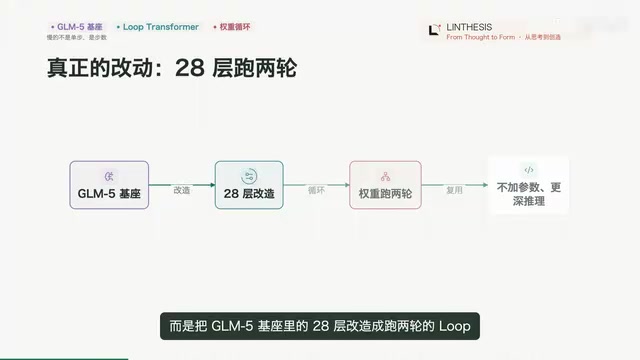
GLM-5.4 Coding Test 4.6x Slower? Unpacking the Loop Transformer Architecture
GLM-5.4 coding test took 431 minutes vs. competitor's 109, 4.6x more steps. We analyze its Loop Transformer architecture, KingBench4 score of 55.3, Max tier's 1.04M token cost, and tier selection advice.

Zhipu GLM-5.4 Quietly Released: A Debut for Loop Transformer Architecture
Zhipu GLM-5.4 quietly lands in coding plans: first Loop Transformer flagship with 750B params, 1M token context, AIM math up from 19.2 to 30.4, and native vision for coding from screenshots.
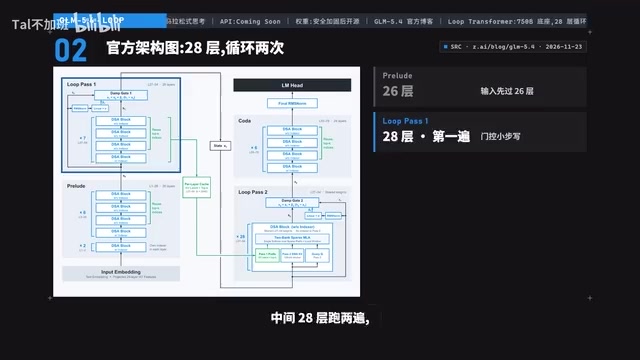
GLM-5.4 Releases 750B Model: Recurrent Transformer Architecture and the 30B Benchmark Controversy
GLM-5.4 releases a 750B model with a recurrent Transformer architecture that runs the same layers twice, claimed to match 2T–3T scale. But the benchmark table tests a 30B small model, not the main model. We break down the architecture changes, benchmark data, four demos, and open-source timeline.