Ponytail 5 Released: Teaching AI Coding Agents the Restraint of a Senior Engineer

Ponytail 5 shifts AI coding agents from 'write less code' to 'smallest complete change,' cutting costs 26% and boosting test coverage to 98%.
Ponytail 5 is a major open-source rewrite that shifts the AI coding agent's objective from minimizing code volume to making the 'smallest complete change' — requiring agents to map the full impact of a modification before writing anything. Its two core commands have been upgraded: review now covers bugs, security, and load beyond just deletions; audit now delivers prioritized fix plans instead of raw checklists. Self-reported benchmarks from 5,900+ Claude Code sessions show 53% less code, 26% lower cost, and high-risk logic test coverage rising from 68% to 98%. The project is MIT-licensed but lacks independent third-party validation.
The open-source project Ponytail has undergone a major rewrite. Author DietrichGebert rebuilt this coding skill from scratch — what he calls a "lazy senior developer" skill. The core idea is simple: make coding agents work like that senior engineer who can replace fifty lines with one — not by writing more, but by writing less and writing it right.
This update is far from a minor patch. According to the author, the entire rewrite was grounded in over 5,900 benchmarked Claude Code sessions, with 3,650 of those dedicated to comparing new rule drafts against the previous version. This data-driven iteration gives Ponytail 5's improvements a reasonably credible quantitative foundation.
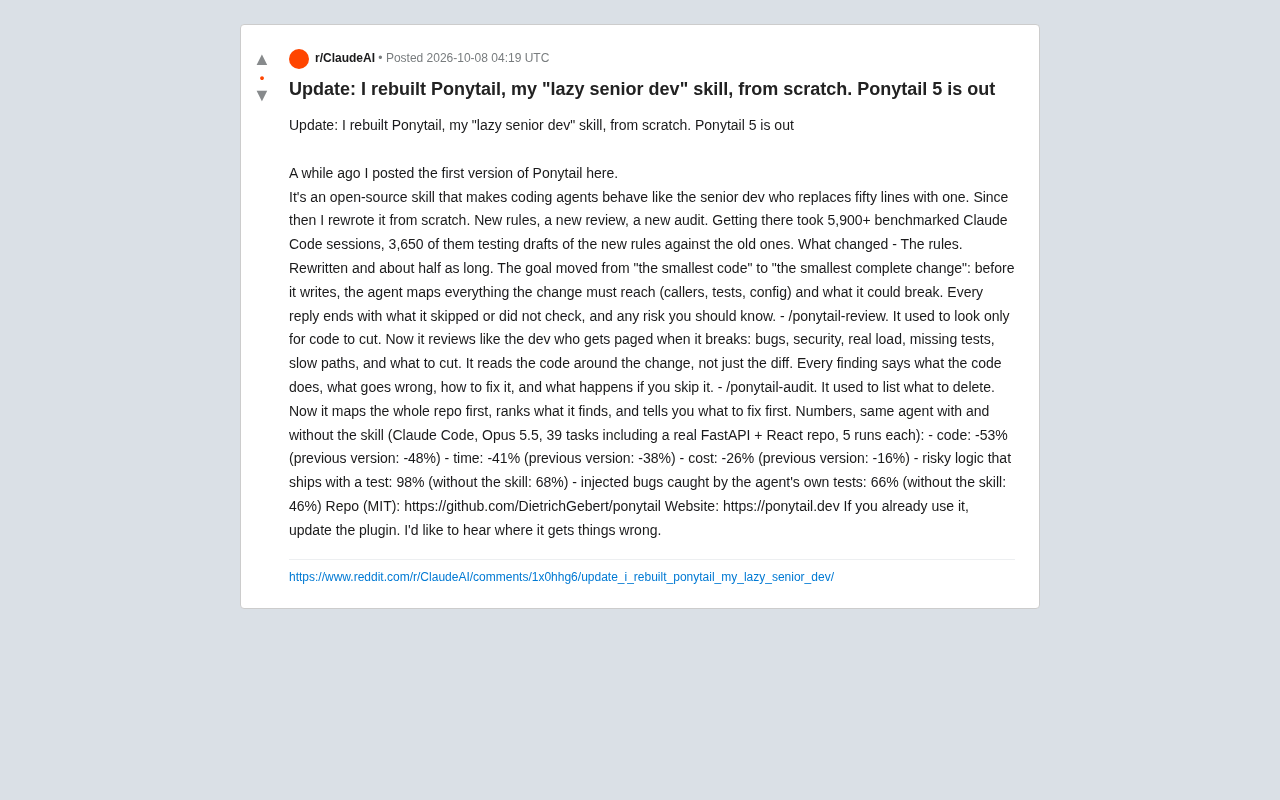
From "Minimal Code" to "Minimal Complete Change"
The most fundamental shift in Ponytail 5 is a change in objective. The old version pursued the "smallest code," while the new version pursues the "smallest complete change."
This distinction is worth dwelling on. Purely optimizing for fewer lines of code can lead to a trap of "short for the sake of short" — stripping out necessary boundary handling or skipping critical tests. "Smallest complete change" instead requires the agent to map out the full scope of a modification before writing a single line: callers, tests, configuration, and anything that might break.
Equally important is the transparency design. At the end of each response, the agent proactively explains what it skipped, what it didn't check, and any risks the user should be aware of. This "full disclosure" mechanism mirrors the habits of great senior engineers — they don't just deliver code, they tell you where the landmines are buried. The rules themselves have also been rewritten and trimmed by roughly half, embodying the author's own "do more with less" philosophy.
The concept of "smallest complete change" aligns closely with the software engineering principle of atomic commits — each commit does one thing, but does it completely, including related tests, documentation updates, and config changes. Ponytail 5 formalizes this human practice as a behavioral constraint for agents: before generating code, it uses static analysis and code graph traversal to trace the propagation path of a change, identify all callers and dependencies, and then determine the minimum necessary change boundary. The key difference from simply demanding "write less code" is that the latter is an output-level constraint, while the former is a decision-level constraint — the agent must first understand the blast radius before choosing the most economical implementation path.
Two Core Commands, Redesigned
Ponytail 5 completely overhauls its two auxiliary commands, elevating them from "subtraction tools" to "context-aware reviewers."
/ponytail-review: Review Like an Engineer Called in to Fight a Fire
The old review command did one thing: find code that could be cut. The new version takes a completely different perspective — it reviews code like the developer who gets called at 3am when the system is down, covering bugs, security issues, real-world load, missing tests, slow paths, and yes, things that can be deleted.
A key detail: it reads the code around the change, not just the diff. This gives it contextual awareness. Each finding is structured around four elements: what this code does, what could go wrong, how to fix it, and what happens if you ignore it. This structured output dramatically reduces the cognitive load of processing review feedback.
/ponytail-audit: Map the Whole Picture First, Then Prioritize
The audit command has similarly evolved from "making a list" to "building a plan." The old version simply listed what should be removed; the new version first surveys the entire codebase, ranks the findings, and then tells you explicitly what to fix first.
Going from "here's what's wrong" to "here's what to fix first" is a qualitative leap in usefulness. With a real project carrying years of technical debt, priority ordering is often more valuable than the problem list itself.
Benchmark Data: Real, Measurable Improvements
The author provides comparison data for the same agent with and without the skill. The test environment was Claude Code with Opus 5.5, across 39 tasks (including a real FastAPI + React repository), each task run 5 times.
| Metric | Ponytail 5 | Previous Version |
|---|---|---|
| Code Volume | -53% | -48% |
| Time Spent | -41% | -38% |
| Cost | -26% | -16% |
Beyond efficiency metrics, the quality improvements are even more striking: 98% of high-risk logic shipped with tests (vs. 68% without the skill); the agent's own tests caught injected bugs 66% of the time (vs. 46% without the skill).
The cost improvement jumping from -16% to -26% — nearly doubling — is especially notable. This suggests the new rules not only slim down code, but also significantly reduce token consumption and rework. That said, these numbers deserve objective scrutiny: the data comes from the author's own testing, the sample size is limited, and there is no independent third-party validation. Real-world results will vary by use case.
The "code volume" reduction metric in the table is typically measured in lines of code (LoC) or token count. In AI coding contexts, code reduction and cost reduction don't have a linear relationship — historical code, comments, and test files carried in the context window all consume tokens. The cost improvement leap from -16% to -26% in Ponytail 5 may be partly attributable to more precise change scoping reducing irrelevant code loaded into context, rather than purely compressing output line count. The "time spent" metric is simultaneously influenced by API latency, token generation speed, and the number of conversation turns — the rule constraints reduce the agent's exploratory attempts and rework loops, which is the primary mechanism behind reduced time.
Open Source and Community Feedback
Ponytail is open-sourced under the MIT license, hosted on GitHub (DietrichGebert/ponytail), with a dedicated website at ponytail.dev. Existing users can get the new version with a simple plugin update.
When publishing the release, the author specifically asked to hear "where it goes wrong." This posture of actively soliciting negative feedback is healthy for a tool project that depends on rule tuning — edge cases and failure stories are typically the best material for the next iteration.
For developers exploring how to constrain AI coding agent behavior, Ponytail offers a compelling perspective: rather than letting agents run free and cleaning up afterward, use a carefully designed set of rules to bake the restraint and deliberateness of a senior engineer directly into the generation process.
In the Claude Code context, a "skill" refers to a set of behavioral guidelines injected into the agent workflow via a custom system prompt or rules file. Unlike general prompt engineering, skills typically exist as structured documents that can be version-controlled, tested, and distributed — which is precisely the technical foundation for Ponytail as a standalone open-source project. Claude Code natively supports loading custom rules via
CLAUDE.mdfiles or slash commands. Ponytail leverages this mechanism to encode senior engineer decision patterns into a reusable constraint layer, giving different users and different projects a consistent behavioral baseline for their agents.
Related articles

Free Unlimited Claude Code Solution: Agnes AI + CC Switch Setup Guide
No paid subscription needed — pair the free AI platform Agnes AI with the open-source tool CC Switch to provide a backend for Claude Code, enabling unlimited free calls to text, image, and video models. This guide covers the full setup, test results, and usage boundaries.

A Complete Zero-Cost Guide to Getting Started with Claude Code for Beginners in China
A beginner's guide to Claude Code for users in China: two installation methods (command line and IDE plugin), full configuration steps for replacing the official API with the free domestic LongCat model, and a hands-on demo of building a small tool with natural language, plus tips.

When the NSA Gets Involved: The AI Supply Chain Crisis Behind Open-Source CVEs and API Key Hijacking
Multiple open-source projects disclosed severe CVEs in one day, PHP flaws alarmed the FBI, and Railway and OpenCode were breached with API keys stolen. This article breaks down the vulnerability window, AI-accelerated exploitation, and the AI supply chain crisis behind the API key black market, with a developer defense checklist.