Pop!_OS Lead Developer Blasts AI Users: The AI Divide in Open Source Has Spiraled Out of Control
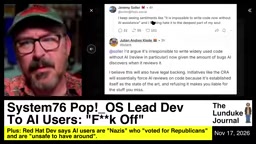
Pop!_OS chief engineer blasts AI developers as the open source AI divide turns emotional and political.
The article centers on Pop!_OS chief architect Jeremy Soller publicly telling AI-using developers to "fuck off," illustrating the sharp split in the open source community over AI. One side argues that not using AI to review code is irresponsible and predicts regulations like the CRA will mandate AI review; the other resents the "you can't write code without AI" narrative. The controversy quickly slid from technical pros and cons into moral judgment and personal attacks, with a senior Red Hat developer even linking AI stance to political voting and making an extreme analogy that "voting Republican is equivalent to voting for Nazis." The video author criticizes the anti-AI camp for politicizing and emotionalizing the issue and stifling rational discussion, and points out that the code-of-conduct author's own speech misconduct undermines the credibility of open source governance. The article concludes by reminding developers that tool choice should be determined by code quality and project responsibility.
A leak from a YouTube tech commentary video has once again pushed the fierce conflict over AI in the open source community into the spotlight. Jeremy Soller, the lead engineer of System76's Pop!_OS distribution, publicly stated that people who use AI to develop software can "fuck off"—and his exact words came with no self-censorship whatsoever.
This is more than just an emotional outburst. It reveals an increasingly sharp rift in the open source world today: one side sees AI as an irreversible productivity revolution, while the other views it as an assault on developer dignity and technical ethics.
The Flashpoint: "You Can't Write Code Without AI"
According to the video, Jeremy Soller—chief architect of Pop!_OS and the COSMIC desktop environment—erupted in response to a popular claim. He wrote that he keeps seeing arguments like "it's now impossible to write code without AI assistance," and that he "hates it with a passion."
This statement is not an isolated case. Another well-known open source developer offered a completely opposite judgment in the same discussion: writing widely used code without using AI for review is "irresponsible," because AI can catch a large number of defects during code review. He even predicted that regulatory initiatives such as the CRA (Cyber Resilience Act) will eventually legally mandate AI review, because AI has become "the industry's state of the art," and refusing to use it means bearing responsibility for missed vulnerabilities.
Both positions carry an unmistakable tone of certainty, and that is precisely the core of the problem: the discussion has slid from technical pros and cons into moral judgment.
CRA (Cyber Resilience Act) is a cybersecurity regulation passed by the EU in 2024. Its full name is the Cyber Resilience Act, and it sets mandatory security requirements for products with digital elements. The regulation requires manufacturers to ensure security throughout the product lifecycle, including vulnerability handling and security updates, and introduces the CE marking. For open source software, the CRA provides conditional exemptions, but if an open source project is integrated into a commercial product, the relevant obligations may be passed downstream. This is why discussions have begun about whether AI-assisted code review can serve as "compliance evidence"—if regulators recognize AI review's defect-detection capabilities, refusing to use it may be interpreted as failing to exercise reasonable due diligence.
From Technical Debate to Personal Attacks
The video's author expressed clear dissatisfaction with this. He acknowledged that there are plenty of arguments worth serious discussion about AI adoption across various businesses and workflows, and that both sides have defensible points. But the reality is that these debates are not happening—instead, "when someone even mentions that AI might not be so bad, they get torn to shreds."
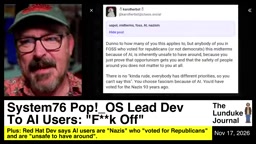
This kind of emotional confrontation does not exist only in the Pop!_OS community. The video also cited another notable incident from the same period: Carlos Garnacho, a senior Red Hat developer who is also deeply involved in the FreeDesktop project and Wayland-related work (misnamed in the video as Carol Herbst, but the Red Hat developer identity is clear), made an even more politically charged statement.
The Red Hat Developer's "Voting Is a Stance" Argument
According to the video's quotation, the developer's statement went roughly like this: in the free and open source software community, anyone who votes Republican (rather than Democrat) in the midterm elections because of the AI issue "is fundamentally an unsafe presence around you," because it proves that opportunism can buy you off and you simply don't care about the safety of those around you.
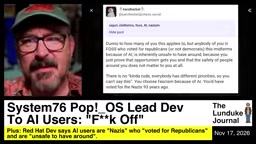
An even more extreme analogy followed immediately: such a choice is "equivalent to voting for the Nazis 93 years ago." The video's author emphasized that the person who made this statement not only has long served at Red Hat, but is also deeply involved in drafting the Code of Conduct for the FreeDesktop organization—an organization largely dominated by Red Hat.
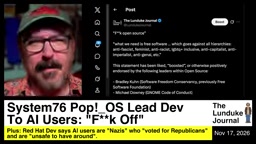
This implies a subtle contradiction: the person responsible for formulating community codes of conduct himself used highly aggressive political analogies in public. The video's assessment is that the anti-AI camp in the open source world "has become extreme and has thoroughly politicized the issue," forming a "profanity-laden attack parade" that makes rational dialogue nearly impossible.
The FreeDesktop Code of Conduct is the code of conduct for the freedesktop.org project community, intended to provide contributors with a harassment-free collaborative environment. The organization hosts key Linux desktop infrastructure such as Wayland, PulseAudio, and systemd, and its governance structure has long been influenced by companies such as Red Hat. Codes of conduct typically include prohibitions on offensive speech and personal attacks, enforced by community members or designated committees. When a core developer involved in drafting the code himself makes extreme political analogies, it creates a test of consistency in rule application—community members will question whether the code only constrains "outsiders" while exempting its authors.
What This Means for Developers
Setting emotions aside, this controversy exposes several real issues.
First, the use of AI tools is being moralized. Whether or not to use AI should be an engineering decision based on project needs, team capabilities, and risk preferences. When it is equated with "whether you care about others' safety" or even "political stance," technical choices lose room for discussion.
Second, open source governance faces a trust challenge. If the authors of codes of conduct themselves cross the boundaries of public discussion, the credibility of community rules will inevitably suffer. The video specifically pointed out that Red Hat "stands behind" this developer, implying that the attitude of corporate employers will also be interpreted by outsiders.
Third, the compliance pressure for AI code review is a real trend. Whether or not Soller agrees, regulatory approaches that link AI review to legal liability have already emerged. For teams maintaining widely used open source projects, this may be a variable more worth watching than verbal sparring.
The video author's position is relatively restrained: he does not deny that there are real questions worth exploring in the AI controversy, but believes that the current way of confronting each other is killing these discussions. When core developers in a community respond to technical disagreements with profanity, what is damaged is not only the atmosphere of dialogue but also outside confidence in the entire open source collaboration model.
For ordinary developers, the practical takeaway from this quarrel may be: the choice of what tools to use for coding should ultimately be determined by code quality and project responsibility, not by who shouts louder.
The compliance trend in AI code review deserves separate elaboration. Currently, mainstream AI code review tools (such as LLM-based static analysis and defect prediction) have been incorporated by some enterprises into CI/CD pipelines to detect potential vulnerabilities, license conflicts, and logic errors before merging. At the regulatory level, the CRA requires "due diligence"-style vulnerability management, and AI review records can serve as process evidence. But legal force is not yet clear: no regulation currently directly stipulates that "AI review must be used"; rather, industry practice is permeating compliance standards. For open source maintainers, the real pressure comes from the compliance requirements of downstream commercial adopters, not from regulatory text itself—meaning that whether to adopt AI review may gradually shift from personal preference to a supply chain contractual condition.
One-line Summary
Pop!_OS lead engineer blasts AI developers, raising concerns over the emotional and political polarization of AI in the open source community.
Paragraph Summary
The article centers on Pop!_OS chief architect Jeremy Soller publicly telling AI-using developers to "fuck off," illustrating the sharp split in the open source community over AI. One side argues that not using AI to review code is irresponsible and predicts that regulations such as the CRA will mandate AI review; the other side resents the "you can't write code without AI" narrative. The controversy quickly slid from technical pros and cons into moral judgment and personal attacks, with a senior Red Hat developer even linking AI stance to political voting and making an extreme analogy that "voting Republican is equivalent to voting for Nazis." The video author criticizes the anti-AI camp for politicizing and emotionalizing the issue and stifling rational discussion, and points out that the code-of-conduct author's own speech misconduct undermines the credibility of open source governance. The article concludes by reminding developers that tool choice should be determined by code quality and project responsibility.
Related articles
Benchmarking WorkBuddy's Five-Platform Strategy: How Agent Development Can Win Through Differentiated Competition
Starting from benchmarking WorkBuddy, this article analyzes differentiated competition strategies for general-purpose agent development: how five-platform full-stack capabilities (desktop/iOS/Android/H5/web) build job-hunting advantages, and how to leverage big tech products to understand underlying implementations.
Claude Gets Creative: 24 AI Projects Anyone Can Replicate
24 real Claude use cases: from Bluetooth phone finder and 8x faster Wi-Fi to 3D-printed bridges, cancer tools, and food allergy drug design—most free to replicate.
Fleetlayer: A Framework for Scheduling…
Fleetlayer: A Framework for Scheduling Multiple AI Agents Across Machines
Fleetlayer is a framework posted on Hacker News for running large numbers of AI Agents across multiple machines. This article analyzes its positioning, the core challenges of multi-machine multi-Agent scheduling, and the current competitive landscape and project maturity in the multi-Agent infrastructure space.