Porsche's All-Electric Macan Turbo Review: An Automotive Existential Crisis
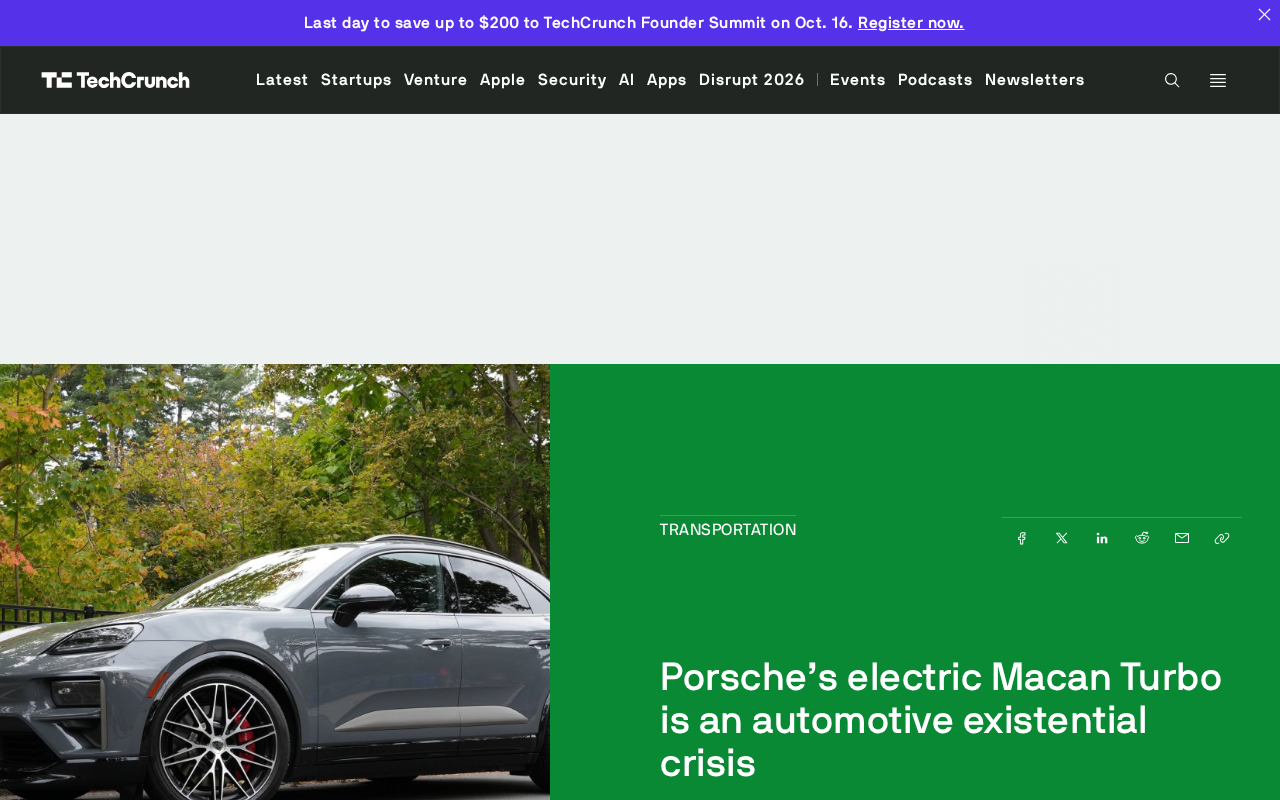
Porsche's all-electric Macan Turbo, lacking visual brand identity, reflects the existential crisis of traditional luxury brands in the EV era.
The article uses the real-world testing of Porsche's first all-electric SUV, the Macan Turbo, to highlight its understated looks and lack of brand recognizability—drawing zero attention during testing, when "being seen" should be part of a Porsche's value. The deeper issue is positioning: the Macan Turbo must satisfy traditional brand expectations, appeal to new EV customers, and meet SUV practicality demands—three forces in tension. Electrification levels performance, erasing the engine note and shifting rhythm that once set Porsches apart. This extends to a universal luxury industry dilemma: as mechanical barriers vanish, brands must compete on more easily copied dimensions like interiors and brand storytelling.
Porsche's first all-electric SUV, the Macan Turbo, was supposed to be a milestone product. But after real-world testing, it raises far more questions than it answers. This isn't just about whether the car is good to drive—it's about what Porsche actually wants to become in the electric era.
So Understated That Nobody Notices
The tester drove this electric Macan Turbo through city streets and suburbs, dropping kids off, picking up groceries—and not a single passerby or fellow driver gave it a second glance. No enthusiasts stopped to ask questions, no envious stares—a remarkably rare occurrence for a Porsche.
The author attributes this to several factors: the gray paint job is too understated, the roofline is slightly bulbous, and the overall proportions are vaguely SUV-like. In other words, the car's design language lacks that instantly recognizable "Porsche-ness."
For consumers who paid a premium for a Porsche, being seen is itself part of the product's value. When a Porsche fails to generate any social attention whatsoever, its function as a status symbol has already been compromised.
In automotive design, "Porsche-ness" refers to a highly recognizable set of visual DNA: a wide, low-slung stance, rounded and muscular fenders, the iconic four-point headlights, and the continuous taillight bar spanning the rear. Building this kind of family design language typically takes decades, and its commercial value lies in making a vehicle identifiable from a great distance or in the briefest of glances. For luxury brands, design recognizability isn't just an aesthetic issue—it directly affects resale value, social visibility, and the owner's pride of ownership. When a Porsche is deemed "not Porsche-like," the issue isn't that the styling is ugly, but that the design language has drifted from the family DNA, reducing the efficiency with which the brand symbol is communicated.
When a Porsche No Longer Feels Like a Porsche
In terms of mechanical competence, the Macan Turbo almost certainly won't disappoint—Porsche's engineering prowess is a given. The real problem lies at the positioning level: it needs to simultaneously satisfy three constituencies—traditional Porsche customers' expectations for brand character, the appeal of electrification to new customer segments, and the SUV market's demand for practicality.
The tension between these three is especially evident in this vehicle. The electric powertrain delivers smoothness and instant torque, but it also erases the signature engine note and gear-shifting rhythm that defined Porsches in the combustion era. When the driving experience is flattened by electrification, what does Porsche use to distinguish itself from EVs that are equally fast, equally smooth, but far cheaper?
If the answer is merely "the brand logo" and "chassis tuning," then its moat is far shallower than one might think.
The Universal Dilemma Electrification Poses for Luxury Brands
The Macan Turbo's predicament is not an isolated case. The entire luxury automotive industry is grappling with the same problem: electrification has leveled the performance playing field technologically and eroded the differentiation labels that traditional luxury brands once relied on.
In the past, cylinder count, displacement, and engine note served as natural class barriers for luxury brands. Consumers could distinguish a V8 from a V6 with their ears alone. But in the electric motor era, the acceleration gap between an entry-level model and a flagship might be just a few tenths of a second, and the difference in NVH performance is far less pronounced than in the combustion era.
Luxury brands are therefore forced to compete on other dimensions—interior materials, smart cockpits, brand storytelling, community management. But the barriers in these dimensions are far easier to replicate than those in mechanical engineering.
The NVH mentioned here—Noise, Vibration, and Harshness—is a core metric in automotive engineering for measuring ride quality. In the combustion era, engines with more cylinders and larger displacement naturally ran more smoothly, with lower vibration and richer sound, making NVH performance one of the most intuitive physical dividing lines between luxury and ordinary cars. But electric vehicles have no internal combustion engine; the primary noise sources become wind noise, tire noise, and high-frequency motor whine, drastically compressing the NVH gap between vehicles. This means the "premium feel" that luxury brands once achieved by piling on mechanical hardware no longer comes automatically on electric platforms—it must be artificially reconstructed through more expensive sound insulation materials, active noise cancellation, and suspension tuning.
Traditional luxury brands built their differentiation labels largely on the displacement and cylinder hierarchy of internal combustion engines. Mechanical specifications like V6, V8, and W12 corresponded to clear price tiers and status symbols—consumers didn't need to understand technical details, they could identify class through sound and badging alone. In the electric motor era, this hierarchy has been completely upended: the 0-to-100 km/h acceleration gap between an entry-level single-motor model and a top-spec dual-motor model might be only about a second, and both are extremely quick and smooth. Cylinder count and displacement—those traditional markers—no longer exist. Luxury brands are thus forced to compete on softer dimensions like material craftsmanship, smart cockpit experiences, brand storytelling, and owner communities—dimensions whose technical barriers and replication costs are often far lower than the precision manufacturing of engines and transmissions.
The Essence of the Existential Crisis
The phrase "automotive existential crisis" in the title is not hyperbolic rhetoric. It precisely describes a core contradiction: the way Porsche defined itself in the combustion era is ceasing to work in the electric era.
Is a Porsche that goes unnoticed still a Porsche? As brand premiums become increasingly difficult to justify through the product itself, Porsche needs to provide new answers—and so far, the answer the Macan Turbo offers, at least in terms of visual distinctiveness and social appeal, is not yet convincing enough.
This is not just Porsche's problem. It's a question that every traditional luxury brand attempting to carry the glory of the combustion era into the electric age must confront head-on.
One-line Summary
Porsche's all-electric Macan Turbo, with its lack of visual brand identity, reflects the existential crisis facing traditional luxury brands in the electric era.
Paragraph Summary
Using the real-world testing experience of Porsche's first all-electric SUV, the Macan Turbo, as a starting point, the article points out that the vehicle's understated appearance and lack of brand recognizability drew zero attention from passersby during testing—yet "being seen" should be part of a Porsche's product value. The author argues the deeper issue lies in positioning: the Macan Turbo must simultaneously satisfy traditional Porsche customers' brand expectations, the appeal of electrification to new customers, and the SUV market's practicality demands—three forces in obvious tension. While the electric powertrain brings smoothness and instant torque, it erases the engine note and shifting rhythm of the combustion era, leveling the performance experience. The article extends this to a universal dilemma across the luxury auto industry—as mechanical barriers vanish in the electric motor era, luxury brands are forced to compete on more easily replicated dimensions like interiors, smart cockpits, and brand storytelling. Porsche now faces the core challenge of redefining its own value.
Related articles

M&M's Spent Millions Replacing Artificial Blue Dye — Why Is It So Hard?
Mars spent millions trying to replace artificial blue dye in M&M's with spirulina, but thick material clogs pipes and residue risks mold, forcing a full production-line rebuild. Here's the engineering behind the reformulation.

Teammate Wanted for Meta Global AI Developer Hackathon: Computer Vision & Medical AI
A Reddit developer seeks teammates for the Meta Global AI Developer Hackathon, focusing on computer vision and medical AI. This article analyzes the track logic, skills-complementarity needs, and topic selection strategy behind this teaming signal.

Multiple Claude Models Hit by Errors: A Postmortem of Fable 5.1, Sonnet 5.5, and Haiku 5.5
Claude Fable 5.1, Sonnet 5.5, Haiku 5.5, and Opus 5.5 fast mode saw elevated errors; Anthropic identified and resolved the issue in 17 minutes. This postmortem covers the timeline, the technical reasons for the multi-model cascading failure, and practical lessons for retry and degradation strategies.