PostEra Is Hiring AI Researchers: Using Machine Learning to Accelerate Drug Discovery

YC-backed AI pharma company PostEra is recruiting drug discovery AI researchers, reflecting real industry demand for interdisciplinary talent.
Using PostEra's job posting as a hook, this article covers the YC W20 company's two technical tracks — ML-based chemical reaction prediction and AI-driven antiviral drug design — and its COVID-19 open-science work. It argues AI pharma's real bottleneck is data quality and experimental validation, not algorithms, and outlines what these roles demand: solid ML fundamentals, chemistry/biology literacy, and real-world data experience.
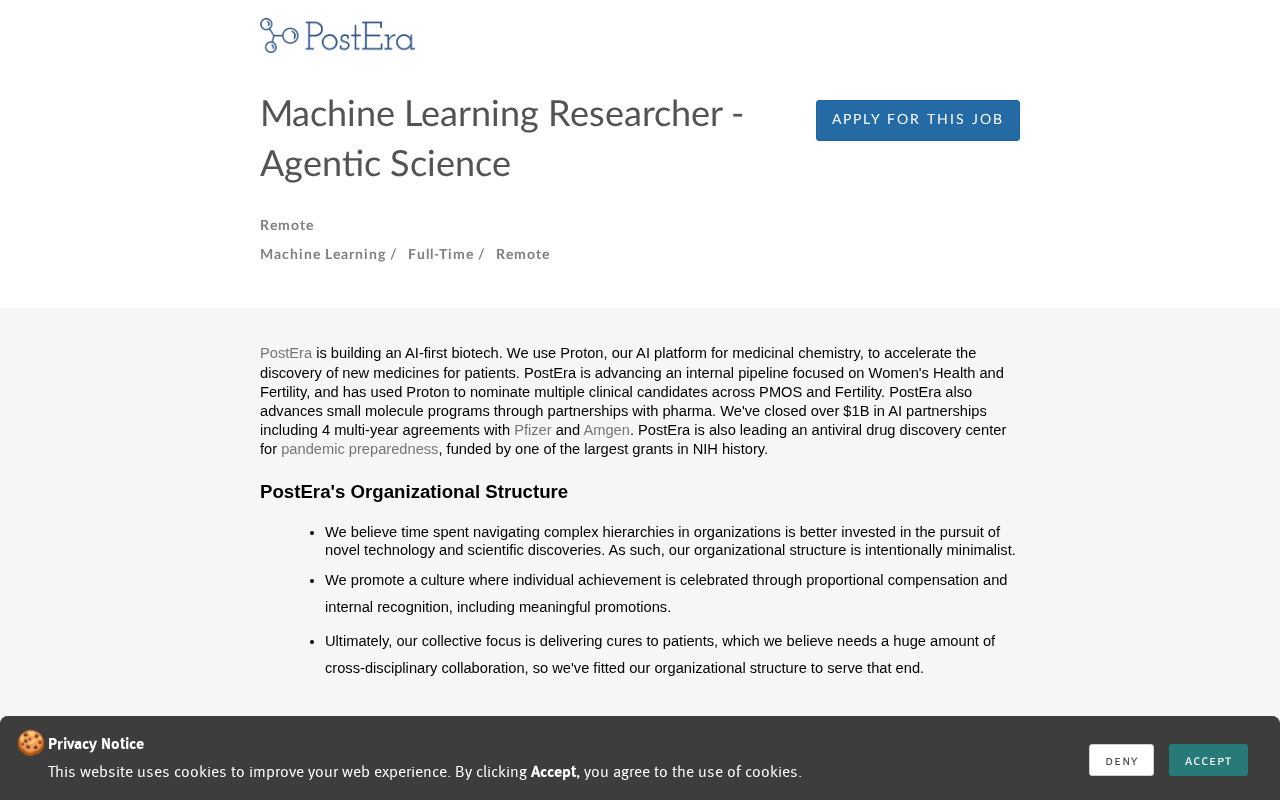
Drug development has long been notorious for its long timelines, high costs, and high failure rates — and AI is now changing that equation. Y Combinator W20 alum PostEra recently signaled it's hiring, looking for AI researchers focused on drug discovery. The job posting itself is brief, but placed in the broader context of AI pharma, it's worth unpacking.
What PostEra Does
PostEra's core business revolves around machine learning and chemical synthesis. Its technical approach roughly splits into two tracks: one uses machine learning models to predict chemical reaction outcomes, helping chemists assess whether a given synthetic route is feasible; the other applies AI to drug molecule design, particularly in antiviral drug research.
The company participated in an open-science project for COVID-19 antivirals, screening potential compounds through a combination of crowdsourcing and algorithms. Projects like this demand substantial compute and model precision, which explains why PostEra needs to keep recruiting AI research talent.
The posting doesn't disclose specific responsibilities or tech stack details, but based on the "AI Researchers for Drug Discovery" framing, candidates likely need a cross-disciplinary background in machine learning, computational chemistry, or structural biology.
The core task of machine learning for chemical reaction prediction is called "retrosynthesis analysis": given a target molecule, work backward to find feasible synthetic routes. Traditional methods rely on chemists' experience to enumerate candidate pathways, while PostEra's approach models reaction prediction as a sequence-to-sequence or graph-to-graph problem, training on large-scale reaction datasets (such as USPTO patent reaction data) to output possible reactant sets and yield estimates. The hard part of these models is the combinatorial explosion of chemical reaction space — a single route often involves a dozen or more steps, each with multiple candidates, and errors accumulate progressively. That's why industry typically combines models with tree search, Monte Carlo tree search, or A* search, using model scores to prune during the search rather than letting the model produce answers on its own.
Molecular representations directly determine what a model can learn. The most common is SMILES strings, which encode molecules as text — compact and directly compatible with language models, but non-unique and insensitive to subtle structural changes. Molecular fingerprints (such as ECFP/Morgan fingerprints) map molecules into fixed-length bit vectors, suitable for similarity search and traditional machine learning, but they lose topological detail. Graph neural networks treat atoms as nodes and chemical bonds as edges, and are currently the mainstream approach for molecular property prediction and generation. On the protein side, PDB structures or amino acid sequences are commonly used, and docking and affinity prediction require 3D conformational information. Understanding the trade-offs among these representations is a fundamental skill for AI research in drug discovery.
Why AI Pharma Companies Keep Hiring
AI pharma isn't a new concept, but cases where models have actually advanced to clinical stages and demonstrated efficacy remain limited. The industry's common bottleneck isn't the algorithms themselves — it's data quality and experimental validation.
An AI pharma company needs three capabilities simultaneously: high-quality chemical/biological datasets, model architectures capable of handling such data, and processes that translate predictions into executable experiments. None can be missing, and each link requires dedicated researchers.
PostEra's decision to keep expanding its research team after YC suggests its technical approach has reached a stage where more manpower is needed to scale. For AI researchers, the appeal of these roles is clear: well-defined problems, relatively structured data, and results that map directly to real drug molecules.
Clinical-stage validation is the hard metric for judging AI pharma's mettle. A drug typically takes over 10 years and averages more than $1 billion from target identification to market, and overall Phase I success rates have long hovered around 10%. AI intervention mainly targets two areas: first, lead compound discovery, compressing candidate screening from years to months; second, predicting preclinical toxicity, pharmacokinetics, and other properties to reduce late-stage failure probability. But as of now, molecules actually designed by AI that have entered clinical trials and produced efficacy readouts remain few and far between — which is the direct reason capital has shifted from frenzy to pragmatism.
Who Fits These Roles
Based on industry norms, AI researchers in drug discovery typically need to meet several criteria:
Solid machine learning fundamentals. Graph neural networks, generative models, and reinforcement learning all have applications in molecular design — you can't just know how to call libraries.
Understanding the language of chemistry or biology. Concepts like SMILES, molecular fingerprints, and protein structures need to be familiar, otherwise it's hard to communicate with experimental teams.
Experience handling real-world data. The gap between public datasets and industrial-grade data is enormous, and this is especially pronounced in pharma.
If you happen to be in this interdisciplinary space, hiring at companies like PostEra is worth watching. Specific job details can be found through the Hacker News discussion thread or the company's website.
Graph neural networks, generative models, and reinforcement learning roughly divide their roles in molecular design as follows: GNNs handle property prediction and molecular encoding, generative models like variational autoencoders and diffusion models handle de novo molecule design or scaffold hopping, and reinforcement learning is used for multi-objective optimization — balancing activity, selectivity, synthetic accessibility, and toxicity simultaneously. A common production pipeline is a closed loop of "generative model proposes candidates + property model scores them + retrosynthesis model evaluates synthesizability," filtering out chemically unsynthesizable molecules early to avoid wasted effort by experimental teams.
A Few Observations
AI pharma's hype has fluctuated over the past few years, and capital's attitude has shifted from frenzy to pragmatism. The companies still hiring tend to be those with actual pipelines advancing and validation from partners. PostEra, backed by the YC network and having built credibility through open-science projects, is one of the players worth watching in this space.
One-line Summary
YC-backed AI pharma company PostEra is recruiting drug discovery AI researchers, reflecting the industry's real demand for interdisciplinary talent.
Paragraph Summary
Using PostEra's job posting as a starting point, this article introduces the YC W20 company's two technical tracks: using machine learning to predict chemical reaction outcomes for assessing synthetic route feasibility, and applying AI to antiviral drug molecule design — including its participation in a COVID-19 open-science project. The author notes that AI pharma's real bottleneck isn't algorithms but data quality and experimental validation, which is why companies need research teams with datasets, model architectures, and experimental translation capabilities. The article then outlines what these roles require: solid ML fundamentals, understanding of chemistry/biology language, and experience with industrial-grade real-world data, while noting that the AI pharma sector has shifted from capital frenzy to pragmatism — only teams with actual pipelines and partner validation are worth watching.
Related articles

GPT-Next Leak, Gemini 4 Argon Imminent: AI News Roundup
GPT-Next leak suggests extreme efficiency; OpenAI's 28-day shipping pledge boosts speed 50%; Gemini 4 Argon nears release; Anthropic subscription value report sparks debate.

GPT-Next Leaked, Gemini 4 Argon Speeds Up, Fable 5.5 May Launch Today
OpenAI's GPT-Next model leaks, expected to be extremely low-cost and possibly part of the 28-day release plan; Gemini 4 Argon internal testing accelerates, NanoBanana 2.1 is live; Semi Analysis tests show Claude Max's equivalent API value is about 5 times that of ChatGPT Pro; Fable 5.5 may launch today.

Gemini 4 Argon Launches Globally: Key Highlights from the AI Daily Brief
Google opens Gemini 4 Argon globally across Pro and Ultra subscriptions and the API, and demonstrates robot control. This article rounds up open-source models, Agent infrastructure, cost transparency, and safety governance updates.