Practical Guide to Accelerating LLM Inference with Apple Silicon Virtual Machines

Guide to optimizing LLM inference with llama.cpp in Apple Silicon macOS virtual machines.
This guide explores how to leverage Apple Silicon's unified memory architecture to accelerate llama.cpp LLM inference within macOS virtual machines. It covers the technical advantages of UMA for memory-bandwidth-bound tasks, Metal backend integration, paravirtualized GPU access in VMs, and practical optimization strategies including quantization format selection, memory allocation, and threading parameter tuning to achieve near bare-metal performance in virtualized environments.
The LLM Inference Potential of Apple Silicon
Recently on Hacker News, a discussion about "Accelerating llama.cpp inference with Apple Silicon and macOS virtual machines" attracted widespread attention, garnering 278 upvotes and 43 comments. The reason this topic resonated so strongly with the community is that it addresses a long-overlooked direction in local large model deployment: how to fully unleash Apple's custom silicon unified memory and GPU compute power within virtualized environments to boost LLM inference performance.
As lightweight inference frameworks like llama.cpp have matured, more and more developers are running 7B, 13B, and even larger parameter models on personal devices. llama.cpp is an open-source project initiated by Georgi Gerganov in March 2023, originally designed to let Meta's LLaMA models run with CPU inference in a pure C/C++ environment without depending on heavy frameworks like Python or PyTorch. Its core innovation lies in supporting multiple quantization formats, compressing model weights from FP16 to 4-bit or 5-bit integer representations to dramatically reduce memory usage and computation. The project rapidly evolved into the de facto standard for local LLM inference, supporting Metal, CUDA, Vulkan, and other GPU acceleration backends, and spawning user-facing applications like ollama and LM Studio.
Apple Silicon (M-series chips), with its unique Unified Memory Architecture (UMA), has become an extremely competitive hardware platform for local inference scenarios.
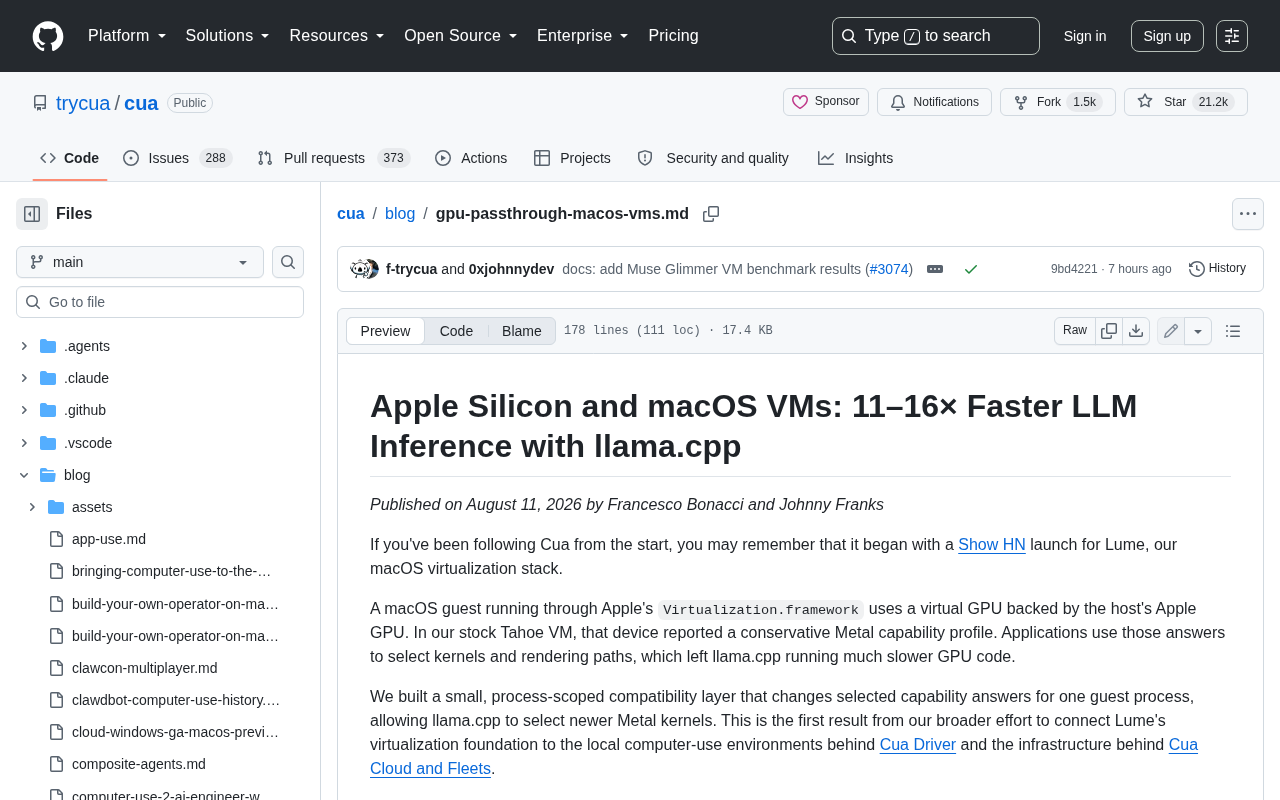
Why Apple Silicon Is Ideal for Local LLM Inference
The Natural Advantage of Unified Memory Architecture
In traditional x86 + discrete GPU setups, model weights need to be shuttled back and forth between system memory (RAM) and video memory (VRAM), creating significant bandwidth bottlenecks and latency. Apple Silicon's unified memory design allows the CPU and GPU to share the same high-bandwidth memory pool. Once a model is loaded, there's no need for redundant copies—the GPU can directly access all weight data in memory.
From a technical perspective, Apple Silicon's Unified Memory Architecture (UMA) unifies memory access for the CPU, GPU, Neural Engine, and other specialized accelerators into a single physical memory pool. In traditional PC architectures, the CPU accesses system RAM through a DDR memory controller while the GPU has its own independent GDDR memory, with data transferred between them via PCIe bus at typically 16-32GB/s. In Apple's UMA design, M-series chips achieve memory bandwidth of 200-800GB/s (depending on the specific model), and all compute units share this bandwidth pool without cross-bus copying. This architecture is particularly significant for LLM inference because large model inference is a classic memory-bandwidth bound task—token generation speed is directly determined by the rate at which model weights are loaded from memory to compute units.
For large models that easily reach tens of gigabytes, this means that on Macs equipped with 64GB or even 128GB of memory, you can smoothly run model sizes that consumer-grade GPUs would struggle to handle. This is also a key reason why the llama.cpp community has long favored the Metal backend.
Deep Integration Between the Metal Backend and llama.cpp
llama.cpp started with pure CPU inference, but with the introduction of the Metal (Apple's graphics and compute API) backend, its performance on Apple Silicon took a qualitative leap. Developers can offload matrix operations to the GPU through Metal, fully utilizing the graphics cores of M-series chips to dramatically boost token generation speed.
Metal is a low-level graphics and compute API that Apple introduced in 2014, designed to replace OpenGL and OpenCL and provide a unified GPU programming interface for iOS and macOS. In LLM inference scenarios, Metal primarily functions through its Compute Shaders capability, enabling developers to write efficient matrix multiplication (GEMM) and vector operation kernels. Unlike NVIDIA's CUDA ecosystem, Metal's advantage lies in its deep integration with Apple hardware—it can directly schedule Apple GPU Shader Cores and leverage the UMA architecture for zero-copy memory access. The Metal backend in llama.cpp has been specifically optimized for Apple GPU SIMD group characteristics (similar to NVIDIA's warps), significantly improving GPU utilization on M-series chips.
Inference Performance Challenges and Breakthroughs in VM Scenarios
Why Virtualization Affects LLM Inference Speed
The core topic of this discussion is inference optimization within macOS virtual machine (VM) environments. In conventional thinking, virtualization typically means performance loss—especially when GPU acceleration requires the virtual machine to directly access underlying hardware, making things considerably more complex.
Apple introduced Virtualization.framework in macOS 11 (Big Sur), a native virtualization API that allows developers to create lightweight virtual machines on Apple Silicon Macs. Unlike traditional Type-2 virtualization solutions (such as Parallels Desktop or VMware Fusion), this framework directly leverages the hardware virtualization support built into Apple chips, providing near-native CPU performance. The key technical breakthrough is that Apple has gradually opened VM access to GPU resources—through Paravirtualized GPU technology, Metal API calls in the guest OS can be efficiently forwarded to the host's physical GPU for execution, rather than relying entirely on software emulation. This makes running GPU-accelerated LLM inference inside a VM a realistic possibility.
The biggest pain point when running llama.cpp in a virtual machine is GPU passthrough and Metal API availability. GPU passthrough in the traditional sense refers to the technology of directly assigning a physical GPU device for exclusive use by a virtual machine, typically implemented on x86 platforms through IOMMU (such as Intel VT-d or AMD-Vi). However, the Apple Silicon platform doesn't support traditional GPU passthrough because its GPU is integrated on the same SoC as the CPU and cannot be physically isolated. Instead, a paravirtualization approach is used: the GPU driver in the guest OS doesn't directly operate hardware but communicates with the host through a streamlined virtual device interface, with the host responsible for actual GPU command submission and memory management. The overhead of this approach depends on the virtualization layer's implementation efficiency—ideally, for compute-intensive tasks (such as matrix multiplication), performance can reach 85-95% of bare metal.
If the virtual machine cannot access the host's GPU, inference can only fall back to pure CPU mode, resulting in significantly reduced speed. This is a real frustration many developers encounter in CI/CD, multi-tenant deployment, or isolated testing scenarios.
LLM Inference Optimization Strategies Within VMs
Based on experiences shared by the community, improving LLM inference performance within virtual machines focuses on several key areas:
- Ensure VM access to GPU: Make the Metal backend available inside the VM to avoid falling back to CPU inference. This typically requires using a virtualization solution that supports paravirtualized GPU and ensuring the guest OS has the correct drivers installed.
- Allocate unified memory appropriately: Reserve sufficient memory for the virtual machine to avoid performance crashes caused by swap being triggered during model loading. Since CPU and GPU share memory under the UMA architecture, memory allocated to the VM simultaneously serves both CPU computation and GPU inference.
- Choose appropriate quantization formats: Use Q4, Q5, and other quantized models to reduce memory usage and computational overhead while maintaining quality. Specifically, model quantization is the technique of converting neural network weights from high-precision floating point (such as FP32 or FP16) to low-precision representations (such as INT8, INT4). In the llama.cpp ecosystem, the GGUF format supports multiple quantization schemes: Q4_0 uses simple 4-bit symmetric quantization with a shared scale factor per 32 weights; K-quant schemes like Q4_K_M and Q5_K_S employ more complex grouped quantization strategies, using different quantization precision for different layers to achieve a better balance between file size and output quality. For example, a 7B parameter FP16 model occupies approximately 14GB of memory, but after Q4_K_M quantization it requires only about 4.1GB, allowing it to run smoothly on a MacBook with 16GB of memory. Precision loss from quantization is typically measured by perplexity, with Q4_K_M usually showing a perplexity increase of only 1-3% compared to FP16.
- Tune threading and batch processing parameters: Adjust llama.cpp inference parameters based on the number of cores allocated to the virtual machine to achieve optimal throughput. Key parameters include
-t(thread count),-ngl(number of GPU offload layers), and-b(batch size), which need to be iteratively tested based on the VM's resource quota.
Through these approaches, developers can get as close to bare metal inference performance as possible while maintaining the isolation advantages of virtualization.
Application Value and Industry Significance of Local LLM Inference
Privacy Protection and Cost Control
In an era of expensive cloud API costs and increasing data privacy concerns, being able to efficiently run LLMs on local Macs or even Mac virtual machines holds significant practical value. Enterprises and individual developers can both prevent sensitive data from leaving their premises and avoid the ongoing costs of per-token billing. Taking GPT-4 level API calls as an example, for high-frequency use cases, monthly costs can reach hundreds or even thousands of dollars, while the marginal cost of local inference is merely electricity.
The VM approach further expands the application boundaries—it allows developers to run multiple isolated inference environments on a single physical device, suitable for automated testing, multi-model comparison, and providing reproducible development sandboxes for teams. In CI/CD pipelines, developers can integrate LLM inference as a test step to verify prompt engineering stability and model output consistency without depending on external API availability and consistency.
Implications for the Developer Ecosystem
The vibrant discussion of this topic on Hacker News also reflects a trend: local AI inference is evolving from "can run" to "runs fast and runs reliably." Apple Silicon, with its unique hardware-level design, is becoming an important platform for edge AI. The continuous optimization around llama.cpp is enabling this hardware advantage to be realized in more scenarios (including virtualized environments).
It's worth noting that this trend is also driving the entire industry to reconsider the possibilities of "edge computing + AI." When a Mac Studio costing a few thousand dollars, equipped with 192GB of unified memory, can smoothly run 70B parameter models, the assumption that "AI inference must rely on data centers" is being challenged. The addition of virtualization technology further improves single-device utilization efficiency, providing small teams and independent developers with unprecedented flexibility.
Conclusion
This exploration of accelerating llama.cpp inference with Apple Silicon and macOS virtual machines, while focused on a relatively technical niche, reveals an important development direction for local large model deployment. For developers who prioritize privacy, cost control, and reproducible environments, mastering the techniques to unleash Apple Silicon compute power within virtual machines will become an increasingly valuable skill. As the llama.cpp ecosystem continues to mature, ongoing breakthroughs in edge AI inference performance and experience are something to look forward to.
Related articles

Uber Deploys ChatGPT Work Company-Wide: AI in the Workplace Enters the Scaled Implementation Phase
Uber deploys ChatGPT Work to 30,000+ employees, extending it from engineering to all roles. We analyze its expert-engineer pairing, end-to-end automation, and questions of AI control and power concentration—insights for scaling AI in the workplace.

Shift at Midnight Hands-On: When "ID Verification" Becomes Alien Hunting
Shift at Midnight blends ID verification with horror survival in a four-player co-op game. We break down its inspection mechanics and chaotic humor.

Zelensky Recounts the Outbreak of War: I Need Ammunition, Not a Ride
Zelensky recalls the first day of war in a YouTube interview: farewell to family, rejecting Biden's evacuation offer with "I need ammunition, not a ride," and how Bucha shaped his stance on compromise and peace talks.