Practical Roadmap for Backend Engineers Transitioning to AI Agent Engineers: Four Steps to Landing a High-Paying LLM Position

A 4-step roadmap for backend engineers to transition into high-paying AI Agent engineering roles.
This article provides a complete practical roadmap for experienced backend developers to transition into AI Agent engineering roles. It covers four key steps: mastering LLM API integration, enabling tool-calling capabilities (RAG, Function Calling), building production-grade Agent systems, and translating project experience into offer-winning resumes. Backend engineers' existing skills in system design, stability, and error handling serve as a powerful competitive advantage in this emerging field.
Why AI Agent Engineer Is a Window-of-Opportunity Role Right Now
The career anxiety among backend developers has been increasingly palpable lately. One engineer with six years of backend experience shared their dilemma: they lack the confidence to interview for a P7 promotion, yet continuing at P6 invites questions about their growth potential. For context, P6 and P7 are part of a widely-used technical leveling system in the tech industry, originally popularized by Alibaba. P6 typically corresponds to Senior Engineer, requiring the ability to independently own module-level development; P7 corresponds to Staff Engineer/Technical Expert, requiring system design capabilities and technical influence. The salary gap between the two is usually 30%-50% or more. The leap from P6 to P7 is one of the hardest thresholds to cross in many engineers' careers. This "can't move up, can't stay put" state is the reality for many experienced backend engineers.
That said, AI Agent Engineer is a role in a classic window of opportunity right now. An AI Agent refers to an AI system capable of perceiving its environment, making autonomous decisions, and taking actions. It differs fundamentally from traditional conversational AI: an Agent doesn't just understand and generate language — it can decompose tasks, formulate plans, invoke external tools, and iteratively execute based on feedback. Since 2024, leading companies like OpenAI, Google, and Anthropic have all made Agent capabilities a core product direction. Enterprise demand for Agent deployment has exploded, directly giving rise to this emerging role. One notable trend: companies are increasingly less likely to ask "Can you train models?" in interviews, and more likely to ask "Can you integrate LLMs into our business?" — can you make the model call tools on its own, run workflows, make decisions, produce results, and deliver reliably?

The essence of this shift is: companies don't need research talent — they need engineering talent who can turn LLMs into productivity. The Agent Engineer role sits between traditional software engineers and AI researchers, with the core responsibility of engineering and productizing LLM capabilities. For backend developers who already have solid engineering skills, this is a transition path with a relatively accessible entry barrier. Some have successfully taken this exact path and landed LLM positions paying 50K+ (monthly, in RMB).
The First Misconception About Transitioning from Backend to AI: Don't Start with Python Basics
When many people declare "I want to transition to AI," their first instinct is "I need to relearn Python from scratch." But this path is far too slow — you might spend three months still wrestling with syntax while accumulating zero actual Agent development capability.
An even more common trap is "bookmark-based learning": studying prompt engineering today, reading about LangChain tomorrow, exploring RAG the day after, bookmarking a mountain of tutorials and absorbing a flood of concepts. You feel like you understand it all, but when it's time to actually build something, you can't produce anything. A quick explanation: LangChain is one of the most popular LLM application development frameworks today, providing a standardized abstraction layer that helps developers connect LLMs with external data sources, tools, memory systems, and other components. RAG (Retrieval-Augmented Generation) is a technical paradigm that combines information retrieval with text generation — it first retrieves relevant document chunks from an external knowledge base, then feeds those chunks as context into the LLM, allowing the model to base its answers on real data rather than pure parametric memory. This effectively mitigates the LLM "hallucination" problem (i.e., confidently fabricating facts). Each of these concepts is easy enough to understand individually, but many people fall into the trap of learning bits and pieces here and there, ultimately getting stuck in a cycle of "continued anxiety, continued procrastination, continued resume submissions with no responses."
The people who actually level up their compensation do something surprisingly simple: follow along with a commercial project and build an Agent that runs, works, and can be deployed. This statement reveals the core logic of career transition — get it running first, then optimize; build a working version first, then refine.
Four Steps to Becoming an AI Agent Engineer
Step 1: Master LLM API Integration
Forget about frameworks and engineering architecture for now. Focus on just one thing: reliably call an LLM and get it to output results in your desired format. Many people get stuck at this first step because they keep deliberating over which model is best or what parameters to choose. The practical advice is: just use one that works. You're building muscle memory, not doing academic research.
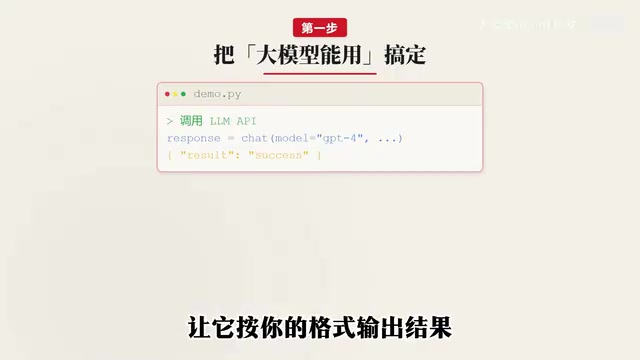
Two core skills to develop at this stage:
- API integration capability: Know how to pass in prompts, retrieve responses, implement streaming output (where the model returns results token by token rather than waiting for complete generation — critical for user experience), and handle errors (including rate limits, timeouts, token limit exceeded, and other common exceptions).
- Prompt control capability: Don't treat prompts like essay writing. Learn to make them controllable — get the model to output strict JSON, answer only according to specific rules, and explicitly say "I don't know" when uncertain. The essence of Prompt Engineering is using natural language to precisely constrain model behavior. Good prompt design can multiply the stability and accuracy of outputs several times over.
Only by controlling the output can you prevent your Agent from falling apart in later stages.
Step 2: Teach the Model to Use Tools
What makes an Agent valuable is that it doesn't just talk — it acts. Tool capabilities can be approached from three common directions: Retrieval-Augmented Generation (RAG), Function Calling, and Code Execution (or API invocation).
Function Calling is a critical capability introduced by OpenAI in mid-2023 and subsequently adopted by major model providers. The core mechanism works as follows: developers predefine a set of functions with their names, parameter formats, and functional descriptions. During conversation, the LLM autonomously determines when to call which function and generates compliant call parameters. The developer's application receives these parameters, executes the actual function logic (such as querying a database, calling a third-party API, performing calculations, etc.), and returns the results to the model for the next step of reasoning. This mechanism evolved LLMs from "can only talk" to "can take action" and is one of the foundational capabilities for building Agent systems.
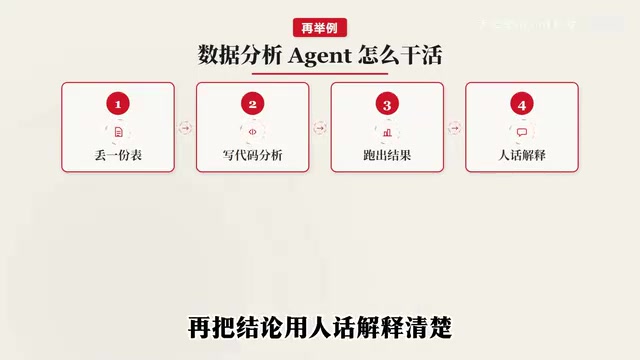
Two typical Agent development examples:
- Knowledge Q&A Agent: It needs to first retrieve from a document repository (typically using semantic search via vector databases, where documents are chunked and converted into vector embeddings for storage), then compile an answer with cited sources — no fabrication allowed. This is the classic use case for RAG.
- Data Analysis Agent: A user uploads a spreadsheet, and the Agent autonomously determines the analysis methodology, writes and executes code (typically running Python in a sandbox environment), then explains the conclusions in plain language.
To sum up this stage in one sentence: Once the model can call tools, it transforms from a "chatbot" into a "coworker." This is the fundamental distinction between an Agent and an ordinary conversational bot.
Step 3: Turn the Agent into a Production-Grade Deliverable System
This is where most people drop the ball — the demo runs fine, but it falls apart under real-world pressure. In software engineering, there's a massive gap between a demo (proof of concept) and a production-grade system, often called the "last mile problem." For Agent systems, this gap is especially pronounced. To go from toy to production-grade Agent, you must start tackling real engineering challenges:
- Context management: How to handle memory in long conversations. Current mainstream models have context windows ranging from 4K to 200K tokens, but longer contexts mean higher costs and slower response times. You need to design reasonable memory compression and summarization strategies to retain the most critical conversation information within limited windows.
- Knowledge base maintenance: How to update content and avoid retrieving garbage. Vector search needs to address semantic drift, chunking strategies, incremental index updates, and more. Retrieval quality directly determines the accuracy of Agent responses.
- Output validation: How to validate model output and handle retries on failure. LLM output is inherently non-deterministic — the same input may produce differently formatted outputs. Reliability must be ensured through structured output constraints (such as JSON Schema validation), regex matching, retry mechanisms, and other techniques.
- System infrastructure: How to implement logging and access control. A complete Agent system also needs to consider call chain tracing, token consumption monitoring, multi-tenant isolation, sensitive information filtering, and other production-environment essentials.
These sound like pure engineering problems — and they are — which is precisely why companies are willing to pay 50K for this role. An Agent Engineer isn't a toy engineer — they're someone who turns toys into productivity. For backend-experienced developers, this step is actually your biggest advantage, because stability, logging, permissions, and error handling are already your bread and butter.
Step 4: Translate Your Agent Project Experience into an Offer-Winning Resume
Writing "familiar with LLMs, understand Agents" on your resume is the same as writing nothing. What you need to write is: what system you built, how it works, what problems you solved, what key mechanisms you used, and how you ensured stability.

Interviewers just want to quickly assess whether you can hit the ground running. So use results-oriented language, for example:
"Built a tool-calling Agent with task planning, retrieval augmentation, and output validation capabilities. Supports multi-turn conversations and context management. Reduced manual processing time from X to Y in [specific scenario]."
With a statement like this, the interviewer can immediately tell you've actually built an Agent project. The key is demonstrating your understanding of the full Agent system pipeline — from model invocation to tool orchestration, from prompt design to production-grade delivery. Every link needs to be backed by specific technical details rather than staying at the conceptual level.
Advice for Backend Engineers Anxious About the AI Transition
If your current state is "I want to do it but don't know where to start, I've looked at a pile of projects but can't piece them together, I've submitted tons of resumes with no responses," here's the core advice: stop white-knuckling the anxiety, because anxiety won't raise your salary — it'll only keep you stuck in place.
The most effective approach is to find a complete Agent project, follow along step by step to get the critical toolchain running, and build a complete, deployable Agent system. Understanding someone else's code and writing your own are two entirely different things. The recommended practice path is: choose a scenario related to your current business domain (e.g., if you've worked on e-commerce backends, try building an e-commerce customer service Agent or order analysis Agent). This way, you can leverage your domain knowledge while creating a coherent technical narrative on your resume.
For backend engineers, the greatest value in transitioning to AI Agent Engineer is this — your existing engineering skills (stability, system design, API integration, error handling) don't become obsolete. They're actually a moat that others can't quickly replicate. Currently, many AI-background practitioners in the Agent space are skilled at model-level optimization but lack experience in systems engineering: they might create an impressive demo, but struggle when facing production-environment challenges like high concurrency, exception handling, and service monitoring. What you actually need to supplement is just prompt control, tool orchestration, and LLM integration. Rather than continuing to hesitate over "should I transition or not," just build your first working Agent version. All subsequent learning will become goal-oriented as a result.
Related articles

GPT-Next Leak, Gemini 4 Argon Imminent: AI News Roundup
GPT-Next leak suggests extreme efficiency; OpenAI's 28-day shipping pledge boosts speed 50%; Gemini 4 Argon nears release; Anthropic subscription value report sparks debate.

GPT-Next Leaked, Gemini 4 Argon Speeds Up, Fable 5.5 May Launch Today
OpenAI's GPT-Next model leaks, expected to be extremely low-cost and possibly part of the 28-day release plan; Gemini 4 Argon internal testing accelerates, NanoBanana 2.1 is live; Semi Analysis tests show Claude Max's equivalent API value is about 5 times that of ChatGPT Pro; Fable 5.5 may launch today.

Gemini 4 Argon Launches Globally: Key Highlights from the AI Daily Brief
Google opens Gemini 4 Argon globally across Pro and Ultra subscriptions and the API, and demonstrates robot control. This article rounds up open-source models, Agent infrastructure, cost transparency, and safety governance updates.