Prism: The Cursor of Hardware Engineering — AI Agents Handle CAD and Simulation in One Place

Prism aims to unify CAD, simulation, 3D viewing, code, and reporting into an all-in-one agent-driven workbench for hardware engineering.
Prism positions itself on Product Hunt as 'the Cursor of hardware engineering,' integrating CAD modeling, physics solvers, a 3D viewer, code writing, and report generation into one AI agent-driven platform that supports Windows, Mac, and Linux with a free trial. Its core logic is to give agents full-chain context and reduce friction from tool switching and data moving in traditional hardware design. The product received 73 votes and ranked #12 but has only 1 comment, suggesting limited discussion, consistent with vertical tools. Key details like solver origin and CAD modeling depth remain undisclosed; simulation accuracy, format compatibility, and workflow reliability are the real thresholds for professional users.
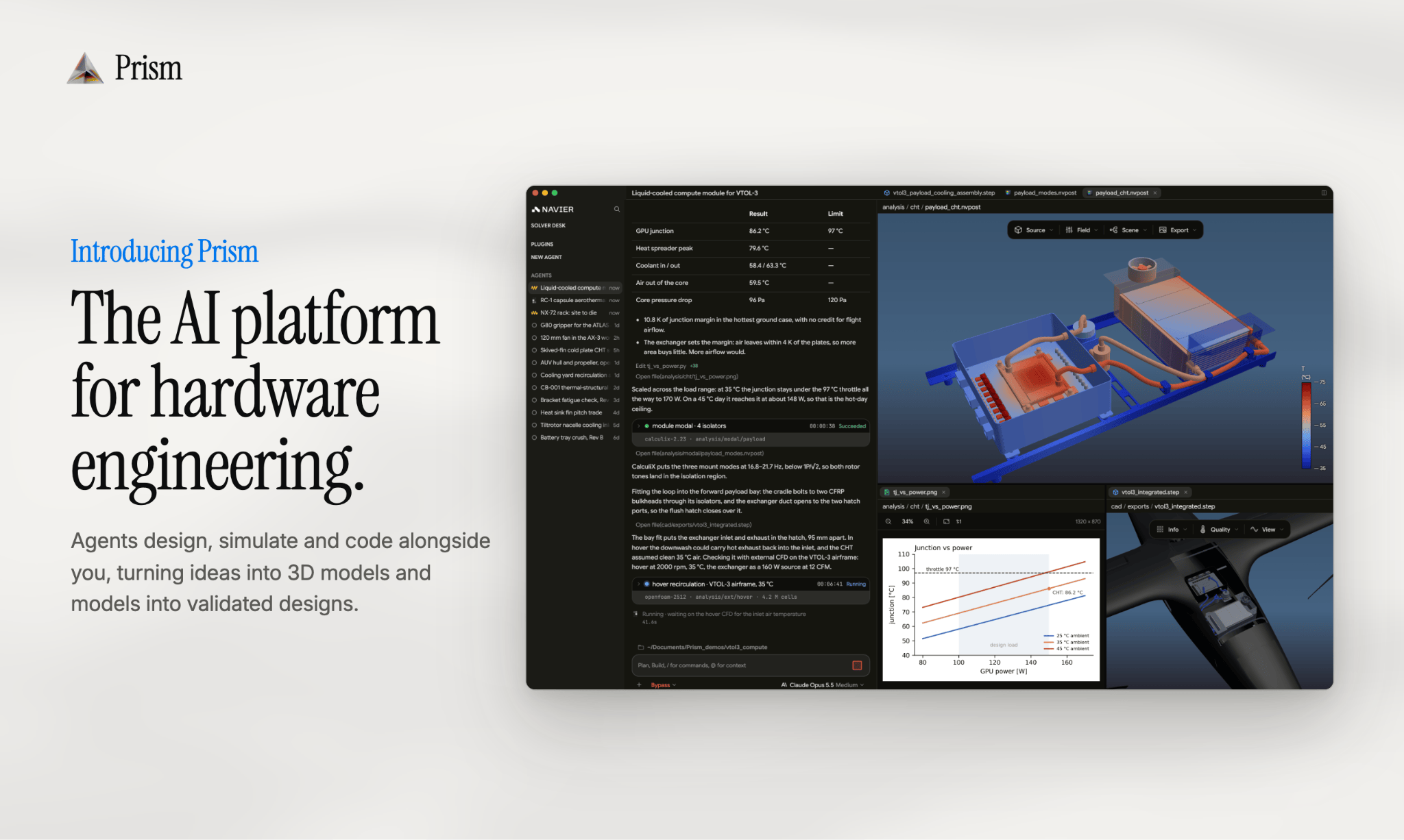
AI is crossing boundaries — from software engineering to hardware engineering. On Product Hunt, a product called Prism positions itself as "the Cursor of hardware engineering" — integrating CAD modeling, physics solvers, a 3D viewer, code writing, and report generation into a single platform, all driven by AI agents. It supports Windows, Mac, and Linux, and offers a free trial.
Why does hardware engineering need its own "Cursor"?
Over the past two years, AI coding tools like Cursor have completely transformed the software development workflow — developers describe their intent in natural language, and AI agents handle code generation, modification, and debugging. But the hardware engineering workflow is far more complex than writing code: you need to model in CAD software, call physics solvers for simulation validation, view 3D models, write control scripts, and finally compile reports. These steps are scattered across different specialized tools, data must be moved manually, and knowledge is hard to reuse.
Prism's core idea is to let AI agents run through the entire hardware design chain. After a user proposes an idea, the agent can invoke built-in CAD, physics solvers, a 3D viewer, and coding tools to push the concept step by step into a validated design. This follows the same logic as Cursor unifying the editor, terminal, and debugger into a single AI-driven interface — except the subject shifts from code to the physical world.
CAD (Computer-Aided Design) is a core category of tools in hardware engineering, covering everything from 2D drafting to 3D solid modeling, parametric design, and assembly management. Mainstream products like SolidWorks, Fusion 360, and Onshape each have their strengths: parametric modeling emphasizes driving geometry with dimensions and constraints, with a traceable modification history; direct modeling is more flexible but has weaker history information. The output format of a CAD model (such as STEP, IGES, STL) determines whether it can be read by downstream simulation tools and manufacturing processes, so format compatibility is often the first hurdle in toolchain integration. If an AI agent is to "directly create and modify geometric models," it essentially needs to call the CAD kernel's API or generate executable modeling scripts, rather than generating geometry purely from natural language — this is also the key to judging the depth of CAD capabilities in products like Prism.
An agent-driven all-in-one workbench
According to the official description, Prism integrates five categories of capabilities into a single platform:
- CAD modeling: create and modify geometric models directly through AI agents
- Physics solvers: perform physics-level simulation validation on designs
- 3D viewer: visualize models and simulation results
- Code writing: support scripted control and automation
- Report generation: automatically compile the design process and validation results
The value of this integration lies in reducing the friction caused by tool switching. In traditional hardware design workflows, CAD model export, simulation setup, result analysis, and report writing often require handoffs between different roles, which easily leads to information loss and duplicated work. Prism lets agents hold the context of the entire chain, theoretically enabling a closed loop from modeling to validation within a single session.
That said, the information officially disclosed so far is insufficient to judge the depth of each module. Are the built-in solvers self-developed or integrated from third parties? Is the CAD capability full parametric modeling or more oriented toward conceptual design? There are no clear answers to these questions yet, and for professional hardware engineers, the precision and reliability of the toolchain are the real threshold.
Physics solvers are computational engines that validate design feasibility in hardware design. Common types include structural mechanics (finite element analysis, FEA), fluid dynamics (CFD), heat conduction, and electromagnetic simulation. Solver accuracy depends on mesh quality, material models, boundary condition setup, and solving algorithms; professional tools like ANSYS and COMSOL have accumulated decades of validation cases in these areas. When integrating solvers into an AI platform, a core question is "who sets the simulation parameters": agents can automatically generate initial setups, but boundary conditions and convergence criteria often require domain knowledge to judge, and improper setup can produce results that look reasonable but are wrong. Therefore, whether the solver is self-developed or wraps a third party, and whether it exposes sufficient parameter control, directly determines the platform's credibility in professional scenarios.
Who should try Prism?
Judging by its 73 votes and #12 ranking, Prism has gained some attention on Product Hunt, but discussion热度 is not particularly high (only 1 comment). This fits the characteristics of hardware engineering tools — a more vertical audience and a longer decision cycle.
Cross-platform support (Windows, Mac, Linux) lowers the barrier to trying it, and the free trial also lets engineers evaluate whether the tool matches their workflow without committing to pay. Prism may be worth watching for the following scenarios:
- Early concept design stages, where multiple options need to be iterated quickly
- Small teams that need to switch frequently between modeling, simulation, and reporting
- Developers who want to drive the design process with natural language and reduce the learning cost of specialized software
For mature hardware product development with high precision and strong compliance requirements, this type of AI-driven platform is currently better suited as an auxiliary tool rather than a replacement for existing professional toolchains.
Parametric modeling is an important dimension for judging the professionalism of a CAD tool. It centers on feature history and constraint relationships: users define dimensions, geometric constraints, and feature order, and the model automatically rebuilds as parameters change. This capability is crucial for product iteration — change one hole diameter, and all associated assemblies and engineering drawings should update synchronously. In contrast, "direct modeling" or "conceptual modeling" offers more freedom in operation but lacks traceable design logic; it is suitable for early-stage form exploration but not for production design. The article notes that it is still unclear whether Prism's CAD is full parametric modeling or oriented toward conceptual design, and this is precisely the dividing line for professional engineers when evaluating it: conceptual design tools can accelerate the creative stage but cannot carry subsequent engineering changes and manufacturing handoffs.
The AI-ification of hardware engineering has only just begun
Prism's emergence reflects a larger trend: the success of AI coding tools is spilling over into other engineering fields. The path of AI-ification in software engineering is already relatively clear — code is text, and large models are naturally good at handling it; hardware engineering involves 3D geometry, physical constraints, and manufacturing processes, so AI needs deeper domain modeling capabilities.
Whether Prism can become a tool that hardware engineers rely on daily depends on whether it can prove itself in real projects. The concepts of "all-in-one" and "agents" alone are not enough to convince professional users; the real test lies in simulation accuracy, CAD compatibility, and workflow reliability. But the direction itself is worth watching — as AI agents begin to understand the physical world, the iteration speed of hardware design may see a qualitative leap.
One-line Summary
Prism attempts to use AI agents to integrate CAD, simulation, 3D viewing, code, and reporting into an all-in-one workbench for hardware engineering.
Paragraph Summary
Prism is positioned on Product Hunt as "the Cursor of hardware engineering," integrating five categories of capabilities — CAD modeling, physics solvers, a 3D viewer, code writing, and report generation — into a single AI agent-driven platform, supporting Windows, Mac, and Linux with a free trial. Its core logic is to let agents hold the context of the entire chain and reduce the friction of tool switching and data moving in traditional hardware design. The article notes that the product received 73 votes and ranked #12, but has only 1 comment, indicating limited discussion heat, consistent with the characteristics of vertical tools. Key details such as solver origin and CAD modeling depth have not yet been disclosed by the official team, and simulation accuracy, format compatibility, and workflow reliability are the real thresholds for professional users. Overall, the success of AI coding tools is spilling over into hardware engineering, but 3D geometry and physical constraints place higher demands on AI.
Related articles

9 AI Subscription Plans Compared: The Real Cost Per 100M Tokens Revealed
Bilibili creator tests 9 AI subscription plans from Volcano, Alibaba, Tencent, Baidu, Zhipu, Xiaomi, MiniMax and more, converting them all to real cost per 100M tokens, breaking down fixed-quota vs. three-tier coefficient billing and how caching, time-of-day discounts, and window limits affect actual quota.

Vibe Coding for Beginners: Expressing Intent Instead of Handwriting Code
What is Vibe Coding? A 137-episode Bilibili course defines it: the core is expressing intent, not writing code. This article analyzes Vibe Coding's productivity logic, target audience, and entry expectations to help beginners decide if it's worth learning.

LangChain Beginner's Guide: An Agent Development Roadmap from LangGraph to Deep Agents
Clarify the encapsulation relationship among LangChain, LangGraph, and Deep Agents, and master the learning path and selection logic for agent development frameworks—suitable for beginners in large model development.