Prized: Enabling Non-Engineers to Build Secure, Compliant Internal Tools

Prized lets non-engineers build secure, compliant internal tools using AI without writing code.
Prized is a security-first AI no-code platform that empowers operations, customer support, and finance teams to build internal tools without engineering support. It features pre-connected and scoped data access, complete audit trails, and one-click deployment behind enterprise SSO—addressing the common pain point of business teams waiting on engineering for simple internal tools while maintaining enterprise-grade security and compliance.
The Pain Points of Internal Tool Development and a New Solution
In modern enterprises, operations, customer support, and finance teams constantly need various internal tools for daily tasks—querying customer data, approval workflows, batch-processing orders, and more. However, building these tools typically depends on engineering teams, leading to queued business requests, slow iterations, and projects shelved due to resource constraints.
Industry research shows that engineering teams spend an average of 30%-40% of their time developing and maintaining internal tools. These tools are often functionally simple with highly repetitive CRUD (Create, Read, Update, Delete) logic, yet they can't be easily outsourced or replaced with generic SaaS solutions due to data security and permission management requirements. This contradiction between "high-frequency demand + low-priority scheduling" is the core pain point of internal tool development.
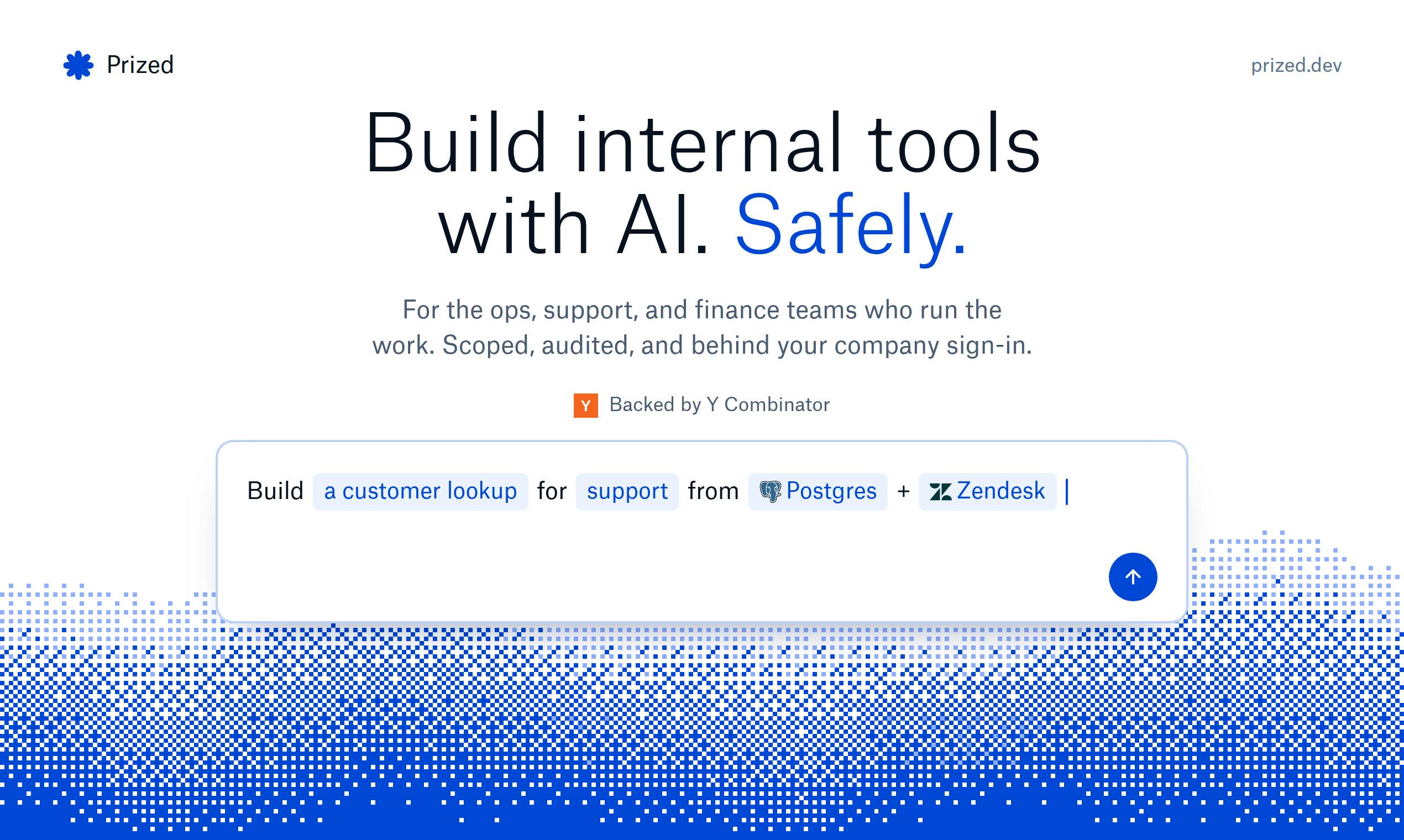
Prized, recently launched on Product Hunt, aims to break this deadlock. Its positioning is crystal clear: enabling operations, customer support, and finance teams to build and deploy secure internal tools using AI—without writing a single line of code. The product received 100 upvotes on launch day, ranking #6, and is categorized at the intersection of Artificial Intelligence, No-Code, and Security.
Core Features: Security-First AI No-Code Tool Building
Unlike the many No-Code tools on the market, Prized puts security front and center. This is evident from the inclusion of "Security" among its category tags. It offers three core capabilities:
Pre-Connected Data with Scoped Permissions
Prized supports pre-connected and scoped company data. Business users don't need to configure complex data source connections themselves when building tools—the system restricts data access scope based on roles and use cases. For positions like finance and customer support that frequently handle sensitive data, this "least privilege" design philosophy effectively reduces the risk of data leaks.
The "Principle of Least Privilege" (PoLP) is one of the fundamental tenets of information security, stating that each user or program should only be granted the minimum set of permissions needed to complete their work. In traditional internal tool development, engineers often configure database access permissions that exceed actual needs for development convenience. Once a tool is misused or compromised, the blast radius expands without limit. Prized's "pre-connected data" design means IT/security teams configure data sources and permission boundaries at the platform level, and business users can only operate within preset "sandboxes"—architecturally eliminating the possibility of unauthorized access.
Complete Access Audit Trails
Every data access generates an audit trail. In an era of increasingly strict compliance requirements, traceable access logs are essential for both internal risk management and external audits. This is a key differentiator between Prized and ordinary drag-and-drop No-Code platforms—it doesn't just let you "build things," it gives enterprises the confidence to actually use them.
Audit trails are a critical element for achieving various compliance certifications. For example, SOC 2 (Service Organization Control 2) certification requires enterprises to demonstrate complete monitoring and logging capabilities for data access; GDPR (General Data Protection Regulation) requires data controllers to document who accessed personal data, when, and for what purpose. A complete audit log typically needs to include the accessor's identity, timestamp, operation type, data scope involved, and operation result. For traditional internal tools, audit capabilities are often retrofitted after the fact, but Prized builds this as a native platform capability—meaning every tool built by business users automatically has compliance-grade traceability, significantly reducing enterprise compliance costs.
One-Click Deployment with Enterprise Login Integration
Prized supports one-click deployment behind company sign-in. By integrating with enterprise identity authentication systems (like SSO), it ensures only authorized employees can access the corresponding tools, avoiding the common security risk of internal tools running exposed on the public internet.
SSO (Single Sign-On) is core infrastructure for enterprise identity management. Its basic principle is that users only need to authenticate once to access multiple trusted application systems, without maintaining separate credentials for each system. Common implementation protocols include SAML 2.0, OAuth 2.0, and OpenID Connect (OIDC). Major enterprise identity providers like Okta, Azure Active Directory, and Google Workspace all support these standard protocols. In real enterprise environments, employees are assigned SSO accounts and corresponding roles upon onboarding, and accounts are immediately deactivated upon departure—with access permissions to all associated applications revoked simultaneously. The value of Prized's SSO integration is that internal tools created by business users are automatically incorporated into the enterprise's unified identity governance framework, requiring no additional user management configuration and avoiding typical security incidents like "a departed employee's tool remains accessible externally."
Why Security-First AI No-Code Platforms Are Timely
Prized's emergence isn't coincidental—it's the product of converging AI programming capabilities and enterprise efficiency demands.
As large language models have matured in code generation, "describing requirements in natural language to generate applications" has moved from concept to reality. From GitHub Copilot's official launch in 2022 to GPT-4, Claude, and other models demonstrating increasingly powerful end-to-end application generation capabilities in 2023-2024, AI code generation has evolved from "helping programmers write functions" to "generating complete full-stack applications from requirement descriptions." This provides the technical foundation for non-engineers to directly participate in software building. Business users understand their own workflows best but often lack technical implementation skills; engineering teams understand technology but struggle to fully grasp every business detail. Prized's approach is to hand "the last mile of implementation" back to business users, freeing engineering teams from tedious internal tool requests to focus on core products.
However, AI-empowered business tool building also introduces new governance challenges: Who ensures these tools don't misuse data? How do you prevent Shadow IT from spiraling out of control?
Shadow IT refers to technology solutions that employees use or create without the approval or knowledge of the IT department. Gartner research indicates that 30%-40% of IT spending in large enterprises falls under Shadow IT. In today's era of increasingly accessible AI tools, this problem is intensifying—business users might use ChatGPT to generate scripts or various No-Code tools to connect to company databases, completely bypassing security review processes. Core risks of Shadow IT include: data leakage (sensitive data transmitted to unapproved third-party services), compliance violations (inability to prove data processing meets regulatory requirements), and operational blind spots (IT teams cannot manage or protect systems they don't know exist).
Prized's answer is "security built-in"—using data scope controls, audit trails, and unified login to pre-build security guardrails rather than patching them after the fact. This design philosophy is its core differentiation advantage compared to traditional No-Code platforms. Essentially, Prized attempts to solve a paradox: giving business users enough autonomy to improve efficiency while maintaining visibility and control for IT and security teams over all tools.
Market Positioning and Potential Challenges
Looking at the competitive landscape, the internal tool building space already has mature players like Retool and Appsmith, while the AI programming assistant space has strong contenders like Cursor and GitHub Copilot. Prized has chosen a more focused entry point: secure, compliant internal tools for non-engineers.
Specifically, Retool was founded in 2017 and is valued at over $3.2 billion. Its core approach provides engineers with drag-and-drop component libraries to accelerate internal tool development—users still need basic programming and database knowledge. Appsmith is Retool's open-source alternative, offering similar low-code capabilities. The core user base for both remains developers or technically-skilled personnel. On the AI programming assistant front, while Cursor and Copilot dramatically improve coding efficiency, their outputs still require users to understand and debug code. The overall internal tools market is projected to reach tens of billions of dollars by 2027, and the niche of "non-technical users + enterprise-grade security" currently has relatively few competitors—precisely the gap Prized is targeting.
This positioning represents both opportunity and challenge:
- Opportunity: Precisely hitting the pain point where business teams "want to build things themselves but are constrained by technology and security"
- Challenge: Striking the right balance between "ease of use" and "secure controllability"—overly strict permission controls may sacrifice flexibility, while being too permissive contradicts the product's core premise
Additionally, as an early-stage product (only 5 comments and 100 upvotes on launch day), Prized still needs to validate the reliability of its security promises in real enterprise environments. Data connection stability, audit log completeness, and compatibility with various enterprise identity systems will all be critical factors determining whether it achieves broad enterprise adoption.
Conclusion: The Future Direction of Internal Tool Development
Prized represents an important trend in AI-era internal tool development: delegating development capabilities to business users while embedding security governance at the platform level. It enables non-engineering teams to rapidly build tools that meet enterprise compliance requirements, improving efficiency while controlling risk.
For enterprises long plagued by backlogs of internal tool requests, this category of "security-first AI No-Code platforms" is worth watching. Of course, whether it can truly deliver on its "security" promise and win enterprise trust in real-world scenarios remains to be proven by time and market validation.
Related articles

Python 3.15 New Feature: Is the sentinel Type Better Than None?
Python 3.15 adds the sentinel type, using named unique sentinel objects to replace None and bare object(), resolving confusion among missing values, explicit emptiness, and invalid input while avoiding type hint failures.

Deep Learning's Three Architectures and the Universal Approximation Theorem: A Complete Guide to MLPs, CNNs, and Transformers
Explaining the inductive bias differences among MLP, CNN, and Transformer, the existence meaning of the Universal Approximation Theorem (UAT), and the role of Taylor expansion in approximation analysis, while clearing up common misconceptions.

GitLab Emergency Patch Release: Analysis of Critical Security Fixes
GitLab releases critical patch 19.5.1, sparking 355 points of discussion on Hacker News. This article analyzes the background, upgrade steps for self-hosted instances, and verification points to help DevOps teams respond quickly to security updates.