RelArena Open-Sourced: A Complete Breakdown of the Relational Machine Learning Benchmark and Foundation Model Toolkit

Prior Labs releases RelArena, an open-source benchmark and foundation model toolkit for relational machine learning.
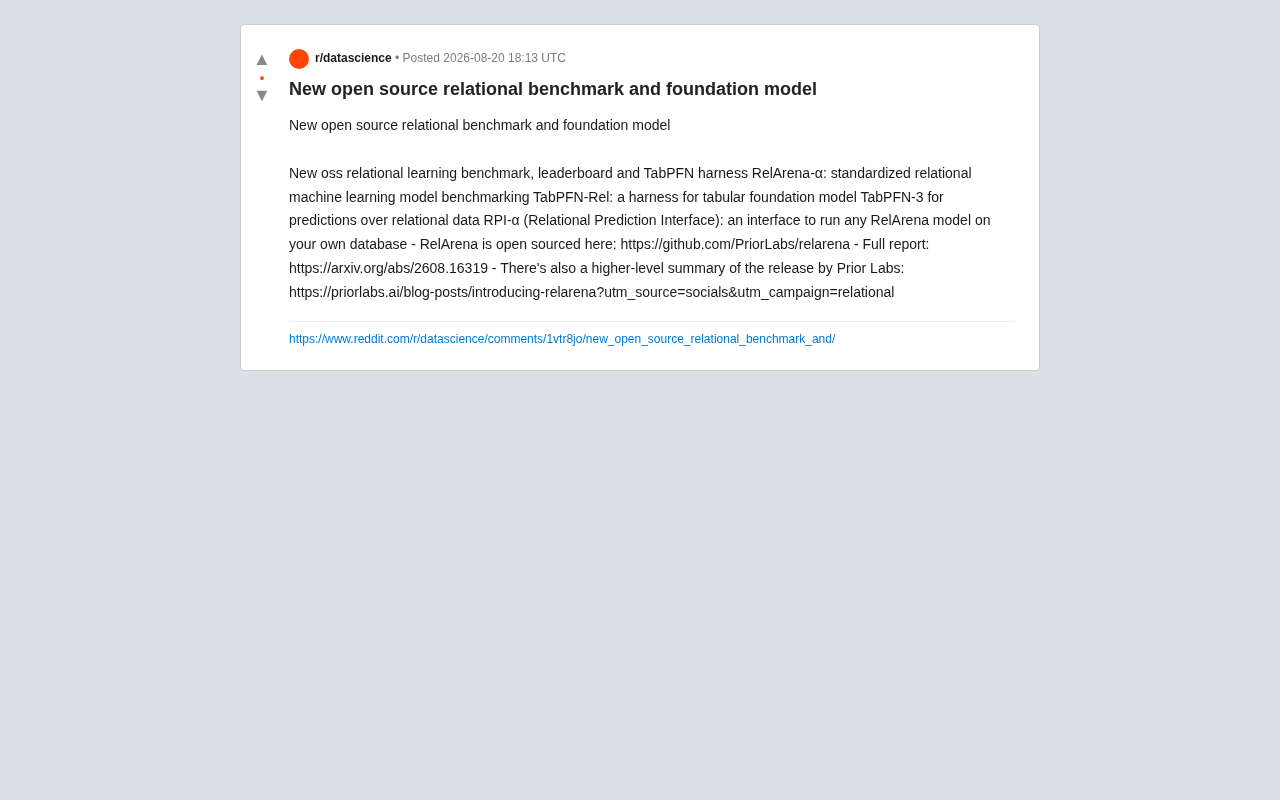
Prior Labs has open-sourced RelArena, a comprehensive project for relational machine learning featuring three core components: RelArena-α (a standardized benchmark with public leaderboard), TabPFN-Rel (a foundation model harness extending TabPFN-3 to multi-table data), and RPI-α (a deployment interface connecting models to real databases). The project aims to fill the gap in standardized evaluation and tooling for relational data, potentially catalyzing the field much like ImageNet did for computer vision.
A New Starting Point for Relational Machine Learning
Among the many branches of machine learning, tabular data and relational data have always been the most prevalent in industry and the closest to real-world business scenarios. Whether it's an e-commerce order database, banking transaction records, or a healthcare system's patient files, the vast majority of enterprise data exists as multiple interrelated tables within relational databases.
The concept of a Relational Database originated from the relational model proposed by Edgar F. Codd in the 1970s. Its core idea is organizing data into multiple two-dimensional tables linked by primary key-foreign key relationships. In practice, an e-commerce system might contain dozens of interrelated tables—users, orders, products, logistics—connected through foreign keys that form complex topological relationships. When traditional machine learning approaches handle such data, data engineers must manually write SQL to perform multi-table JOIN operations, then use GROUP BY and other aggregation operations to flatten one-to-many and many-to-many relationships into single-row feature vectors. This process, known as "Relational Feature Engineering," typically consumes 60-80% of a data science project's time.
However, compared to the fields of computer vision and NLP, relational machine learning has long lacked unified evaluation standards and mature foundation model tools.
The recently open-sourced RelArena project by Prior Labs aims to fill this gap. This release not only introduces a standardized relational machine learning benchmark but also provides an accompanying foundation model toolkit and practical interfaces, establishing solid infrastructure for research and deployment across the entire field. Prior Labs is a research team originating from the AutoML lab at the University of Freiburg in Germany, led by Professor Frank Hutter—one of the top research groups in automated machine learning, having produced widely popular AutoML tools such as Auto-sklearn, BOHB, and SMAC. Prior Labs inherits the lab's deep expertise in Bayesian optimization and meta-learning, with the TabPFN series embodying the core philosophy of incorporating "prior knowledge" into neural networks.
Detailed Breakdown of RelArena's Three Core Components
This release from Prior Labs is not a single tool, but rather a complete ecosystem of components built around relational learning, spanning benchmark evaluation, model inference, and production deployment.
RelArena-α: Standardized Benchmark and Public Leaderboard
RelArena-α is the centerpiece of the entire release. It is a standardized benchmark for evaluating relational machine learning models, equipped with a public leaderboard.
In the past, researchers evaluating relational learning models often used their own datasets and defined their own evaluation metrics, making it nearly impossible to compare different approaches horizontally. This is precisely where the value of a standardized benchmark lies—it provides consistent datasets, task definitions, and evaluation protocols, allowing models from different teams to compete fairly under the same measuring stick.
This is analogous to the role played by ImageNet in computer vision and GLUE in natural language processing—critical infrastructure for driving rapid iteration in a field. Looking back historically, the release of the ImageNet dataset in 2009 and AlexNet's breakthrough performance in the 2012 ImageNet competition directly catalyzed the deep learning revolution; the introduction of the GLUE benchmark in 2018 accelerated the rapid iteration of pre-trained language models like BERT and GPT. In the tabular data domain, while the OpenML platform has provided numerous single-table datasets, it has always lacked a systematic benchmark for multi-table relational scenarios. RelArena-α fills precisely this void—it not only defines datasets but also standardizes data splitting methods, evaluation metrics, leakage prevention protocols, and other critical details to ensure comparisons between different methods are statistically fair.
TabPFN-Rel: A Foundation Model Tool for Relational Data
TabPFN-Rel is a foundation model harness that extends TabPFN-3, a tabular foundation model, to prediction tasks on relational data.
TabPFN (Prior-Data Fitted Networks) is a highly regarded direction in the tabular data domain in recent years. Its core idea is to pre-train a Transformer model capable of "in-context learning" that can make predictions on new tabular data at inference time without retraining. Specifically, TabPFN adopts a paradigm called In-Context Learning (ICL): during pre-training, the model learns the meta-ability of "how to learn" through massive synthetic datasets; at inference time, training samples and test samples are simply fed together as context into the Transformer, which directly outputs predictions without any gradient updates. This is similar to GPT's few-shot capability but applied to structured tabular data. Traditional methods (such as XGBoost, LightGBM) require retraining and hyperparameter tuning for each new dataset, whereas TabPFN's approach fundamentally transforms the workflow.
TabPFN-3 is the third generation of this series, with significant improvements in model capacity, supported data scale, and feature types. The significance of TabPFN-Rel lies in extending this "plug-and-play" foundation model capability from single tables to complex multi-table relational scenarios—the most common form of real-world databases. The technical challenge is enabling the model to understand inter-table topology and one-to-many, many-to-many aggregation semantics. For example, when predicting whether a user will churn, the model needs to simultaneously understand the hierarchical relationships between the user profile table, historical orders table, and customer service ticket table, automatically extracting valuable signals from them.
RPI-α: Relational Prediction Interface for Your Own Database
RPI (Relational Prediction Interface) solves the "last mile" deployment problem. It is a universal interface that allows developers to run any RelArena model directly on their own databases.
The practical value of this component cannot be overlooked. For most enterprises, whether cutting-edge models can truly be deployed hinges on integration costs. RPI-α lowers the barrier from academic benchmarks to production deployment through a standardized interface, enabling research results to be translated into actual business value more quickly. Developers only need to specify database connection information and the target prediction column, and RPI automatically handles schema discovery, relationship inference, and prediction pipeline construction—no need to manually write complex ETL pipelines.
Why Relational Foundation Models Deserve Attention
Relational data constitutes the bulk of enterprise digital assets, yet traditional machine learning workflows typically require tedious feature engineering when handling such data: manually joining multiple tables, aggregating them, and then feeding the results to downstream models. This process is not only time-consuming but highly dependent on domain expert experience and difficult to scale.
In industry, Automated Feature Engineering has always been a high-value but high-difficulty direction. Existing solutions such as Featuretools and tsfresh can automatically generate features based on time windows or aggregation operations, but they are fundamentally rule-based exhaustive searches prone to combinatorial explosion and lacking semantic understanding. According to McKinsey estimates, enterprise data teams spend approximately 40% of their effort on data preparation and feature engineering. If this work could be automated by models, it would unleash enormous productivity gains.
The introduction of the foundation model paradigm has the potential to fundamentally change this landscape. Through general representation capabilities acquired via pre-training, models can automatically understand inter-table relationships and capture cross-table features, dramatically reducing manual feature engineering effort. The advantage lies in implicitly completing feature crossing and relationship modeling through end-to-end learning, avoiding explicit enumeration of the feature space. This follows the same logic as how large language models transformed the text processing paradigm—using a powerful pre-trained model to replace large amounts of task-specific custom work.
Prior Labs' strategy of simultaneously releasing a benchmark, model tool, and deployment interface as a "triple package" also reflects the team's ambition to drive standardization across the entire field. A healthy technology ecosystem requires models that push performance boundaries, fair evaluation standards, and user-friendly deployment tools—all three are indispensable.
RelArena Open Source Ecosystem and Community Participation
RelArena is fully open-sourced on GitHub (github.com/PriorLabs/relarena), accompanied by a detailed technical report (arxiv.org/abs/2608.16319) and a high-level summary on the official Prior Labs blog.
An open-source strategy is crucial for promoting a new benchmark. Only when code, data, and evaluation protocols are fully public can the community verify reproducibility of results, contribute new methods, and continuously expand the benchmark's coverage. Researchers can directly submit their models to RelArena and appear on the leaderboard, creating a virtuous cycle of competition and collaboration. This open benchmark operating model has been validated as effective in multiple AI subfields—for example, Hugging Face's Open LLM Leaderboard greatly accelerated open-source language model development, while the Papers With Code platform sped up knowledge dissemination by aggregating SOTA results across tasks.
Summary and Outlook
The release of RelArena marks the beginning of relational machine learning having its own "standard toolbox." From a unified evaluation benchmark, to a ready-to-use foundation model, to a deployment interface for real databases, Prior Labs is attempting to create a complete pipeline from research to production.
For data science practitioners long frustrated by feature engineering and researchers following the cutting edge of tabular and relational data, this open-source toolkit is well worth exploring in depth. As an early "α" version release, its performance in real-world complex scenarios and the model's generalization capabilities still await further validation through community practice. It's worth noting that the challenges facing relational foundation models are also considerable: database schemas vary enormously across industries, table counts range from a handful to hundreds, and data types span numerical, text, time series, geographic information, and other modalities. How models maintain stable generalization performance in such highly heterogeneous environments will be a key research question going forward.
Regardless, once a field has a shared measuring stick, it means it has entered the fast lane of accelerated development. Just as ImageNet was to computer vision and GLUE was to natural language processing, RelArena has the potential to become that critical catalyst for the field of relational machine learning.
Related articles

Apple HomeView Hands-On Review: Is the $300 Smart Home Hub Worth It?
Apple HomeView hands-on: a $300 smart home hub with facial recognition for quick account switching, but no App Store or voice recognition. Is the wall-mounted version worth it? Should you buy the first generation?

Meta Muse Wonder Launch: What It Means for Meta's Return to the Frontier AI Race
Meta releases Muse Wonder and WonderFull, benchmarks reach the frontier, community feedback is polarized. An in-depth look at Meta's return to the frontier AI race, its personal agent strategy, and Zuckerberg's different path.

Apple Home Smart Home Lineup Leaked: LG and Schneider Team Up, UWB Door Lock on Board
Apple Home ecosystem gains new LG and Schneider devices: UWB smart lock with proximity unlock, 2.5K dual-camera doorbell, privacy indoor camera, and AirPods-like seamless pairing.