PrO-GPs: Reshaping Gaussian Process Posterior Inference Around Predictive Goals

PrO-GPs prioritize predictive calibration as the primary goal, making Gaussian processes more reliable under model misspecification.
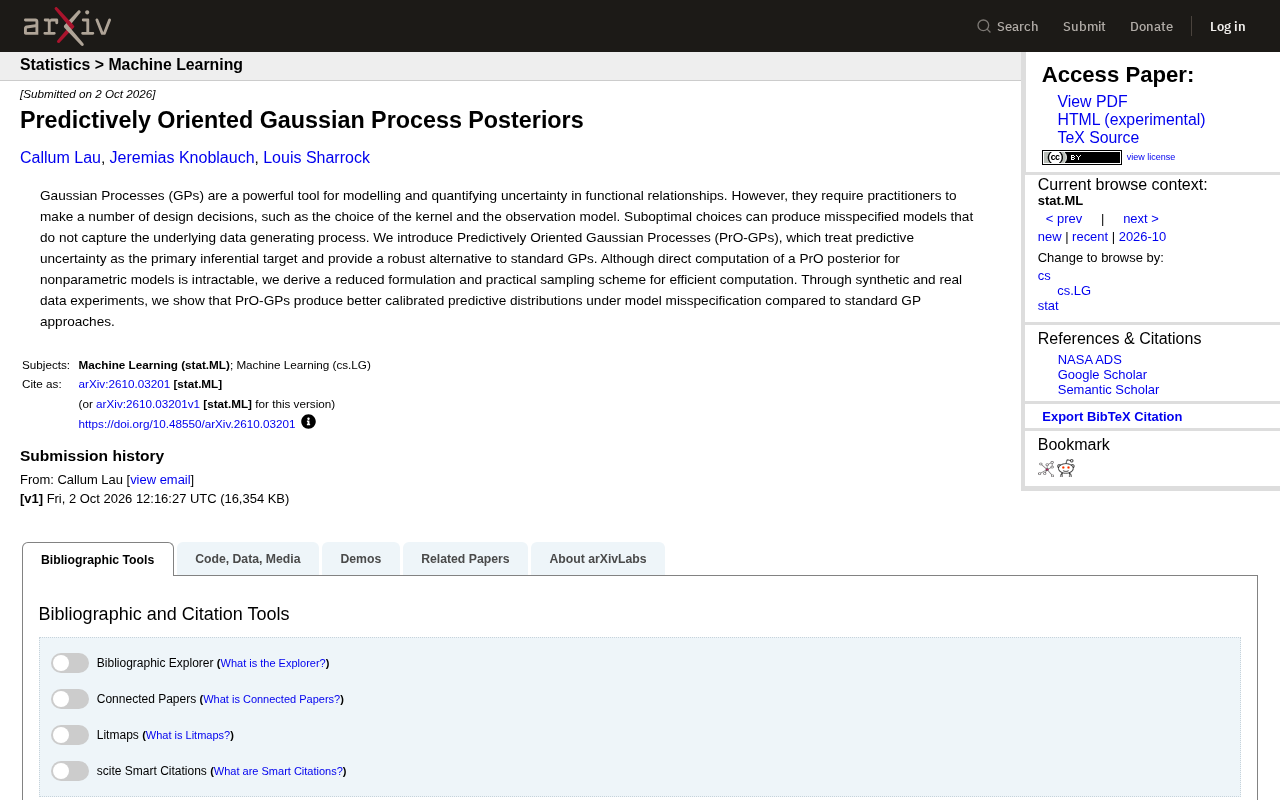
Gaussian Processes are classic tools for uncertainty quantification, but their predictive quality depends heavily on correct kernel and observation model choices — misspecification leads to badly miscalibrated confidence intervals. The newly proposed PrO-GPs invert the traditional inference logic: instead of targeting a posterior over the underlying function, they treat predictive uncertainty calibration as the primary inferential goal. To handle the intractability of direct computation in nonparametric models, the authors derive a reduced formulation and a practical sampling scheme. Experiments on synthetic and real data show PrO-GPs significantly outperform standard GPs in calibration under misspecification, offering a more reliable option for uncertainty-sensitive applications like Bayesian optimization and scientific modeling.
The Pain Point of Gaussian Processes: Design Choices Make or Break Performance
Gaussian Processes (GPs) are powerful tools for uncertainty quantification in machine learning and statistical modeling. They model functional relationships and produce predictions with confidence intervals, and are widely used in Bayesian optimization, spatial statistics, time series forecasting, and beyond.
However, that power comes at a cost. Users must make a series of critical design decisions — most notably the choice of kernel function and the specification of the observation model. These choices may seem like technical details, but they directly determine whether the model can faithfully capture the underlying data-generating process. A poor choice leads to model misspecification, which distorts predictive distributions and makes uncertainty estimates unreliable.
This is precisely the problem that a newly published arXiv paper (arXiv:2610.03201) sets out to address. The authors propose Predictively Oriented Gaussian Processes (PrO-GPs), which fundamentally reconsider the priority ordering of GP inference.
The kernel function is the core component of a Gaussian process — it defines the similarity structure between function values, essentially encoding prior assumptions about smoothness, periodicity, trends, and so on. Common kernels include the Radial Basis Function (RBF/Squared Exponential), Matérn, and periodic kernels; different choices lead to dramatically different predictive behavior. The observation model determines how measurement noise is handled — for example, whether noise is assumed to be Gaussian or heavy-tailed. Both design decisions typically require domain expertise or extensive tuning, and the consequences of misspecification are twofold: the predictive mean may deviate from the truth, and more dangerously, uncertainty estimates become systematically miscalibrated, giving users false confidence in incorrect results. In settings like Bayesian optimization, this miscalibration directly causes the acquisition function to explore in the wrong directions, with compounding errors growing rapidly over iterations.
The Core Idea: Making Predictive Uncertainty the Primary Goal
Standard GP inference follows a particular logic: first establish a posterior over parameters or function space, then derive predictive distributions from that posterior. This means predictive quality is, in a sense, a byproduct of modeling assumptions — if the kernel or observation model is wrong, predictions naturally go astray.
PrO-GPs innovate by inverting this priority. Rather than first pinning down the precise form of the underlying function, they treat predictive uncertainty directly as the primary inferential target. In other words, instead of asking "what does the true function look like?", PrO-GPs ask "is my predictive distribution over future observations well-calibrated?"
This prediction-centric perspective makes the model more robust to misspecification. Even if the kernel choice is imperfect, the PrO posterior still yields relatively reliable predictive intervals — which is especially important in practical applications where guaranteeing a perfectly specified model is nearly impossible.
Why Robustness Matters So Much
In real-world data modeling, a "correctly specified model" is almost a luxury. The true data-generating process is almost always more complex than any kernel we might choose. Standard GPs in such settings tend to produce either overconfident or overly conservative uncertainty estimates — exactly the kind of failure most damaging to downstream decision-making processes like active learning and Bayesian optimization. PrO-GPs offer a path to "using the model confidently even when the model is imperfect."
Technical Challenges and Solutions
Elegant in theory, but not easy to implement in practice. The paper openly acknowledges that directly computing the PrO posterior is intractable for nonparametric models. This is because the prediction-oriented objective involves complex integrals over an infinite-dimensional function space that cannot be expressed in closed form.
To address this, the authors do two things:
- Derive a reduced formulation that transforms the otherwise intractable computation into a mathematically manageable expression;
- Design a practical sampling scheme that enables efficient approximate computation of the PrO posterior.
This combination of theoretical simplification and sampling-based approximation is the key step that takes PrO-GPs from a conceptual idea to a usable tool. It preserves the core advantages of the prediction-oriented framework while avoiding computational infeasibility.
"Intractable" in Bayesian inference refers to the inability to compute posterior distributions exactly using closed-form analytical formulas in a finite number of steps — typically because the normalizing constant involves high-dimensional integration. Standard GPs admit analytical solutions thanks to the closure properties of Gaussian distributions under linear operations: a Gaussian prior combined with a Gaussian likelihood yields a Gaussian posterior. But PrO-GPs' prediction-oriented objective breaks this conjugate structure, making the posterior form substantially more complex. The sampling scheme employed in the paper is essentially a Monte Carlo approximation (e.g., MCMC or importance sampling), using large numbers of samples to estimate posterior expectations that cannot be computed exactly. The reduced formulation is derived by mathematically transforming the objective into a more tractable equivalent expression, reducing the computational cost of sampling and making the method practically viable for small-to-medium-scale problems.
Experimental Validation: Improved Calibration Performance
The paper validates PrO-GPs using both synthetic and real-world datasets. Results show that under model misspecification, PrO-GPs produce better calibrated predictive distributions than standard GP approaches.
"Calibration" is the central metric for evaluating the quality of probabilistic predictions — a well-calibrated model's stated 90% confidence intervals should genuinely cover the true value approximately 90% of the time. Standard GPs often exhibit poor calibration under misspecification, and the experimental results for PrO-GPs demonstrate a meaningful improvement on this front.
This means that for applications highly sensitive to uncertainty quantification — such as scientific modeling, risk assessment, and automated experimental design — PrO-GPs represent a noteworthy alternative worth considering.
Probabilistic prediction calibration can be quantified through tools such as reliability diagrams or the Continuous Ranked Probability Score (CRPS). Intuitively: if a model claims a certain interval has 80% coverage, but in practice only covers 60% of true values across many predictions, the model exhibits "overconfident" calibration bias. Conversely, if actual coverage exceeds the claimed value, the model is too conservative and overestimates uncertainty. Standard GPs, when the kernel is misspecified, tend to underestimate predictive variance, producing confidence intervals that are too narrow — i.e., overconfidence bias — which is especially dangerous in high-stakes decision-making contexts like medicine or materials science. PrO-GPs mitigate this systematic bias by directly optimizing the predictive objective, and their experimental results show significantly improved calibration error under misspecification conditions.
Significance and Outlook
The contribution of PrO-GPs goes beyond a new algorithm — it proposes a methodological shift: when we cannot guarantee a perfectly specified model, rather than striving for a precise characterization of the underlying mechanism, we should directly optimize the target we actually care about — prediction itself.
This perspective resonates with recent research directions such as "prediction-driven inference" and "robust Bayes," reflecting a growing emphasis in statistical machine learning on the problem of model misspecification. For practitioners, PrO-GPs offer a more trustworthy tool for real, complex, and imperfect data environments.
Of course, as a newly posted preprint, the full value of PrO-GPs still awaits broader experimental validation and community scrutiny — for example, scalability to high-dimensional problems and large datasets, and systematic comparison with other robust GP variants. But the core idea already points Gaussian process modeling in a promising new direction.
Related articles

Free Unlimited Claude Code Solution: Agnes AI + CC Switch Setup Guide
No paid subscription needed — pair the free AI platform Agnes AI with the open-source tool CC Switch to provide a backend for Claude Code, enabling unlimited free calls to text, image, and video models. This guide covers the full setup, test results, and usage boundaries.

A Complete Zero-Cost Guide to Getting Started with Claude Code for Beginners in China
A beginner's guide to Claude Code for users in China: two installation methods (command line and IDE plugin), full configuration steps for replacing the official API with the free domestic LongCat model, and a hands-on demo of building a small tool with natural language, plus tips.

When the NSA Gets Involved: The AI Supply Chain Crisis Behind Open-Source CVEs and API Key Hijacking
Multiple open-source projects disclosed severe CVEs in one day, PHP flaws alarmed the FBI, and Railway and OpenCode were breached with API keys stolen. This article breaks down the vulnerability window, AI-accelerated exploitation, and the AI supply chain crisis behind the API key black market, with a developer defense checklist.