Programmable Semantic Interventions: Learning Causal Carriers Without Counterfactual Data
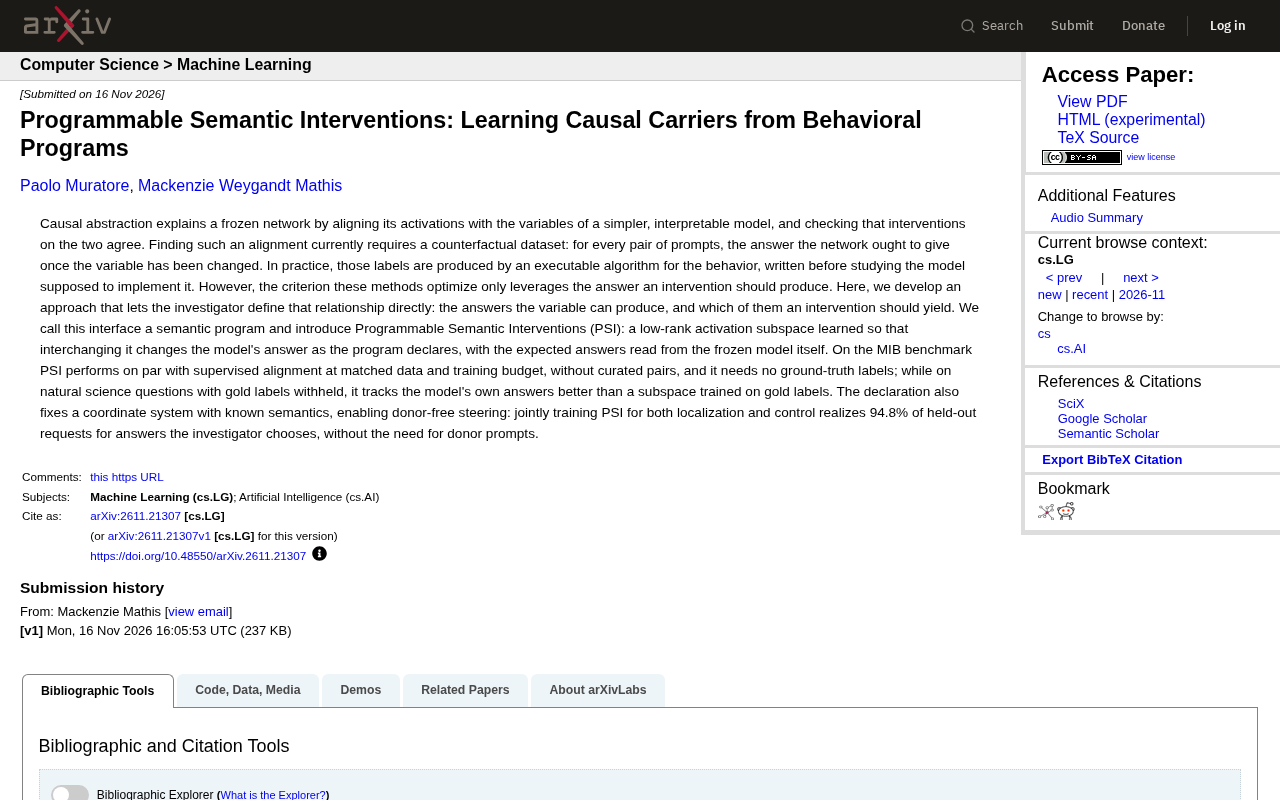
PSI replaces counterfactual datasets with semantic programs, enabling label-free causal abstraction and donor-free steering.
The paper proposes Programmable Semantic Interventions (PSI), which replaces the counterfactual datasets required by traditional causal abstraction with "semantic programs". A semantic program has researchers declare the answer space a variable can produce and the answer an intervention should yield; PSI then learns a low-rank activation subspace so that swapping it changes the model's output as declared, with expected answers read directly from the frozen model. On the MIB benchmark, PSI matches supervised alignment without paired data or ground-truth labels; on natural science questions, it tracks the model's own answers better than subspaces trained with gold-standard labels. Joint training of localization and control achieves a 94.8% held-out request success rate without donor prompts. Limitations: semantic programs still require manual definition, and generalization remains to be verified.
A New Path for Causal Abstraction: From Behavioral Programs to Semantic Programs
When explaining a frozen neural network, the traditional approach is causal abstraction: aligning network activations with the variables of a simpler, interpretable model, and testing whether interventions on both remain consistent. But this route has long been constrained by the need to obtain counterfactual datasets—for every pair of prompts, one must know what answer the network "should" give once a variable is changed. In practice, these labels are often generated by behavioral algorithms that researchers write before studying the model. The problem is that the criteria optimized by such methods only use the answer the intervention "should" produce, while ignoring which answers the variable itself can produce and which one the intervention should select among them.
According to the paper Programmable Semantic Interventions: Learning Causal Carriers from Behavioral Programs, researchers can directly define this relationship rather than relying on pre-annotated counterfactual pairs.
What Is a Semantic Program
The authors call this interface a "semantic program": researchers declare which answers a variable can produce, and which one an intervention should produce from among those answers. This is more flexible than traditional counterfactual labels—it does not require providing a specific answer for every prompt pair, but instead describes the rules of the answer space and the intervention mapping.
Building on this, the paper proposes Programmable Semantic Interventions (PSI): learning a low-rank activation subspace such that swapping this subspace causes the model's answer to change in the way declared by the program, while the "expected answer" is read directly from the frozen model itself. This means no manually curated paired data and no ground-truth labels are needed.
Causal Abstraction is a theoretical framework for explaining neural networks: it seeks a simpler, interpretable high-level model (such as a logic circuit or causal graph) such that the network's low-level activation variables map onto the high-level model's variables, and interventions on both remain causally consistent. For example, if the high-level model specifies that "changing variable A should cause output B", then intervening on the corresponding subspace of the network should produce the same output change. The core difficulty of this framework lies in obtaining counterfactual data—that is, knowing "what the network should have output if some variable were changed". Traditional approaches rely on algorithms pre-written by researchers to generate these counterfactual labels, but such methods only focus on the answer the intervention "should" produce, ignoring which answers the variable itself can produce and how the intervention selects among them. Causal abstraction is commonly used in mechanistic interpretability research, such as circuit discovery and feature attribution, but its data requirements limit scalability.
How PSI Works and Its Key Design
The core of PSI is a low-rank activation subspace. The training objective is for the swap operation on the subspace to correspond to the answer changes declared by the semantic program. Compared with supervised alignment methods, PSI's supervision signal comes from the consistency between program declarations and the frozen model's outputs, rather than externally annotated counterfactual answers.
This design brings two direct benefits. First, greater data efficiency: there is no need to construct counterfactual labels for every prompt pair. Second, the semantic program simultaneously fixes a coordinate system with known semantics, so that subsequent localization and control can operate within the same representation space.
Low-Rank Activation Subspace is the core technical component of the PSI method. In neural networks, the activation space is usually high-dimensional (e.g., thousands of dimensions), but many semantic concepts (such as "whether the answer is correct" or "sentiment polarity") may occupy only a low-dimensional subspace. A low-rank subspace means using fewer principal components or basis vectors to capture these semantic directions of variation. PSI trains a low-rank projection matrix such that, when activation values are swapped within this subspace, the model's output changes in the way declared by the semantic program. The low-rank constraint not only reduces the number of parameters and prevents overfitting, but also forces the model to concentrate semantic variation in a few interpretable directions. Unlike traditional supervised alignment, which directly fine-tunes fully connected layers or adds adapters, PSI's intervention operates by swapping subspace coordinates, thereby keeping the rest of the model frozen and allowing localization and control to share the same coordinate system. This design relies on matrix factorization and subspace learning techniques, such as singular value decomposition or low-rank adaptation.
Experimental Results: On Par with Supervised Alignment, and No Ground-Truth Labels Needed
The paper reports two sets of key experiments. On the MIB benchmark, under matched data and training budgets, PSI performs comparably to supervised alignment methods, but without carefully curated paired data and without ground-truth labels.
On natural science questions with gold-standard labels that are hidden, PSI tracks the model's own answers better than a subspace trained with gold-standard labels. This result suggests that the mechanism of reading expected answers from the frozen model may, in practical settings, align more closely with the model's internal behavior than external labels do.
Donor-Free Steering: 94.8% Held-Out Request Success Rate
The semantic program's declarations also fix a coordinate system with known semantics, thereby enabling "donor-free steering". The authors train PSI jointly for localization and control, achieving a 94.8% held-out request success rate on researcher-selected answers, without requiring donor prompts.
This number is noteworthy: traditional steering methods usually need donor prompts to provide target activations, whereas PSI directly specifies the target semantics through program declarations, simplifying the steering pipeline.
Donor Steering is a common paradigm in model steering: to change the model's output on a given prompt, one provides a "donor" prompt that naturally elicits the target activation pattern, and then injects the donor prompt's activations into the inference process of the original prompt. This method depends on finding a suitable donor prompt, and semantic differences between the donor and the target prompt may introduce noise. Donor-Free Steering, by contrast, requires no additional prompt; instead, it directly constructs or selects a target activation vector in the low-rank subspace according to the target answer declared by the semantic program, and then swaps it into the model activations. By jointly training localization (finding the semantic subspace) and control (operating within that subspace), PSI enables the model to output researcher-selected answers without donor prompts. A 94.8% held-out request success rate means that on requests not involved in training, the method still successfully steers the model at a very high proportion. This reduces the steering pipeline's dependence on prompt engineering and improves controllability over sensitive or rare semantics.
Significance and Limitations
The value of PSI lies in shifting causal abstraction's data requirements from "counterfactual answer pairs" to "semantic program declarations", reducing the burden of manual annotation while retaining the intervention-consistency checks needed for interpretability analysis. It also offers a new donor-free approach to model steering.
That said, semantic programs still require researchers to manually define the answer space and intervention mapping, which to some extent shifts the annotation burden to the program-writing stage. In addition, the paper mainly validates on the MIB benchmark and natural science questions, and the method's generalization to broader tasks remains to be tested.
MIB Benchmark (Mechanistic Interpretability Benchmark) is a standardized test suite for evaluating mechanistic interpretability methods, typically containing multiple tasks (such as classification and sequence prediction) and small pretrained models, requiring methods to localize task-relevant neurons or subspaces and to test intervention effects. MIB emphasizes comparing different methods under matched data and training budgets to avoid unfair comparisons caused by resource differences. PSI performs comparably to supervised alignment methods on MIB, showing that it can achieve competitive performance without counterfactual labels. In addition, the "natural science questions" mentioned in the paper may refer to question-answering tasks requiring reasoning or factual knowledge, whose gold-standard labels are hidden to simulate real-world scenarios where labels are hard to obtain. The choice of these benchmarks reflects the current interpretability field's focus on reproducibility and generalization, but also suggests that PSI's validation scope is limited and needs further testing on more diverse tasks (such as multi-turn dialogue and code generation).
FAQ
What is the relationship between PSI and causal abstraction?
PSI continues the intervention-consistency idea of causal abstraction, but replaces counterfactual datasets with semantic programs, so that the alignment process no longer depends on pre-annotated answer pairs.
Why is donor-free steering important?
Traditional steering requires donor prompts to provide target activations, whereas PSI directly specifies the semantic target through program declarations, reducing dependence on additional prompts and achieving researcher-selected answers on 94.8% of held-out requests.
Related articles

The CAPSARII Project: How Ultra-Low-Power Wearable Sensors Enable Battlefield Health Monitoring
The CAPSARII project presents an ultra-low-power wearable platform and battlefield IoT framework for military health monitoring, integrating smart textile sensing, RISC-V edge AI, federated analytics, and post-quantum encryption, with stress classification benchmarks and a compression roadmap.

Paying Creators for Training Data May Accelerate AI Displacement
Research reveals that compensating creators for training data may accelerate AI displacement of low-quality creators, raising creator income but reducing consumer surplus. Policy must balance creator protection with consumer welfare.

How Explicit Behavioral Constraints Reduce LLM Code Generation Failures
A controlled experiment shows that lightweight structural specs reduce LLM code failures by only 8.7%, while explicit behavioral obligations cut failures by 47.2% and improve developer calibration.