Programmers Pivoting to AI: Opportunities in Application Development and Pitfalls to Avoid

A practical framework for programmers to enter AI via Agent development and model fine-tuning — with clear risk warnings.
This article outlines a tiered framework for programmers looking to enter the AI field. It contrasts the steep requirements of algorithm engineering with the accessible path of AI application development — covering Agent development (learnable in ~1 month) and model fine-tuning (~2 more months). It also warns that the current salary premium is a short-lived window, and recommends a dual-track strategy pairing AI skills with Java or C/C++ as a stable baseline.
How Ordinary Programmers Can Embrace AI
Faced with the AI wave, how should an average programmer break in? During a livestream, Mashibing laid out a clear, tiered framework. He divided the ways ordinary people can embrace AI into several levels: the most basic is tool usage — becoming proficient with tools like DeepSeek, AI coding assistants, and so on, using them to generate presentations, summarize reports, and assist with coding.
In this process, a key topic comes up: Prompts. When AI first emerged, the role of "Prompt Engineer" had its moment in the spotlight. Prompt Engineering refers to the practice of carefully designing input text to guide large language models toward more accurate and useful outputs. In the early days of GPT-3 and GPT-4, models had limited ability to understand instructions, and the wording, structure, and arrangement of examples significantly impacted output quality — creating demand for dedicated roles. However, as next-generation models like GPT-4o, Claude 3, and DeepSeek-V3 have dramatically improved their contextual understanding, automatically inferring user intent and tolerating ambiguous phrasing, this role has largely faded. That said, in complex business scenarios, structured prompting techniques (such as Chain-of-Thought reasoning, few-shot examples, and role assignment) can still significantly improve task quality and remain especially critical for workflow design in Agent development. So if you want AI to assist your work efficiently and precisely, mastering solid Prompt techniques remains a valuable foundational skill.
But simply using tools sets a very low bar. For professionals who genuinely want to work in AI, Mashibing breaks the field into two major tiers: algorithm engineers and application developers.
Algorithm Engineers: A High-Salary Bar Most Can't Reach
Algorithm engineers are the people who actually invent AI algorithms — the teams behind technologies like ChatGPT, DeepSeek, Gemini, Claude, and Cursor. Their core work includes designing Transformer variant architectures, optimizing pre-training and alignment strategies (such as RLHF and DPO), and solving engineering challenges in large-scale distributed training. Take DeepSeek as an example: its architectural innovations in MLA (Multi-head Latent Attention) and MoE (Mixture of Experts) are the product of elite algorithm teams. This kind of work demands deep mathematical foundations (linear algebra, probability theory, optimization theory) and the ability to engineer solutions on clusters of tens of thousands of GPUs. It's one of the two highest-paying career tracks in software, with correspondingly steep requirements.
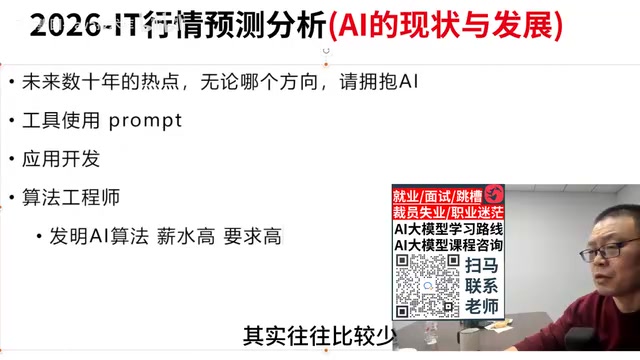
Mashibing is candid about this: to join the algorithm team at a reputable company, you most likely need a graduate degree from a top-tier (985) university, with a major closely related to algorithms. His assessment is realistic: most people simply don't meet this bar.
Why is the bar so high? His analysis is insightful: innovation doesn't scale with headcount — adding unqualified members to a team doesn't produce breakthroughs, so algorithm teams tend to be small. At the same time, inventing new algorithms requires massive compute resources and top-tier talent, which only large companies can afford — algorithm engineers at leading teams like OpenAI, Google DeepMind, Baidu ERNIE, and Alibaba Tongyi typically earn over one million RMB annually, yet the total number of core practitioners globally is estimated at only a few thousand. Smaller companies simply can't compete. These two factors together make algorithm engineering positions naturally scarce.
AI Application Development: Where Ordinary Programmers Can Actually Win
For most programmers, the real opportunity lies in AI application development. This direction can be further divided into two sub-levels.
Level One: AI Agent Development
The first level is Agent development — enabling people to interact with Agents in simpler, more intuitive ways, and delegating formerly manual, process-driven tasks to Agents for autonomous execution and tool orchestration.
An AI Agent is an AI system capable of perceiving its environment, forming plans, and autonomously executing multi-step tasks — distinct from one-shot large language model queries. The core tech stack includes: orchestration frameworks like LangChain and LlamaIndex for managing model call chains and memory; tool calling (Function Calling/Tool Use), enabling models to operate external APIs, databases, and browsers; RAG (Retrieval-Augmented Generation), injecting private knowledge bases into model context; and multi-agent collaboration frameworks like AutoGen and CrewAI. In terms of engineering difficulty, Agent development closely resembles traditional backend development (API integration, workflow orchestration, state management) and requires almost no deep learning theory. Current mainstream use cases include enterprise customer service automation, code generation assistants, and automated data analysis reporting.
Mashibing shared a real-world example: a student from a lower-tier 211 university who focused on both Java backend development and AI/LLM during his master's program, and graduated with 8 job offers, including:
- ICBC R&D Center: RMB 210K pre-tax (rising to 300K after five years, Beijing hukou, no overtime)
- Hikvision Shanghai Research Institute: RMB 390K pre-tax
- North Huachuang Java Backend: RMB 400K pre-tax (996 schedule)
- BYD, Tianjin Cement Industry Research Institute, ZTE: all AI Agent development roles
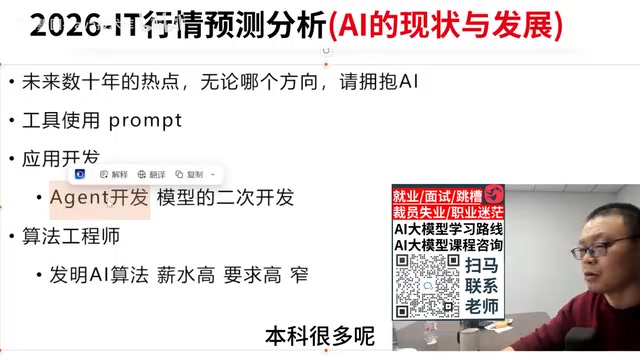
Two trends stand out from this offer breakdown: backend roles currently pay slightly more than Agent development roles, but the number of Agent development positions is growing rapidly. More importantly, this track has low academic requirements — Mashibing believes students with the learning ability of a typical second-tier university (二本) can reach this level, and many undergraduates can handle the work.
The learning cost is also very low. He explicitly stated that, with some existing programming experience, learning Agent development takes only about one month of part-time effort (two hours on weekdays, six hours on weekends) to reach the standard for submitting job applications. By comparison, reaching the concurrency level required for backend development takes at least three to six months.
Level Two: Model Fine-Tuning and Secondary Development
The second level is model secondary development — also called model fine-tuning, deployment, and repurposing. This involves taking open-source models built by algorithm engineers (such as Tongyi Qianwen or DeepSeek) and developing industry-specific applications on top of them — for use cases in foreign trade, law, medicine, and more. You can even feed your own industry data to fine-tune a new model and expose it via business APIs.
The mainstream fine-tuning approach here is Parameter-Efficient Fine-Tuning (PEFT), especially LoRA (Low-Rank Adaptation) — by adding small trainable low-rank matrices alongside the original model weights, fine-tuning can be completed with just hundreds to thousands of domain-specific data samples on one or a few consumer-grade GPUs, dramatically lowering the barrier for enterprise deployment. "Deployment and API exposure" is typically handled using inference frameworks like Ollama and vLLM, with tools like FastAPI wrapping model capabilities into standard REST interfaces for business systems to consume. For engineers with Python and backend experience, this learning curve is relatively manageable.
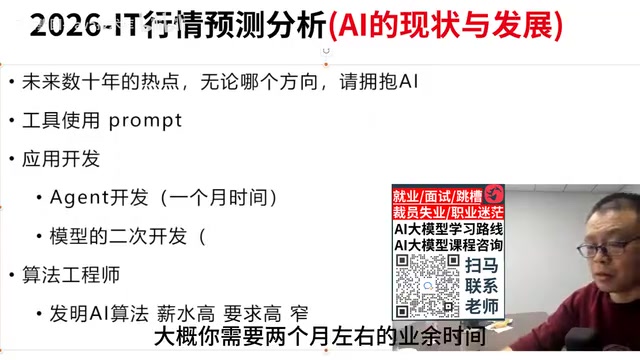
This portion requires understanding the principles behind six or seven common algorithms used by algorithm engineers (without needing to derive them), and knowing how to configure and tune common parameters. For a student with second-tier university learning ability, building on Agent development knowledge, model secondary development takes roughly another two months of part-time study. Combined, the entire AI application development track can be covered in about three months.
Three Hidden Risks Behind the Window-Period Dividend
This direction sounds appealing: short learning cycle, alignment with cutting-edge trends, and a salary premium.
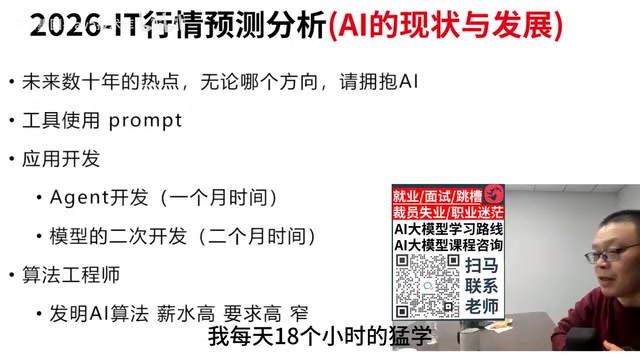
But Mashibing repeatedly emphasized a straightforward truth: if something is easy, it won't stay highly valued for long. The current premium exists because many companies haven't yet realized that this skillset isn't that hard to acquire. He offered several clear assessments and risk warnings:
First, the window is short. He predicts that within the next two to three years, AI application development will become "something every programmer is expected to know." At that point, it won't be optional — but knowing it won't be a differentiator either. So if you're targeting this track, move fast: "this train won't wait."
Second, the absolute number of positions is still limited and concentrated in Tier 1 cities. Using a rough index: if Java roles total 10 and C/C++ roles are around 5, then Agent and application development roles currently sit somewhere between 1 and 2. This means if you're job hunting outside a Tier 1 city, or can't land one of these roles, you'll still need solid traditional development skills to fall back on.
Third, job listings can be misleading. Many postings on job boards labeled "Algorithm Engineer" actually require model secondary development skills. So don't be intimidated when you see that title — open the listing, read the requirements, and you'll often find it's standard application development work you're fully qualified to apply for.
Closing: A Dual-Track "Frontier + Baseline" Strategy
Mashibing's final recommendation is a "Frontier + Baseline" combination strategy: on one hand, embrace AI and pursue what will be a hot direction for the coming decades; on the other hand, given that AI application development still has a relatively narrow job market and a low barrier to entry (meaning competition will intensify), you should also choose a broader baseline language track as a safety net — his recommendation is to pick between Java or C/C++.
There's solid market logic behind this advice. Java dominates enterprise backend development (banking, insurance, e-commerce) through the Spring ecosystem and commands the largest domestic recruiting volume. Demand from stable industries like finance and government is recession-resistant, and the Spring AI framework is rapidly maturing with a clear integration path for AI application development. C/C++, on the other hand, is an essential language for embedded systems, autonomous driving, and high-performance computing — hardware-adjacent tracks where demand continues to grow as the smart vehicle and robotics industries explode. The underlying engines of AI inference frameworks (such as TensorRT and ONNX Runtime) also rely on C++, giving it a unique technical moat. Compared to Python and other AI-common languages, both Java and C/C++ offer a broader job market and more stable career prospects — serving as an effective hedge against the increasing competition that will emerge as the AI application development premium erodes.
This thinking offers genuine value for ordinary programmers: seize the window of opportunity that new technology provides, while keeping a viable fallback for when the premium fades and competition intensifies. After all, those who move first stand the best chance of capturing the reward — latecomers will find themselves dealing with an increasingly commoditized skillset.
Key Takeaways
Related articles

Transformer²: Achieving Co-Design of Robot Morphology and Control with a Unified Architecture
Deep dive into how Transformer² uses a unified Transformer architecture to integrate robot morphology design and motion control into one model, enabling task-driven end-to-end co-design for embodied AI.

Tutorial: Installing Tailscale on a Jailbroken Kindle to Create a Private Network Node
Learn how to deploy Tailscale on a jailbroken Kindle, turning an idle e-reader into a private network node. Covers cross-compilation, power optimization, and risk considerations.
Tutorial: Installing Tailscale on a Jailbroken Kindle to Create a Private Network Node
Learn how to deploy Tailscale on a jailbroken Kindle to turn an idle e-reader into a private network node. Covers cross-compilation, power optimization, and risk considerations.