Prompt Engineering Is No Longer the Bottleneck: The Real Challenges of Putting AI Agents into Production
The key bottleneck for AI applications has shifted from prompt engineering to system design, with Agent definitions, framework choices, and RAG chunking being the real engineering challenges.
The article argues that prompt engineering is no longer the decisive bottleneck for AI application success — the real challenge has shifted to system design. The author covers four dimensions: first, the concept of "Agent" is being abused, causing teams to over-engineer simple workflows, when an Agent should properly be defined as "a system with goals that can make autonomous decisions and handle failure"; second, successful Agents in production are narrow and deep specialized pipelines, and teams should focus on tool design, failure handling, and observability rather than chasing the latest models; third, frameworks matter far less than architectural patterns, with plan-first-execute, separate retrieval from reasoning, and structured handoffs being cross-framework validated best practices; fourth, the core difficulty in RAG lies in chunk boundaries, not the embedding model — incorrect splitting leads to context-missing hallucinations. The conclusion: what will be scarce in the future are system designers who can build maintainable, trustworthy AI systems.
Prompt Engineering Is No Longer the Bottleneck — So What Is?
An engineer with years of deep experience in AI recently shared his observations: there is a massive gap between demo and production systems, and few people are willing to face it honestly. His core judgment: model capabilities are improving rapidly, but the real engineering challenges have shifted to system design. Prompt engineering matters, but it has long ceased to be the decisive bottleneck for AI application success.
This view deserves serious attention. Over the past two years, many teams have poured energy into optimizing prompts and switching to the latest models, only to find that their systems' performance in production hasn't fundamentally improved. So where does the problem lie?
The Word "Agent" Is Being Abused
One of the biggest semantic confusions in the AI world today is that everything gets called an "Agent." A function that calls a tool is called an Agent. A chatbot with memory is called an Agent. A script with a loop is called an Agent. This dilution of the concept isn't just a matter of wording — it's leading to real engineering decision failures.
Without a precise definition, teams over-engineer simple workflows while under-investing in genuinely complex systems. The author mentions seeing many teams spend weeks adding "Agent-style" orchestration to workflows that could have been handled with a single structured prompt.
His definitional standard: An Agent is a system that has goals rather than instructions. It autonomously decides what to do next, can handle failure, and knows when it's done. By this standard, a system that requires a human to command it step by step is just a chat interface; a system that can recover from tool call failures and try alternatives barely qualifies; only one that can decompose goals and delegate subtasks counts as a true Agent.
The ReAct pattern is a classic starting point for understanding an Agent's autonomous decision-making mechanism, proposed by Shunyu Yao and others in 2022. Its core idea is to have the LLM alternate between "Reasoning" and "Acting": the model first outputs a thought, decides which tool to call, observes the tool's returned result, then continues reasoning based on that result, looping until it reaches a final answer. This "thought—action—observation" loop is precisely the key structure that distinguishes an Agent from a single prompt call. However, ReAct itself does not guarantee task completion or failure recovery — it is only a reasoning framework. A truly production-ready Agent needs goal management, retry strategies, and termination condition judgments layered on top — which explains why the author emphasizes "having goals" rather than "having loops" as the core of the Agent definition.
The Real Picture in Production
Setting aside the demo filter, what do Agents actually look like in deployment? Based on the author's conversations with multiple teams, most real Agent deployments are narrow and deep — customer support triage, document extraction, code review for specific repositories. They are not general-purpose reasoning engines, but specialized pipelines with an intelligent decision layer.
Teams getting good results share one common trait: they don't chase the latest model releases, but instead grind away at three things:
- Tool design: What can the Agent call, and are the interfaces clean?
- Failure handling: How does the system respond when a tool returns useless results?
- Observability: Can you precisely trace the reason behind every decision the Agent makes?
Conversely, teams that swap GPT-4 for the latest frontier model without changing anything else often fail to achieve the expected results. This precisely confirms one fact — model replacement is not system upgrade.
The Framework Wars Are a False Proposition
LangChain, LangGraph, CrewAI, AutoGen, Semantic Kernel... new frameworks appear almost every month, while others write articles declaring old frameworks dead. But the author's practical experience is: frameworks matter far less than patterns.
After repeatedly validating across multiple frameworks, he distilled several framework-agnostic effective patterns:
- Plan first, then execute: Let the reasoning step produce a plan and the execution step strictly follow it — don't mix the two together
- Separate retrieval from reasoning: Acquiring context and using context are two different jobs; mixing them creates system chaos
- Explicit handoffs: When Agents pass work between each other, the handoff must be structured and recordable, not a string passed through a prompt
The author's conclusion is incisive: frameworks are scaffolding; architecture is the building itself. Rebuild the same architecture with three different frameworks, and the results are largely the same.
Orchestration refers to the control logic in a multi-step AI workflow that determines who executes each step, in what order, and how context is passed. It generally falls into two categories: deterministic orchestration, where code explicitly hard-codes the flow branches, such as "retrieve first, then judge, then call the tool"; and model-driven dynamic orchestration, where the LLM decides the next step based on the current state. The patterns the author proposes — "plan first, then execute," "separate retrieval from reasoning" — are essentially answering orchestration-level questions, not framework selection questions. Understanding this helps avoid a common misconception: assuming that switching to a more "advanced" framework automatically yields better orchestration. In reality, the design quality of the orchestration logic is the variable that determines system reliability; the framework is merely the container that holds it.
The RAG Retrieval Problem: The Overlooked Trap of Chunk Boundaries
RAG has become virtually standard for all production AI systems dealing with proprietary data. But tutorials rarely cover a critical issue: chunk boundaries are almost always wrong.
When you split documents into chunks and embed them, you are effectively making assumptions about "which context belongs together." These assumptions often fail — a paragraph that can only be understood in combination with the preceding one gets retrieved in isolation, and the model hallucinates about the missing context.
Improvement directions include overlapping windows, semantic chunking, parent document retrieval, and other better chunking strategies. But the author believes the fundamental solution lies in rethinking what you store — sometimes what should be stored is not raw text, but a structured representation of the information.
A practical troubleshooting tip: if your RAG pipeline returns results that are "technically correct but contextually useless," the problem is almost certainly in chunking or metadata, not the embedding model.
Embedding is the process of mapping text into high-dimensional vectors, where semantically similar text is closer together in vector space, and retrieval works by computing vector similarity to find relevant segments. Chunking is the operation of splitting long documents into smaller units before embedding — because embedding models have context length limits, and also to achieve finer retrieval granularity. The core tension in chunk boundaries is this: cut too large, and irrelevant information mixed into a chunk dilutes the semantics; cut too small, and a chunk may lose its independent comprehensibility. Overlapping windows mitigate boundary fragmentation by having adjacent chunks share a portion of text; semantic chunking determines cut points based on the semantic similarity of sentences or paragraphs rather than fixed word counts; parent document retrieval stores small chunks for precise matching but returns the larger chunk they belong to in order to preserve full context. Understanding the trade-offs among these three is the foundation for diagnosing RAG retrieval failures.
The Future Belongs to System Designers
Models will keep getting stronger, context windows will keep expanding, and per-token costs will keep falling. But none of this will change the fundamental engineering challenge: building an AI system that runs reliably when you're not in the room.
The problems worth solving are governance, observability, and reliable tool use — not chasing benchmark scores. The author judges that the truly scarce engineers of the future are those who can build AI systems that other engineers can maintain and trust. This skill is closer to system design than to model research or prompt engineering.
This judgment has strong practical guidance for the present: rather than spending energy on "tuning better prompts" or "chasing the latest models," go back to the fundamentals of software engineering — designing clean interfaces, handling edge cases, and building observable monitoring systems. These are the keys to taking AI applications from demo to production.
One-line Summary
Prompt engineering is no longer the bottleneck for AI applications — system design, Agent definitions, framework choices, and RAG chunking are the real engineering challenges.
Paragraph Summary
The article argues that prompt engineering is no longer the decisive bottleneck for AI application success — the real challenge has shifted to system design. The author explores four dimensions: first, the concept of "Agent" is being abused, causing teams to over-engineer simple workflows, when an Agent should properly be defined as "a system with goals that can make autonomous decisions and handle failure"; second, successful Agents in production are narrow and deep specialized pipelines, and teams should focus on tool design, failure handling, and observability rather than chasing the latest models; third, frameworks matter far less than architectural patterns — plan first then execute, separate retrieval from reasoning, and explicit structured handoffs are cross-framework validated best practices; fourth, the core difficulty in RAG lies in chunk boundaries, not the embedding model — incorrect splitting leads to context-missing hallucinations. The conclusion: what will be scarce in the future are system designers who can build maintainable, trustworthy AI systems.
Related articles

M&M's Spent Millions Replacing Artificial Blue Dye — Why Is It So Hard?
Mars spent millions trying to replace artificial blue dye in M&M's with spirulina, but thick material clogs pipes and residue risks mold, forcing a full production-line rebuild. Here's the engineering behind the reformulation.
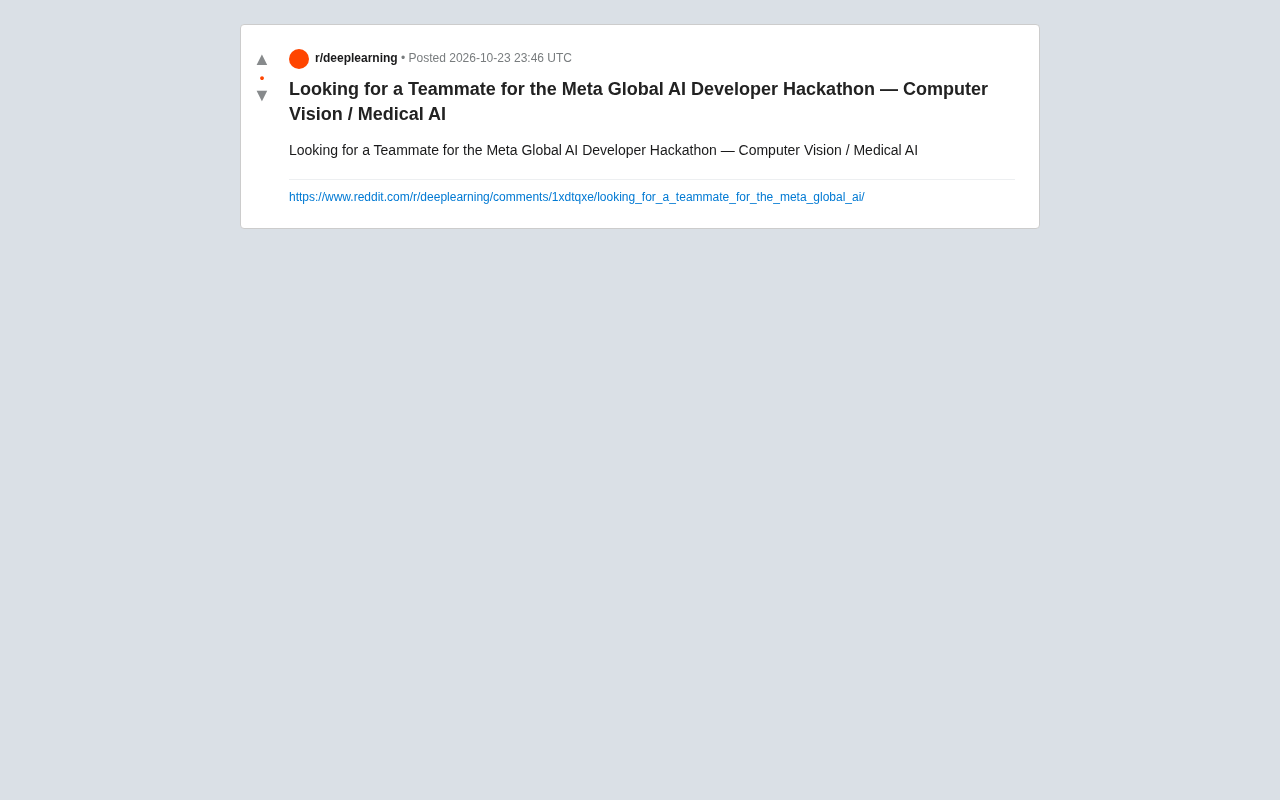
Teammate Wanted for Meta Global AI Developer Hackathon: Computer Vision & Medical AI
A Reddit developer seeks teammates for the Meta Global AI Developer Hackathon, focusing on computer vision and medical AI. This article analyzes the track logic, skills-complementarity needs, and topic selection strategy behind this teaming signal.
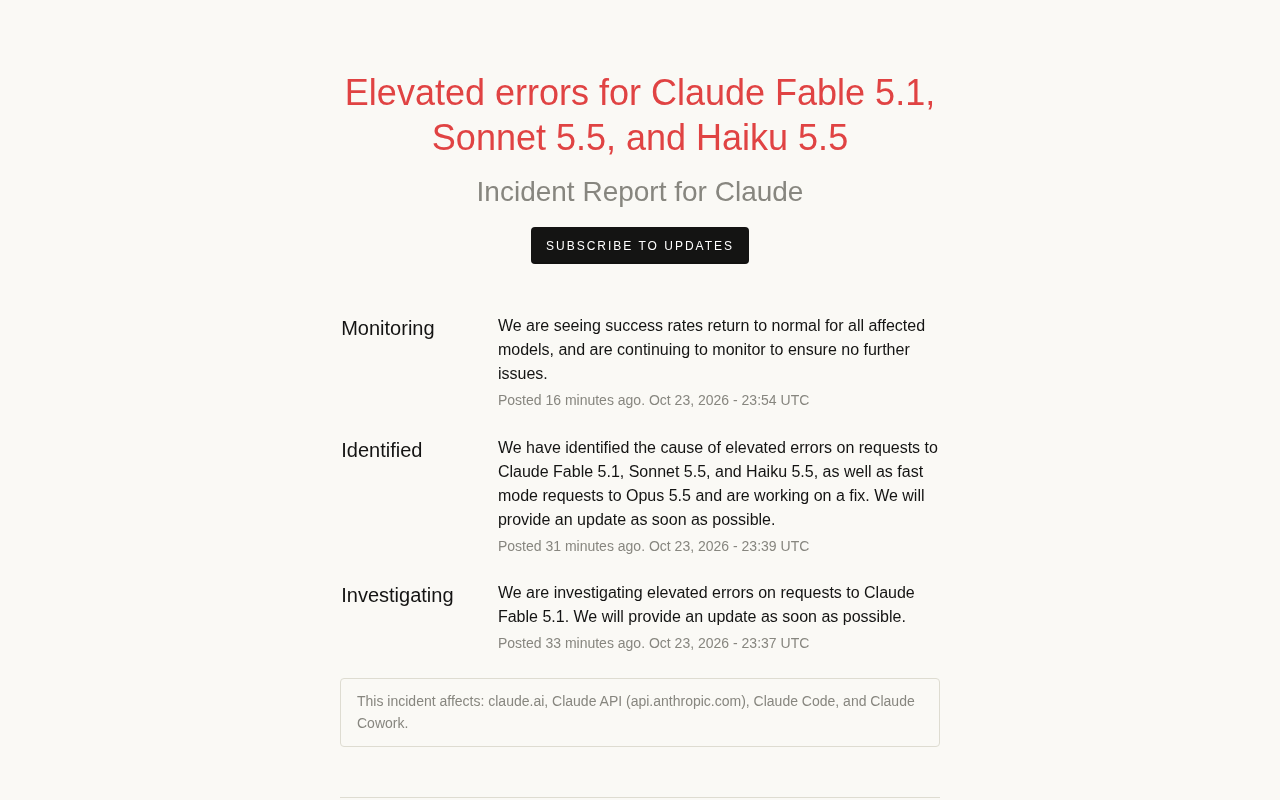
Multiple Claude Models Hit by Errors: A Postmortem of Fable 5.1, Sonnet 5.5, and Haiku 5.5
Claude Fable 5.1, Sonnet 5.5, Haiku 5.5, and Opus 5.5 fast mode saw elevated errors; Anthropic identified and resolved the issue in 17 minutes. This postmortem covers the timeline, the technical reasons for the multi-model cascading failure, and practical lessons for retry and degradation strategies.