Protecting SSH Keys with the macOS Secure Enclave: A Practical Guide to Apple's Hardware-Level Security

macOS Secure Enclave seals SSH private keys inside the chip for signing — secure but device-bound and ecosystem-limited.
The article explains using the macOS Secure Enclave to protect SSH private keys: keys are generated and sealed inside the chip, so the main system can only request signatures and cannot export them, even with root. Limits include ECDSA-only support (no RSA), no backup or migration, and reliance on third-party tooling. It compares favorably with YubiKey/TPM on built-in convenience, but trails on openness and multi-device use.
Why Do SSH Keys Need Hardware-Level Protection?
SSH keys are the "passports" developers use to connect to servers and deploy code, but the way they're stored is often more fragile than you'd imagine — most people leave their private keys in plaintext at ~/.ssh/id_rsa. If the device is lost, compromised, or the key is accidentally shared, an attacker can walk right in. Traditional passphrase protection only stops casual theft; it can't defend against a determined memory grab or file exfiltration.
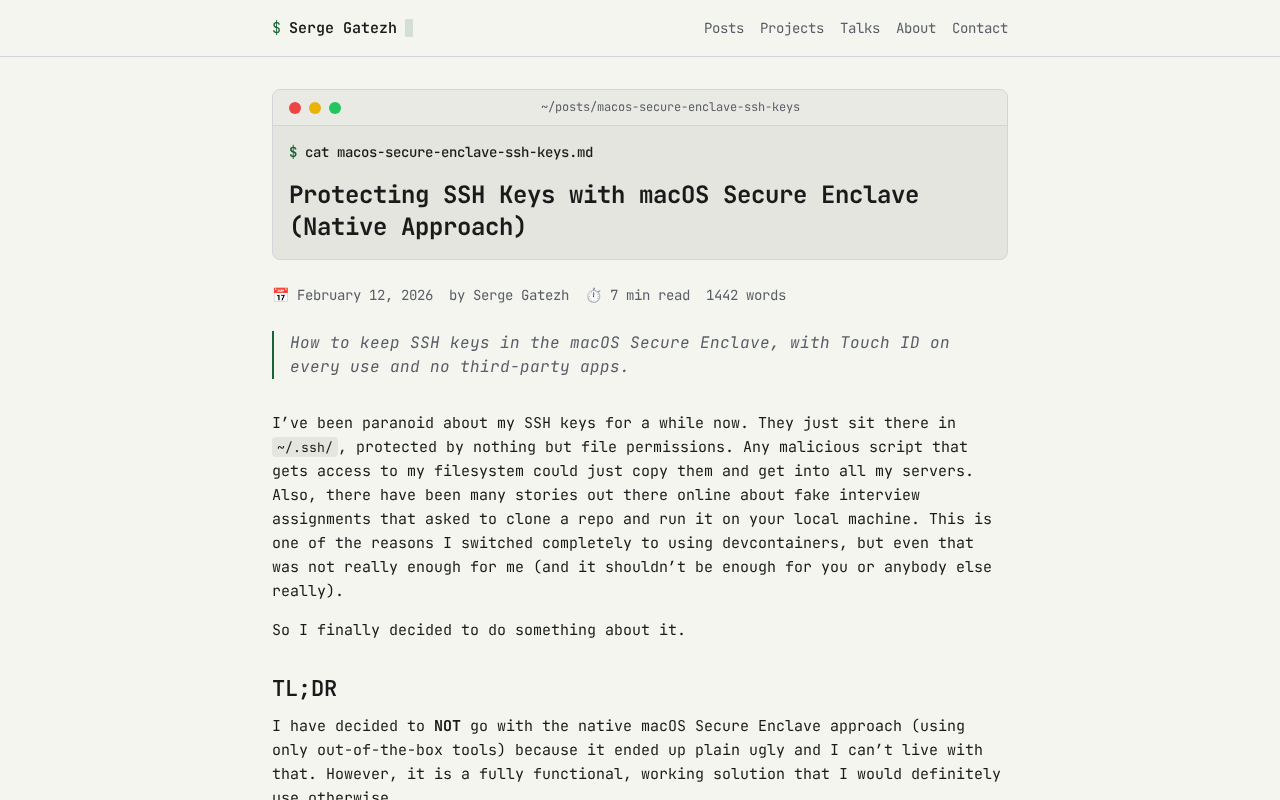
According to an article published on the tech blog gatezh.com (which scored 331 points and 121 comments on Hacker News), macOS's Secure Enclave offers a more thorough approach: it locks private key generation and signing operations inside a dedicated security chip, so the plaintext private key never appears in system memory. This has drawn considerable discussion among developers and raises a practical question: can ordinary users actually put it to use?
How the Secure Enclave Does It
The Secure Enclave is an independent security coprocessor designed in-house by Apple, responsible for handling sensitive data such as Touch ID and Apple Pay. It has its own encryption engine and storage, isolated from the main system. When an SSH private key is marked as "non-exportable," the private key is actually generated by the Secure Enclave and sealed inside the chip; the main CPU can only request that it perform signing — it cannot read the private key out.
The article's core workflow is roughly this: using ssh-keygen's PKCS#11 or Apple's provided key store interfaces, generate a key pair inside the Secure Enclave, then export the public key and configure it in the target server's authorized_keys. From then on, every SSH authentication performs the signing operation inside the chip, so the private key is never exposed. Even if an attacker gains root access to the system, they cannot export the private key itself — a level of protection far beyond traditional passphrase encryption.
PKCS#11 is a cryptographic device interface standard developed by RSA Laboratories. It defines how applications interact with cryptographic devices such as hardware security modules (HSMs) and smart cards, without having to care about the device's specific implementation. In the SSH context, OpenSSH communicates with external cryptographic devices through a PKCS#11 provider, letting private key signing operations happen inside the device. When the Secure Enclave is wrapped as a PKCS#11-compliant provider, ssh-keygen and ssh-agent can call it just like an ordinary hardware token, enabling a "private key never leaves the chip" signing flow. However, Apple does not directly provide a complete PKCS#11 module; the community typically relies on libp11 or a custom bridge to map the Secure Enclave's key store API to the PKCS#11 interface — and this is one source of toolchain friction.
Pitfalls and Limitations in Practice
Judging from the Hacker News discussion, this technology is not plug-and-play. First, the Secure Enclave only supports specific algorithms such as ECDSA — RSA keys cannot enjoy the same protection, and some older servers or infrastructure still prefer RSA. Second, once generated, keys cannot be backed up or migrated — the chip is bound to the device, so switching machines means regenerating keys and updating the authorized list on every server, a nontrivial operational burden for developers managing many hosts.
Another point of contention is toolchain maturity. Some commenters noted that, compared with TPM or YubiKey solutions on Linux, macOS's Secure Enclave lacks official first-class support in the SSH context and requires third-party scripts or newer OpenSSH features. This also explains why the article sparked discussion: it solves a real pain point, but the path to adoption still involves friction.
ECDSA (Elliptic Curve Digital Signature Algorithm) and RSA are two mainstream public-key signature algorithms. RSA has a long history and extremely broad compatibility — virtually all SSH servers and older OpenSSH versions support it by default — but its keys are longer (commonly 2048–4096 bits), and signing and verification are computationally more expensive. ECDSA is based on elliptic curve mathematics and uses much shorter keys at equivalent security strength (e.g., a 256-bit curve is roughly equivalent to 3072-bit RSA), with faster signing and lower bandwidth overhead. The Secure Enclave's hardware crypto engine natively supports ECDSA over NIST curves such as P-256, but does not support RSA signing operations, so only ECDSA keys can enjoy chip-level protection. This is also why the original article emphasizes that "some older servers or infrastructure still prefer RSA" — in environments that only accept RSA, the Secure Enclave approach cannot be applied directly, and you need to additionally keep software keys or switch to an external hardware key.
Comparison with YubiKey and TPM Solutions
Hardware key protection is not a new topic. External security keys such as YubiKey already support SSH FIDO2 credentials, and TPM solutions have mature practices on Linux and Windows. The Secure Enclave's uniqueness lies in being "built in" — no extra hardware to carry, Touch ID handles authentication, and the experience is smoother. The cost is being bound to a single device, with less ecosystem openness than external keys.
Cross-referencing multiple sources, the community consensus is: the Secure Enclave suits individual developers with high security requirements who can accept the cost of device binding; if you need to share keys across multiple machines or use RSA for compatibility with legacy systems, an external hardware key remains the safer choice. As for specific performance differences, the original article provides no quantitative comparison — the discussion focuses more on usability and operational costs.
FIDO2 is a passwordless authentication standard jointly developed by the FIDO Alliance and W3C, centered on the WebAuthn protocol and the CTAP2 device protocol. Security keys such as YubiKey implement "resident credentials" via CTAP2, with key material stored inside the device and non-exportable; the device performs the signing during authentication. Since OpenSSH 8.2, credential types such as sk-ssh-ed25519 have been introduced, binding SSH public-key authentication to FIDO2 devices: authentication not only requires plugging in the hardware key but usually also requires touching the button or entering a PIN, achieving "possession + presence" two-factor authentication. Compared with the Secure Enclave, the advantage of FIDO2 external keys is portability across devices and an open ecosystem standard — the same key can be used on multiple computers; the downside is needing to carry extra hardware, occupying USB/NFC ports, and the fact that some servers and older OpenSSH versions do not yet support sk- key types.
Who Should Consider Migrating
If you develop on a Mac day to day, mainly connect to modern servers that support ECDSA, and can accept the premise that "keys cannot be migrated," the Secure Enclave approach is worth trying. It can significantly reduce the risk surface of private key leakage, and is especially suited to developers who often use laptops in cafés, coworking spaces, and similar environments.
But if your workflow involves multiple devices, legacy system compatibility, or team key sharing, evaluate the migration cost first. The security benefits of upgrading are real, and so are the operational costs. The value of this article is not a "one-click solution" but pointing in a direction: use the security hardware already in the operating system to raise key protection from the software layer to the hardware layer.
One-line Summary
macOS Secure Enclave can seal SSH private keys inside the chip for signing — secure, but device-bound and ecosystem-limited.
Paragraph Summary
The article discusses how to use the macOS Secure Enclave to protect SSH private keys. Traditional private keys sit in plaintext in the ~/.ssh directory; a passphrase only stops casual theft and cannot prevent memory grabs or file exfiltration. As an independent security coprocessor, the Secure Enclave allows private keys to be generated and sealed inside the chip, with the main system only able to request signatures and unable to export the key — even root access cannot read it. But practical limitations exist: only specific algorithms such as ECDSA are supported, so RSA keys get no equivalent protection; keys cannot be backed up or migrated, so switching machines requires regenerating and updating authorizations on every server; and the toolchain depends on third-party scripts or newer OpenSSH features, lacking official first-class support. Compared with external solutions like YubiKey and TPM, the Secure Enclave wins on being built in (nothing to carry) and smooth Touch ID authentication, but is weaker in ecosystem openness and multi-device compatibility. The article concludes the approach suits developers who use a Mac as their primary machine, connect to modern servers, and can accept the cost of device binding.
Related articles
Unlock All Claude Models for Free? Developer Mode + Gateway Configuration Tutorial
A YouTube tutorial claims that enabling Claude desktop developer mode and configuring a third-party gateway allows free use of all models, including Opus 5.5. This article breaks down the steps, analyzes the gateway technical principles, and reveals the triple risks of account bans, data privacy, and service stability, as well as the authenticity of model names.
Robinhood's Hybrid AI Reviewer: 60% of Data PRs Auto-Merge
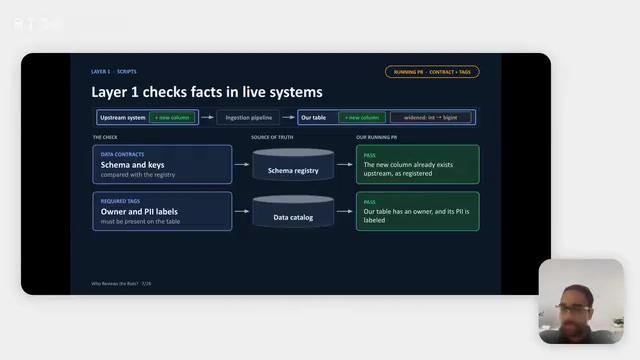
Robinhood's data platform team shares a hybrid AI PR reviewer: deterministic scripts verify facts, AI Agents judge contextual risk, and humans keep key decisions. About 60% of data pipeline PRs merge without human review, cutting review workload ~75%, saving ~132 engineering hours monthly, and reducing related incidents ~30%.

Making Marketing Videos with Claude Code Is More Efficient Than AI Video Generation
Generate marketing videos programmatically with Claude Code—more flexible and cheaper than AI video generators. Reference a style, generate a storyboard, output content as code, and make edits instantly.