Proving the Riemann Hypothesis: How Alpöge and Claude Teamed Up to Tackle a Century-Old Problem
The Riemann Hypothesis proof framework uses a triple mechanism and Lean formal verification to control prime distribution errors and rule out right-side zeros.
The article starts from the deeper significance of the Riemann Hypothesis, noting that the core question is whether mathematics can precisely control error growth in prime distribution. Via the von Mangoldt function and the Riemann zeta function, each nontrivial zero's real part determines the growth of oscillatory terms, with right-side zeros destroying control. The announced proof framework combines divisibility, amplification, and cost control, drawing on the Stepanov method. Analytic reduction uses an upper bound on weighted prime powers to rule out right-side zeros and zeta symmetry to rule out left-side ones, forcing all nontrivial zeros onto the critical line. Lean formal verification has passed independent machine checks, but community review is ongoing. The article stresses that understanding why a proof works is as important as verifying it.
From Prime Distribution to Error Control: The Essential Problem
The deeper significance of the Riemann Hypothesis goes far beyond "where exactly are the primes distributed." According to the analysis in this YouTube video, the truly critical question is: to what extent can mathematics precisely control the distribution of primes? We already have decent approximation formulas, but how large the error term can grow is the core challenge.
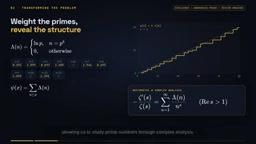
Rather than counting primes directly, the researchers assign logarithmic weights to prime powers via the von Mangoldt function. This treatment builds a bridge between arithmetic and the Riemann zeta function, allowing prime problems to be studied with complex-analytic tools. Each nontrivial zero contributes an oscillatory term to the prime-counting formula, and the real part of the zero controls the growth scale of that term. A zero lying to the right of one-half produces a larger growth scale, making the distribution harder to control.
The von Mangoldt function is defined as: if (n = p^k) ((p) prime, (k \ge 1)), then (\Lambda(n) = \log p); otherwise (\Lambda(n) = 0). It focuses attention on prime powers and assigns logarithmic weights, enabling an exact connection between the prime-counting problem and the logarithmic derivative of the Riemann zeta function. Specifically, (-\zeta'(s)/\zeta(s) = \sum_{n=1}^{\infty} \Lambda(n) n^{-s}) (for (\mathrm{Re}(s) > 1)). This identity is the bridge: the poles on the left side correspond exactly to the zeros of the zeta function and the pole at (s=1), while the right side encodes information about prime powers. Thus, analysis of the zeta function's zeros can be translated directly into estimates of weighted sums over primes—this is the fundamental reason complex-analytic tools can intervene in the prime distribution problem.
Nontrivial zeros refer to the zeros of the Riemann zeta function (\zeta(s)) in the strip (0 < \mathrm{Re}(s) < 1). The trivial zeros are the negative even integers (s = -2, -4, -6, \dots), whose contribution to the prime-counting formula is small and well understood. Nontrivial zeros are different: the explicit formula shows that the prime-counting function (\psi(x) = \sum_{n \le x} \Lambda(n)) can be written as (x) minus (\sum_{\rho} x^{\rho}/\rho) plus some lower-order terms, where the sum runs over all nontrivial zeros (\rho). Each zero contributes an oscillatory term of the form (x^{\rho}/\rho), whose amplitude growth is controlled by (x^{\mathrm{Re}(\rho)}). If some zero has real part greater than (1/2), the amplitude of the corresponding term grows at rate (x^{\mathrm{Re}(\rho)}), exceeding the (x^{1/2}) scale and thereby destroying fine control over the error in prime distribution. Therefore, the Riemann Hypothesis is equivalent to all nontrivial zeros having real part (1/2), i.e., the error term is controlled at the order of (O(x^{1/2} \log x)).
The Proof Framework: A Triple Mechanism of Divisibility, Amplification, and Cost Control
According to the video, the announced proof combines three interacting mechanisms—divisibility, amplification, and cost control. This approach draws on the spirit of the Stepanov method: amplifying useful arithmetic properties through a chain of theta lifts.
Amplification is not without cost. Additional bounds are introduced to prevent the cost of amplification from outweighing the benefits. Together, the three work in concert, ultimately converging into a core inequality that controls weighted sums over primes.
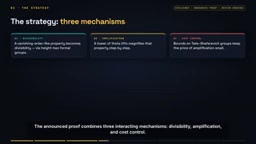
The Stepanov method originates from Sergei Stepanov's 1960s work on the Riemann Hypothesis over function fields. Its core idea is to construct an auxiliary function that vanishes at sufficiently many points but whose degree is not high enough, forcing it to be identically zero and thereby deriving a contradiction or the desired conclusion. This method was later developed by Bombieri and others and became one of the key tools for proving the Riemann Hypothesis over function fields. In the proof framework described here, the spirit of the Stepanov method manifests as: gradually amplifying useful arithmetic properties through a chain of theta lifts, so that the auxiliary object satisfies divisibility conditions in more and more places, while cost-control terms ensure that the price of amplification does not spiral out of control. This tension between "amplification and constraint" is the key to why the method works.
Analytic Reduction: Ruling Out Right-Side Zeros with an Upper Bound
The analytic reduction step of the proof relies on a sufficiently strong upper bound for weighted prime powers. According to the video, this upper bound is used to rule out zeros lying to the right of the critical line. The symmetry of the zeta function then helps rule out zeros on the left. This process can be completed using a single interval, and its structure is compared to solving a system of linear equations, building on work from the 1920s and 1930s.
Following this chain of logic, every nontrivial zero must lie on the critical line, i.e., have real part one-half.

Formal Verification: How Lean Checks Every Step of Reasoning
Unlike numerical experiments, a formal proof is a chain of logical deductions. Lean checks whether each statement follows rigorously from definitions, axioms, and established theorems. According to the video, independent machine checking has passed, while broader review by the mathematical community is still ongoing.
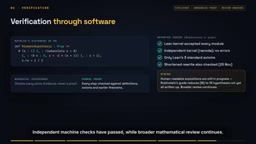
Lean is an interactive theorem prover based on dependent type theory, whose core language is an extension of the Calculus of Constructions. In Lean, mathematical statements are encoded as types, and proofs are terms of that type; checking whether a proof is correct is equivalent to the type checker verifying that the term has the claimed type. This process is carried out by computer strictly according to formal rules, without relying on human intuition or oversight. Lean's mathematical library mathlib already contains a large amount of formalized modern mathematics, making the formalization of complex analysis possible. The fundamental difference between formal verification and numerical experiments is: numerical experiments can only test finitely many instances, whereas a formal proof covers all cases—as long as the axiom system is consistent, the conclusion has absolute logical necessity.
Significance and Open Questions
If this proof is ultimately fully accepted by the mathematical community, its impact will ripple through a large number of results that currently depend on the Riemann Hypothesis. It also demonstrates how artificial intelligence and formal verification might change the paradigm of mathematical discovery.
But the video also raises a thought-provoking point: understanding why a proof works is just as important as verifying that it works. Machine checking can confirm the validity of a derivation, but it may not replace human insight into mathematical structure.
One-line Summary
The Riemann Hypothesis proof framework attempts to control prime distribution errors and rule out right-side zeros through a triple mechanism and Lean formal verification.
Paragraph Summary
Starting from the deeper significance of the Riemann Hypothesis, the article points out that the core question is whether mathematics can precisely control the error growth in prime distribution. Through the bridge between the von Mangoldt function and the Riemann zeta function, the real part of each nontrivial zero determines the growth scale of the oscillatory term in the prime-counting formula, and right-side zeros would destroy control. The announced proof framework combines three mechanisms—divisibility, amplification, and cost control—drawing on the spirit of the Stepanov method, amplifying arithmetic properties through theta lifts while using additional bounds to control costs. The analytic reduction uses an upper bound for weighted prime powers to rule out zeros to the right of the critical line, then invokes the symmetry of the zeta function to rule out those on the left, ultimately forcing all nontrivial zeros onto the critical line. Lean formal verification has passed independent machine checking, but review by the mathematical community is still ongoing. The article concludes by emphasizing that understanding why a proof works is just as important as verifying that it does.
Related articles

AI and Mathematicians Collaborate to Prove the Riemann Hypothesis? The Controversy Behind 1.7 Billion Lines of Lean Code
AI and mathematician Levent Alpoge used 17 million lines of Lean code to prove the Riemann Hypothesis? An AnyGeometry definition sparked controversy, yet an independent audit says the logic holds. This article explains the Riemann Hypothesis, the Yes machine controversy, and the real impact on RSA encryption.

PeppermintOS Launches Void Edition: A Lightweight Experience Without SystemD or XLibre
PeppermintOS launches PepVoid based on Void Linux, featuring XFCE and XLibre with a non-SystemD architecture. This article covers installation, software center experience, preinstalled software, and technical verification for users interested in a lightweight non-SystemD distribution.

Clojure Native Apps: Letting AI Reshape Software at Runtime
Explore how Clojure enables native apps to be reprogrammed at runtime by developers or AI, drawing on Emacs' extensibility, and analyzing REPL-driven development, AI collaboration, and challenges.