public-apis: The Ultimate Free API Resource Collection with 450K Stars on GitHub

GitHub's 450K-star public-apis project is the ultimate curated directory of free APIs for developers.
The public-apis project on GitHub has amassed over 459,000 stars by solving a universal developer pain point: finding free APIs. It organizes hundreds of APIs across dozens of categories—from weather and finance to machine learning—with standardized labels for authentication, HTTPS, and CORS support. Maintained through community contributions and Python-driven automation, this resource is invaluable for building apps, prototypes, and AI products in the API-as-a-Service era.
A Phenomenal GitHub Open Source Project
In the open source world of GitHub, very few projects manage to break through the 450,000-star threshold. public-apis/public-apis is precisely such a phenomenon—with an astonishing 459,233 stars and 50,768 forks, it consistently ranks among the most popular projects on GitHub. What's even more impressive is that despite accumulating such massive attention, it still gains approximately 2,476 new stars per day, maintaining its momentum over time.
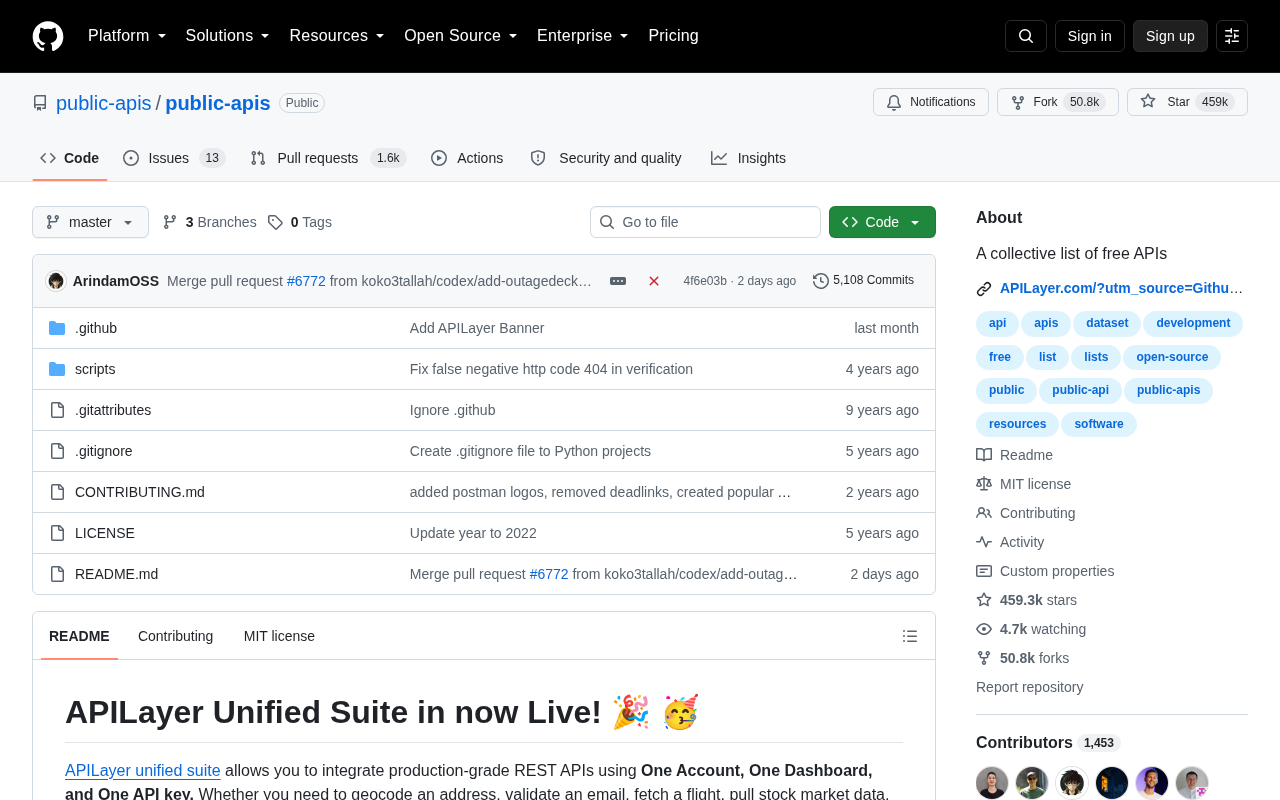
GitHub's Star mechanism is a key metric for measuring project popularity in the open source ecosystem. When users click Star, it's essentially bookmarking and endorsing the project—similar to a "like" on social media. A Fork means a user has copied the complete codebase to their own account, typically indicating deeper engagement—whether for contributing code, customizing, or studying the project. Throughout GitHub's history, projects that have surpassed 400,000 stars are extremely rare, usually being universally valuable resource-type projects for global developers, such as freeCodeCamp and developer-roadmap.
This project's positioning is remarkably straightforward: it's A collective list of free APIs. No complex frameworks, no flashy features—at its core, it's a structured API resource directory maintained collectively by the community. Yet it's precisely this "simplicity" that precisely addresses the most genuine pain point of developers worldwide.
Why Developers Can't Live Without This API List
Solving the High-Frequency Need of "Finding APIs"
Whether building personal projects, developing prototypes, or learning to code, developers are almost constantly searching for usable data interfaces. Building a weather app? You need a weather API. Practicing frontend development? You need APIs that provide test data. Integrating payment, maps, translation, or image recognition features? Third-party services are essential.
However, before this list existed, finding suitable free APIs often meant extensive searching, trial and error, and pitfalls. Which APIs are free? Do they require authentication (Auth)? Do they support HTTPS? Do they support Cross-Origin Resource Sharing (CORS)? This critical information was scattered across the internet, and the cost of verifying each one individually was extremely high.
Highly Structured Information Organization
The core value of public-apis lies in its highly structured organization of information. The project categorizes hundreds of free APIs by topic, covering dozens of domains—from Animals, Anime, and Art & Design to Blockchain, Cryptocurrency, Development Tools, Finance, Machine Learning, News, Weather, and more.
Each API entry clearly labels several core attributes:
- Auth (Authentication Method): Whether it requires an API Key, OAuth, or no authentication
- HTTPS: Whether encrypted transmission is supported
- CORS: Cross-Origin Resource Sharing support status
- Description: A concise explanation of functionality
It's worth understanding the technical meaning behind these attributes. An API Key is the simplest form of authentication—essentially a unique identifier string that developers attach to HTTP headers or URL parameters when making requests, allowing the server to identify the caller and manage quotas. OAuth (particularly OAuth 2.0) is a more complex authorization framework that allows users to authorize third-party applications to access their protected resources without exposing passwords, widely used in social login and third-party data access scenarios. APIs requiring no authentication have the lowest barrier to entry but typically come with stricter rate limits or more limited functionality.
CORS (Cross-Origin Resource Sharing) is a critical mechanism in the modern web security model. For security reasons, browsers enforce the Same-Origin Policy by default, meaning frontend JavaScript can only send requests to servers with the same protocol, domain, and port as the current page. When developers need to call third-party APIs directly from the frontend, if the API server hasn't set CORS-related headers like Access-Control-Allow-Origin in its response, the browser will block the response. This is why CORS support is crucial for frontend developers—APIs without CORS support can only be called through backend proxy forwarding, adding architectural complexity and deployment costs.
This standardized presentation allows developers to determine within seconds whether an API meets their technical requirements, dramatically reducing the cost of information filtering.
Technical Architecture and Community Operations Behind the Project
Python-Driven Automated Maintenance System
Although this project's main content is a Markdown-formatted list, its primary language is marked as Python. This isn't coincidental—facing such a massive API list, the project incorporates automated scripts for link validity detection, format validation, and entry verification. This mechanism ensures that resources in the list don't become massively broken due to neglect over time, continuously maintaining content availability and credibility.
This type of automated maintenance is very common in large open source projects. Typical implementations include: scheduled CI/CD pipelines (such as GitHub Actions) that traverse each URL in the list and verify HTTP response status codes, automatically flagging or removing entries that return 404 or other error statuses, and performing format compliance checks on newly submitted PRs. This "machine + human" collaborative model ensures that the project doesn't sacrifice quality while scaling.
Community-Driven Crowdsourced Maintenance Model
Behind the 450,000 stars is a massive and active contributor community. Any developer can submit a Pull Request to add newly discovered free APIs to the list or update entries with changed information.
A Pull Request (PR) is a collaboration mechanism based on the Git distributed version control system and a core workflow in modern open source communities. Contributors first Fork the target repository, make modifications on their own branch (such as adding new API entries), then submit a Pull Request to the original repository, asking project maintainers to review and merge those changes. Maintainers can conduct code reviews within PRs, suggest modifications, and ensure submitted content meets the project's quality standards and formatting guidelines. This mechanism both ensures quality control and lowers the barrier to community participation.
It's precisely this decentralized, crowdsourced maintenance model that keeps this API list constantly updated, keeping pace with changes in the API ecosystem. This also explains its enduring popularity: a single maintainer cannot possibly cover the constant emergence of new APIs worldwide, while the community's collective power gives this list virtually unlimited scalability and vitality.
The Unique Value of public-apis in the AI Era
In today's AI wave, the value of public-apis has been further amplified. The list includes numerous API resources related to Machine Learning and Artificial Intelligence, covering natural language processing, image recognition, speech synthesis, text generation, and more.
For developers looking to quickly build AI applications, this list provides an excellent starting point. You can discover various ready-made model services and data interfaces here, integrating AI capabilities into your products rapidly without training models from scratch. This model aligns perfectly with the current trend of "AI as API"—companies like OpenAI, Anthropic, and Google are increasingly offering large language models, multimodal models, and other AI capabilities as APIs, enabling developers to access powerful inference capabilities with a single HTTP request. Additionally, for scenarios requiring massive datasets to train or test models, the rich data APIs in the list provide valuable resource entry points.
Practical Tips for Using public-apis Effectively
Define Your Needs and Leverage Category Navigation
The first step in using public-apis is to clearly define what type of data or service you need. Jumping directly to the relevant category quickly narrows your search scope. The project's directory structure is clear and supports rapid navigation to target categories.
Pay Close Attention to Auth, HTTPS, and CORS Attributes
When selecting an API, be sure to note the three key attributes: Auth, HTTPS, and CORS. If you're developing a frontend project, CORS support is crucial. If data security is a concern, prioritize APIs that support HTTPS. Auth information directly determines your integration complexity and development efficiency.
It's particularly worth noting that HTTPS has evolved from "recommended" to "required" in today's web ecosystem. Modern browsers display security warnings for non-HTTPS pages, and many newer Web APIs (such as Service Worker, Geolocation, etc.) require running in a secure context. Choosing APIs that support HTTPS is not only a security best practice but also a basic prerequisite for ensuring your application runs correctly in modern browsers.
Understand the Actual Boundaries of "Free"
A special reminder: "free" in the list often refers to providing a free tier or free quota (Freemium model)—many APIs still charge after exceeding certain usage limits. This tiered pricing strategy is the standard business model in the API economy—providers attract developers to try and integrate through the free tier, then generate revenue through paid tiers as application scale grows. Therefore, before using any API in a production environment, be sure to carefully read each provider's specific terms and pricing policies. Pay attention to daily/monthly call limits, rate limiting, and how excess charges are calculated to avoid unexpected costs.
Conclusion
The success of public-apis is essentially a perfect embodiment of the collaborative spirit of open source communities. It has no complex technical barriers, yet precisely solves a shared pain point for developers worldwide. Those 459,233 stars aren't just a number—they represent votes of trust cast through the actions of countless developers.
Whether you're a programming beginner or a senior engineer, whether you're building traditional web applications or AI products, adding this free API list to your bookmarks is a worthwhile recommendation. In an era where API-as-a-Service is increasingly prevalent, knowing "where to find APIs" is itself an important development skill.
API-as-a-Service is a product of software architecture evolution in the cloud computing era. With the rise of microservices architecture and serverless computing, more and more functionality is being encapsulated as independently callable API services. Developers don't need to set up and maintain their own infrastructure—they can obtain capabilities ranging from payment processing and geocoding to AI inference simply through HTTP requests to third-party APIs. This model has given rise to so-called "combinatorial innovation"—developers build new applications by assembling multiple API services like building blocks, dramatically shortening the development cycle from idea to product. The commercial success of companies like Twilio, Stripe, and OpenAI exemplifies this trend. Resource aggregation projects like public-apis serve as indispensable "navigation maps" within this API economy ecosystem.
Related articles

Apple HomeView Hands-On Review: Is the $300 Smart Home Hub Worth It?
Apple HomeView hands-on: a $300 smart home hub with facial recognition for quick account switching, but no App Store or voice recognition. Is the wall-mounted version worth it? Should you buy the first generation?

Meta Muse Wonder Launch: What It Means for Meta's Return to the Frontier AI Race
Meta releases Muse Wonder and WonderFull, benchmarks reach the frontier, community feedback is polarized. An in-depth look at Meta's return to the frontier AI race, its personal agent strategy, and Zuckerberg's different path.

Apple Home Smart Home Lineup Leaked: LG and Schneider Team Up, UWB Door Lock on Board
Apple Home ecosystem gains new LG and Schneider devices: UWB smart lock with proximity unlock, 2.5K dual-camera doorbell, privacy indoor camera, and AirPods-like seamless pairing.