Puffin: Giving AI Agents Identities and Inboxes to Take Over Your Digital Communications

Puffin assigns AI agents independent emails and collaboration platform seats, giving them digital identities with dual-mode operation.
Puffin is a Product Hunt tool that gives AI agents independent digital identities, including dedicated emails, Discord/Slack/Telegram seats, and calendars. It offers approval and full autopilot modes, balancing efficiency and controllability, and supports built-in or user-owned agents. Cross-platform integration is available, but the product is early and integration depth needs verification. It addresses the identity gap in AI agent deployment.
AI agents are moving from the lab into everyday tools, but most remain trapped inside chat windows, unable to have independent communication identities like humans do. A new product on Product Hunt, Puffin, aims to solve this: it assigns each AI agent a dedicated email address, Discord/Slack/Telegram seat, and calendar, letting them truly integrate into your workflow.
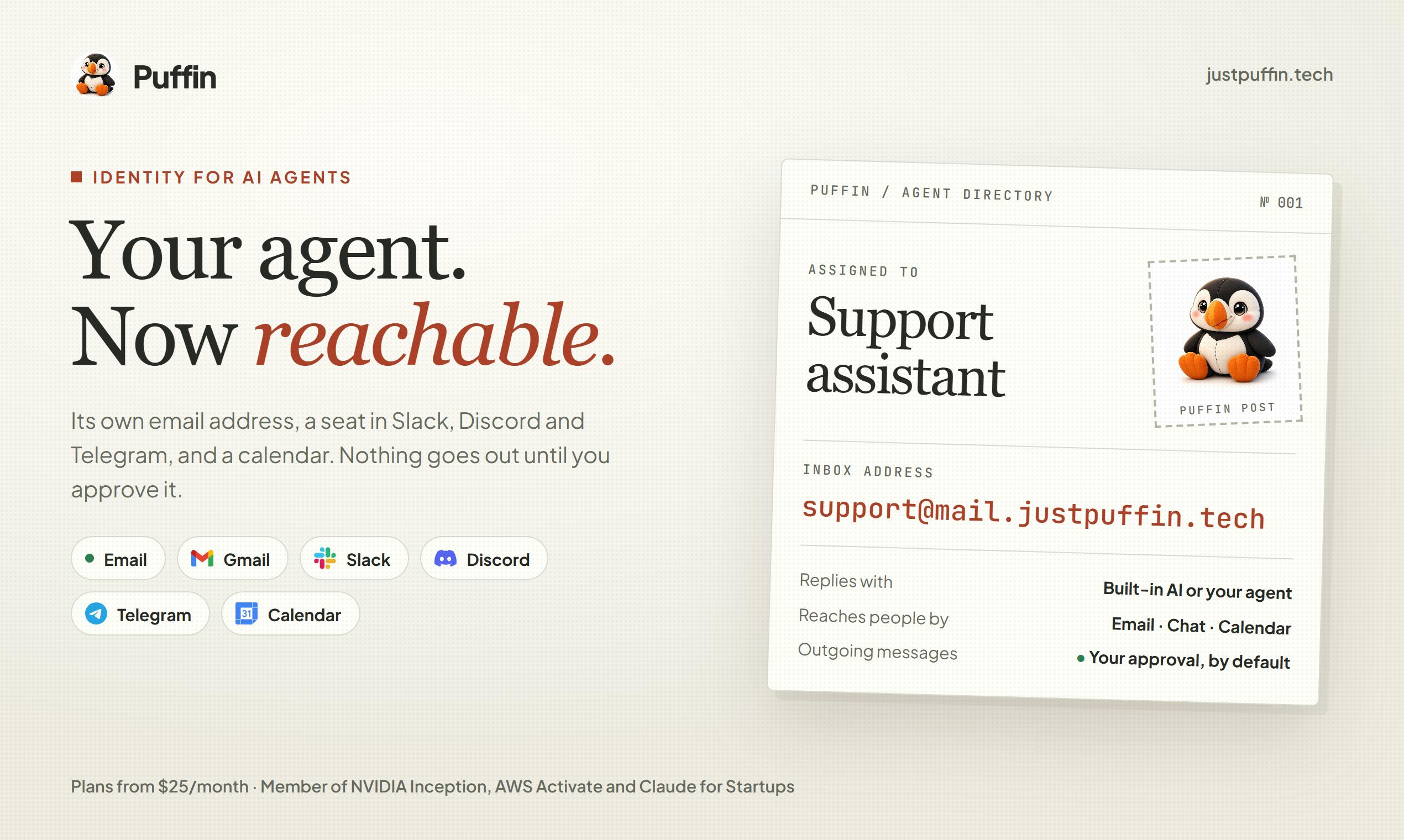
Giving AI Agents a "Digital Identity"
Puffin's core idea is simple: every AI agent needs an independent identity, not just an API call. By creating dedicated email addresses for agents, they can send and receive emails, manage calendar invitations, and even hold a place in team collaboration tools. This means agents are no longer passive tools waiting for instructions, but "digital colleagues" that can actively participate in communication.
From its positioning, Puffin targets teams looking to deeply embed AI into business processes. Whether automatically handling customer inquiries, coordinating meeting times, or responding to requests in Slack channels, agents can complete tasks under their own identity rather than being tied to a user account.
AI Agent refers to a software entity capable of perceiving its environment, making autonomous decisions, and executing actions to achieve goals. Unlike traditional AI models that only respond passively to input, agents typically have memory, planning, and tool-calling capabilities and can proactively initiate tasks. In Puffin's context, giving agents independent identities means they no longer rely on human accounts but have their own communication credentials (such as email addresses and collaboration platform seats), enabling them to receive and send information and manage schedules like team members. This solves the pain point of "identity absence" in collaboration tools, transforming agents from background tools into directly addressable participants, laying the foundation for automated workflows.
Dual Modes: Approval and Full Autopilot
Puffin offers two operating modes: approval mode and full autopilot mode. In approval mode, every message generated by the agent requires human confirmation before sending, suitable for scenarios with high accuracy requirements; in full autopilot mode, the agent can reply autonomously, suitable for well-defined, repetitive tasks.
This design balances efficiency and controllability. Users can flexibly switch modes based on task risk, enjoying the convenience of automation while retaining intervention rights at critical steps. According to the Product Hunt page, agents can use built-in AI to reply or connect to the user's own agent, offering high flexibility.
Human-in-the-Loop (HITL) is a design pattern that integrates human judgment into automated processes, especially suitable for high-risk scenarios or those requiring nuanced decisions. In Puffin's approval mode, every message generated by the agent requires human confirmation, which is essentially HITL: humans act as the final gatekeeper to prevent errors or inappropriate content from being sent. Full autopilot mode removes this step, relying on the agent's autonomous judgment. Switching between the two modes allows users to balance efficiency and safety, and reflects a core challenge in current AI agent deployment—how to maximize automation benefits while maintaining controllability.
Ambitions for Cross-Platform Collaboration
Puffin supports Discord, Slack, and Telegram, covering mainstream team collaboration and community communication scenarios. Agents obtaining a "seat" on these platforms means they can be @mentioned, participate in channel discussions, and receive direct messages like ordinary members.
This cross-platform capability makes agents a unified entry point for team communication. For example, a project management agent can receive task updates in Slack, send weekly reports via email, and sync progress in Telegram groups. However, the product is still in its early stages, and the depth of integration and stability remain to be verified.
Discord, Slack, and Telegram are three mainstream team collaboration and community communication platforms, but with slightly different positioning: Slack focuses on internal enterprise collaboration, Discord is popular in developer communities and interest groups, and Telegram excels in channels and groups. Assigning "seats" to agents on these platforms means they need to adapt to each platform's API and interaction protocols to participate in channel discussions, receive @mentions and direct messages as ordinary members. This cross-platform integration capability makes agents a unified communication entry point but also brings technical complexity—different platforms have different permission models, message formats, and rate limits, and integration depth directly affects user experience.
Early Feedback and Market Positioning
Puffin received 67 upvotes on Product Hunt, ranking 18th, with moderate discussion heat. As a tool for developers and efficiency teams, it addresses a real pain point in AI agent deployment: identity absence. But this赛道 is highly competitive, with automation platforms like Zapier extending into AI and emerging agent frameworks attempting to standardize the identity layer. Whether Puffin can establish itself with its combination of email + collaboration tools depends on its integration quality and building user trust.
For teams wanting to try AI agent automation, Puffin offers a low-barrier entry point. But it's recommended to start with approval mode, gradually verify the agent's reply quality, and then consider granting full autopilot permissions.
Key Takeaways
- Puffin assigns each AI agent a dedicated email, collaboration platform seat, and calendar, giving it a digital identity.
- Supports both approval and full autopilot modes, allowing users to control message sending permissions.
- Integrates with Discord, Slack, and Telegram, enabling agents to participate in communication like team members.
- Can use built-in AI or connect to your own agent, offering high flexibility.
- The product is in its early stages; integration depth and stability need further observation.
One-line Summary
Puffin assigns AI agents dedicated emails and collaboration platform seats, giving them digital identities and supporting dual-mode operation.
Paragraph Summary
Puffin is a tool launched on Product Hunt that aims to give AI agents independent digital identities, including dedicated emails, Discord/Slack/Telegram seats, and calendars. The core idea is to let agents no longer depend on user accounts but actively participate in communication like team members. The product offers approval and full autopilot modes, balancing efficiency and controllability, and supports connecting to built-in AI or user-owned agents. Cross-platform integration covers mainstream collaboration scenarios, but the product is still early, and integration depth and stability remain to be verified. Puffin addresses the pain point of identity absence in AI agent deployment but faces competition from platforms like Zapier; teams are advised to start with approval mode.
Related articles

Gemini 4 Neon Review: Benchmark Scores Rival Carbon, API Pricing and Quota Breakdown
Google Gemini 4 Neon is now live, benchmark scores closely tracking Carbon, API pricing 3/15 at twice Hydrogen's rate. This article compiles Bilibili creator testing: Neon can replace 90% of Carbon scenarios, AntiGravity quota consumption is only one-third of Carbon, plus subscription channel restrictions and 2API ban risks.

Gemini 4 Helium Coming Soon? Signals of Google Loosening Subscription Restrictions
Google team member hints releases will continue; community speculates Gemini 4 Helium (Flash Lite) may be next. Subscription ban controversy gets a response as product lead says "Soon," suggesting restrictions may be lifted. This article covers Gemini developments, OpenAI Coding Agent and risk management, Doubao real-time audio-video API, and compute business dynamics.

AI-Assisted React Development in Practice: Optimizing a Video App and Handling Errors
A 14-year veteran developer demonstrates AI-assisted React video app optimization: compressing video from 80MB to 5MB (~94%) via ImageKit, plus reliable error handling and retry mechanisms. Includes planning, code understanding, and verification methods for working with AI.