Pulsar: Letting Different AI Agents Message Each Other Across Frameworks
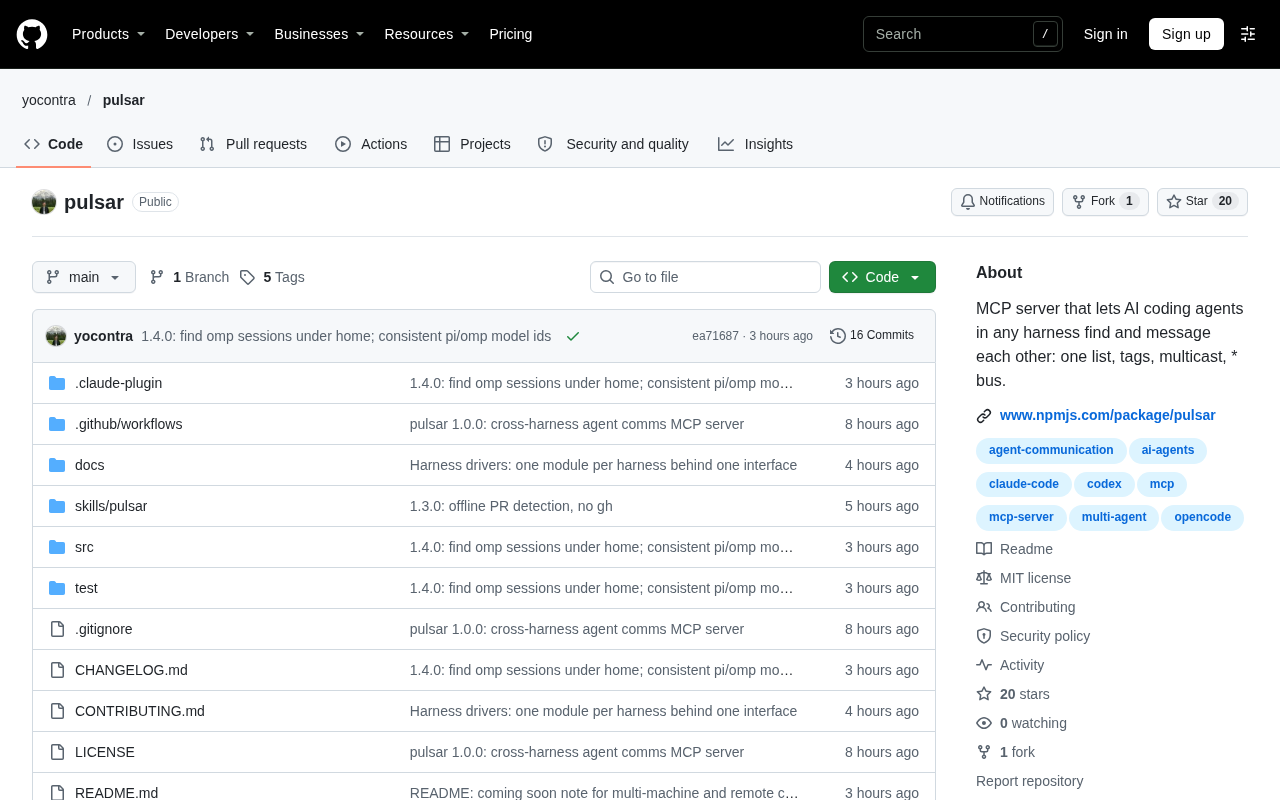
Pulsar aims to provide a unified communication layer for cross-harness Agents, but public information is very sparse.
The article introduces the Show HN project Pulsar on Hacker News, positioned as "cross-harness Agent-to-Agent communication and messaging," intended to solve the fragmentation problem in which Agent ecosystems like Claude Code, Cursor, AutoGPT, and LangChain each operate independently and struggle to talk directly. The author argues that if Pulsar can reliably deliver cross-harness messages, it would effectively upgrade Agent calls from point-to-point hardcoding to routing based on a unified protocol, offering real value for multi-Agent workflows. However, the article also frankly notes that the original post has only 3 points and 0 comments, discloses no support matrix, message protocol, open-source status, or real-world cases, has no community feedback, and cannot be assessed for maturity, so readers are advised to check the project repository directly.
The AI Agent ecosystem is becoming fragmented: Claude Code, Cursor, AutoGPT, and LangChain each operate in their own silo, with virtually no way to talk to one another directly. When developers want one Agent to hand a task off to another, they often have to write glue code by hand. A Show HN project called Pulsar, which appeared on Hacker News, attempts to solve this problem—it is defined as a tool for "cross-harness Agent-to-Agent communication and messaging."
What Pulsar Aims to Solve
Based on the project description, Pulsar's core positioning is agent-to-agent messaging, with the key term being "cross-harness." Harness here refers to the external framework or runtime environment that runs an Agent. Different harnesses tend to have their own message formats, invocation protocols, and lifecycle management, and Pulsar attempts to act as a communication layer between them.
This echoes the growing industry conversation around Agent interoperability. As more teams use multiple Agent frameworks simultaneously, message routing and context passing become real practical friction points in engineering.
The Difference Between a Harness and an Agent Framework: In the context of Agent engineering, a harness specifically refers to the runtime shell that wraps a large model and is responsible for orchestrating tool calls, maintaining conversation state, and managing the execution lifecycle. Claude Code and Cursor's Agent mode can both be viewed as concrete harnesses. It differs from library-style frameworks like LangChain: libraries have developers assemble the call chain themselves, whereas a harness typically comes with a fixed message structure, tool registration method, and termination conditions. Precisely because each harness customizes these conventions, cross-harness communication requires an additional adaptation layer—which is why Pulsar emphasizes "cross-harness" rather than "cross-framework."
Three Directions Worth Watching
The Abstract Value of a Communication Layer
If Pulsar can reliably deliver messages across harnesses, it effectively transforms Agent-to-Agent calls from "point-to-point hardcoding" into "routing based on a unified protocol." This abstraction is especially important for multi-Agent workflows: after a task is decomposed, sub-Agents may run in different environments and need a neutral channel to pass messages through.
Common Patterns in Agent-to-Agent Communication: Multi-Agent systems currently take several main forms of collaboration—hierarchical orchestration where a primary Agent directly calls sub-Agents, publish-subscribe through a shared blackboard or message queue, and point-to-point request-response. The first two are usually bound within a single framework and break down once a sub-Agent changes runtime environment. The neutral routing layer that Pulsar advocates resembles the role of message middleware in microservices: the sender does not need to know which harness the receiver runs on, only to deliver messages according to a unified protocol. Whether this design holds up depends critically on whether the protocol can sufficiently express context, tool results, and error states—which is exactly the part the original post notes is still missing technical details.
Implementation Still Needs Verification
It should be stated frankly that the Show HN post itself carries limited information: only 3 points, 0 comments, and no technical details, support matrix, or architecture description. Which harnesses Pulsar specifically supports, how the message protocol is defined, whether it is open source, and whether there are real-world use cases are all unaddressed in the source material.
How Show HN Posting Works: Show HN is a dedicated section on Hacker News where creators showcase new projects. The barrier to posting is low—anyone can submit—so the post itself does not constitute any quality endorsement. A post's points accumulate from community votes, while comments reflect actual discussion activity; 3 points and 0 comments usually mean the project has just been published and has not yet entered the mainstream view. When evaluating such projects, the community generally checks whether the repository is public, whether there is a README and architecture diagram, and whether runnable examples are included. The original article notes that all of this information is absent, which is an objective description of information completeness rather than a rejection of the project itself.
Community Feedback Remains Blank
The Hacker News comment section currently has no discussion, meaning the project has not yet been tested by the community in practice. For developers interested in Agent infrastructure, this is more of a signal worth tracking than a solution ready to be adopted.
Summary
Pulsar hits on a real fragmentation pain point in the Agent ecosystem, and the direction is worth watching. But based on the currently available public information, its technical maturity and usability cannot yet be assessed. Readers who are interested are advised to visit the project repository directly to confirm its support scope and protocol design.
One-line Summary
Pulsar attempts to provide a unified communication layer for cross-harness Agents, but public information is very sparse.
Paragraph Summary
The article introduces the Show HN project Pulsar on Hacker News, positioned as "cross-harness Agent-to-Agent communication and messaging," intended to solve the fragmentation problem in which Agent ecosystems such as Claude Code, Cursor, AutoGPT, and LangChain each operate independently and struggle to talk to one another directly. The author argues that if Pulsar can reliably achieve cross-harness messaging, it would effectively upgrade Agent calls from point-to-point hardcoding to routing based on a unified protocol, which has practical value for multi-Agent workflows. However, the article also frankly notes that the original post has only 3 points and 0 comments, discloses no support matrix, message protocol, open-source status, or real-world cases, and has no community feedback, so its maturity cannot be assessed. Readers are advised to check the project repository directly to confirm.
Related articles

OpenAI to Shut Down Agent Builder and Two Other Services on November 30, Developers Must Migrate Urgently
OpenAI will shut down Agent Builder, the evals dashboard, and reusable prompts on November 30; evals is already read-only. Here's the scope, OpenAI's migration paths (Agent SDK, PromptFu, your own code), and what developers should export and rebuild this week.

RankSpot: A Pay-Per-Use SEO & AI Search Execution Layer That Lets Agents Write, Publish, and Build Backlinks for You
RankSpot is an SEO & AI search execution layer for AI Agents. Connect via MCP to Claude or ChatGPT to write, publish & build backlinks. Pay-per-use, $3/article.

Appxiom: Giving AI Coding Assistants Production Context
Appxiom gives AI coding agents production context—crashes, jank, memory leaks, failed network calls—across Android, iOS, Flutter, KMP, and Web, ranking bugs by Goal Friction Impact.