PuppyRouter Model Rankings 0923: GLM5.3 Takes the Crown, GPT-6 Makes Its Debut

GLM5.3 Flash tops PuppyRouter's daily chart while GPT-6 Sol wins on price-to-performance.
PuppyRouter's latest model usage rankings show GLM5.3 Flash breaking GPT-5.6 Sol's month-long streak to claim the daily top spot. The newly launched GPT-6 Sol earns strong recommendations at half the price of its predecessor, while flagship GPT-6 Extra leads frontier benchmarks in Computer Use, SVG generation, and Frontier Code. Gemnet 3.8 Flash and DeepSync V4.1 Flash also make the top ten. The rankings reveal three emerging competitive dimensions: high user price-sensitivity, speed as a key differentiator, and a clear split between flagship and value-tier models.
PuppyRouter Model Rankings Breakdown: GLM5.3 Flash's Surprise Win, GPT-6 Series Goes Live
After a long hiatus, PuppyRouter has updated its model usage rankings. This leaderboard — built on real user call volume — arguably reflects developer preferences more accurately than pure benchmark tests. After all, users vote with their wallets: price-to-performance and real-world usability tend to be more persuasive than benchmark scores. The biggest story this edition is the dethroning of long-reigning GPT-5.6 Sol, with the dark horse GLM5.3 Flash taking its place.
This article is based on data from PuppyRouter's (puppyrouter.com) Rankings page and the host's hands-on commentary, summarizing the performance and positioning of the top ten models.
A Change at the Top: GLM5.3 Flash Is the Biggest Surprise
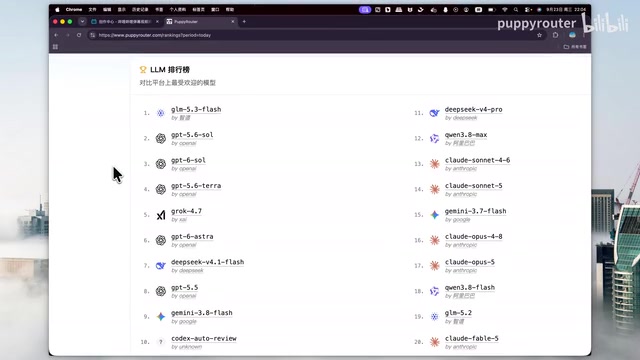
Under PuppyRouter's pricing structure, the best value spot typically belonged to GPT-6 Sol rather than GLM5.3 Flash. But in this edition, GLM5.3 Flash claimed the top spot on the daily chart by sheer popularity.
What makes this remarkable is that for at least the past month, GPT-5.6 Sol had held the number one position without interruption — and it still dominates the weekly and monthly charts. The fact that GLM5.3 Flash managed to decisively overtake it on the daily chart suggests the model has built strong user loyalty in specific use cases.
Newly Released GPT-6 Sol: Price-to-Performance Is the Headline
GPT-6 Sol, which ranks near the top, is a new model released by OpenAI that day and immediately made available on PuppyRouter. The host's review centers on one phrase: value for money.
In hands-on testing, GPT-6 Sol outperforms GPT-5.6 Sol in some capability dimensions while falling short in others — a mixed bag overall. The real ace up its sleeve is pricing: GPT-6 Sol costs just half of what GPT-5.6 Sol does, and in some cases is even cheaper than Tera. Given near-comparable capability at half the price, it has become one of the host's top recommendations on the platform when cost is factored in.
The Middle Tier: Balancing Speed and Overall Capability
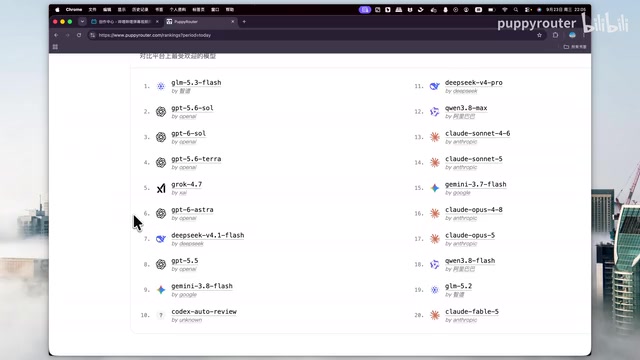
Fifth-place Grok 4.7 is described as "fast and hardworking" — solid overall capability, but clearly not in the very top tier. The host positions it as a fast, practical, and reasonably priced workhorse.
Sixth-place GPT-6 Extra is currently OpenAI's most powerful model, leading across frontier benchmarks including Computer Use, SVG generation, and Frontier Code. It forms a clear "flagship vs. value" pairing with GPT-6 Sol.
Seventh-place DeepSync V4.1 Flash is a native multimodal model and DeepSync's first to officially adopt an Encoder-Decoder architecture. However, the host notes that despite this claim, its behavior still leans toward a Decoder-style structure. From a platform value standpoint, this model also ranks among the top performers.
Encoder-Decoder and pure Decoder are two mainstream paradigms in large language model design. Traditional Encoder-Decoder models (like the earlier T5 and BART) use an encoder to compress input into a semantic representation, which a decoder then uses to generate output — well-suited for tasks like translation and summarization that require holistic input comprehension. Today's dominant models like GPT and LLaMA almost exclusively use pure Decoder architectures, generating text token by token in an autoregressive fashion, with strong performance in open-ended generation and code writing. DeepSync V4.1 Flash's claimed Encoder-Decoder architecture theoretically implies additional design for understanding input structure, but the host observes that its actual behavior remains Decoder-like. This kind of "label vs. reality" mismatch isn't uncommon in multimodal models — vendors sometimes apply the Encoder-Decoder label to localized cross-modal encoding modules while the overall generation logic remains a standard autoregressive Decoder.
Differentiated Players: Writing Strengths and Speed Specialists
Eighth-place GPT-5.5, despite its lower version number, has a loyal following in writing and several other use cases. Comments from users once led the host to suspect a misconfiguration when 5.5 was being called — but it turned out users were actively choosing it. The model has distinct and hard-to-replace strengths in writing capability. That said, the host acknowledges that the vast majority of platform users skew toward Coding tasks, making 5.5's audience relatively niche.
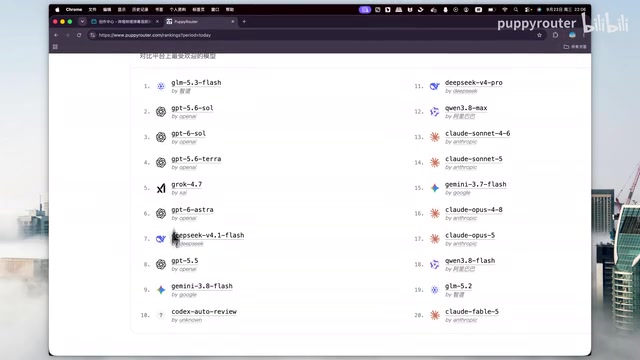
Ninth-place Gemnet 3.8 Flash can be summed up in one word: fast. Just fast. Its capabilities are average, but its extreme speed more than makes up for it — and that's exactly why it's popular on the platform. For speed-first use cases, it's a solid choice.
A Special Case at Number Ten and a Free-for-All from 11–20
Tenth place is, strictly speaking, not an independent model. It is essentially GPT-5.6 or whatever GPT-6 model the user has selected, wrapped inside the Auto Review workflow mode. If Auto Review mode is not enabled, or if full access mode is used, this "model" is never called. Its presence on the chart is more a statistical artifact of feature packaging than a reflection of any standalone model's popularity.
Places 11 through 20 show a chaotic mix of models. Worth noting: Cloud Ops 5.5, released by the Cloud family that day, is currently only available in the Cloud Max group and has not yet rolled out to Curl or Cursor groups — insufficient call volume means it didn't make the chart.
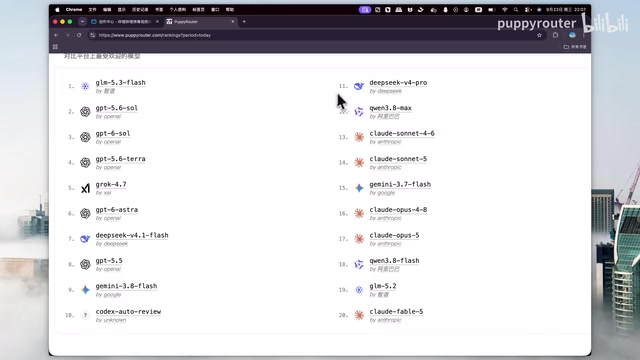
Auto Review is a workflow packaging mode on PuppyRouter, distinct from the "full access mode" where users directly select a specific model. In Auto Review mode, the platform automatically routes tasks to backend models based on task type. In this edition, the tenth-place call volume actually represents the aggregate of tasks that Auto Review routed to GPT-5.6 or the GPT-6 series — not a standalone newly released model. The design philosophy behind this feature is to lower the barrier to model selection: users don't need to manually evaluate which model best fits a given task; the platform decides for them. As a result, its ranking on the leaderboard reflects how frequently the feature is used, not how popular any single underlying model is — a distinction worth keeping in mind when interpreting the data.
What the Rankings Signal
Looking at this edition as a whole, several trends emerge. First, users are highly price-sensitive: GPT-6 Sol quickly earned its top recommendation on the strength of its halved price, and GLM5.3 Flash's rise to the top confirms the same logic. Second, speed is becoming a meaningful competitive dimension — Gemnet 3.8 Flash's top-ten finish on speed alone is proof of this. Third, flagship models like GPT-6 Extra continue to lead on frontier capabilities, but the workhorses driving high-frequency daily usage tend to be mid-tier models that strike the right balance between capability and cost.
One important caveat: this leaderboard reflects the call preferences of PuppyRouter's user base, which skews heavily toward Coding use cases. The results are therefore biased toward programming scenarios and should not be read as a comprehensive capability ranking. For the latest daily, weekly, and monthly chart data, visit the Rankings page at puppyrouter.com.
PuppyRouter is a model aggregation and routing platform (AI Router). Its core value lies in unifying access to large language models from multiple vendors under a single interface, where users can switch between models on demand while the platform handles billing, rate limiting, and routing. Leaderboard data from this type of platform differs fundamentally from official benchmarks like MMLU or HumanEval: benchmarks measure a model's "ceiling capability" on standardized test sets, while call-volume charts reflect the sustained choices of real developers in production environments — where pricing, response speed, reliability, and API compatibility all influence outcomes. A model that ranks highly on benchmarks may not rank highly on usage charts, and vice versa. Understanding this distinction is essential to applying leaderboard insights to the right decision-making contexts.
Related articles

Build an AI Super Employee System at Zero Cost: A Full Breakdown of Automated Agent Workflows
A deep breakdown of the AI super employee system demoed on Bilibili: agent orchestration, digital human voiceovers, map and enterprise lead generation, 24/7 customer service, and legal modules. We analyze the business logic and compliance risks behind zero-cost signup to help entrepreneurs judge the real ROI of this AI digital employee system.

The Essential Difference Between Chatbots and AI Agents: Crossing from Conversation to Execution
What's the difference between a chatbot and an AI agent? Based on the MCP series on the Learn Tech channel, this article uses examples like booking flights and summarizing notes to explain: a chatbot only gives answers, while an agent actually completes tasks through a think-act-observe loop. It breaks down the four core components—model, tools, memory, and goal—as well as MCP's role as a bridge, and discusses agents' applicable boundaries and permission risks.

Free GitHub Repo: 342 Hours of AI Courses, from Math to MCP Servers
A free GitHub repo offers 342 hours of AI courses: 523 lessons across 20 phases, from math fundamentals to agent building and MCP servers. Nearly 100,000 learners have started.